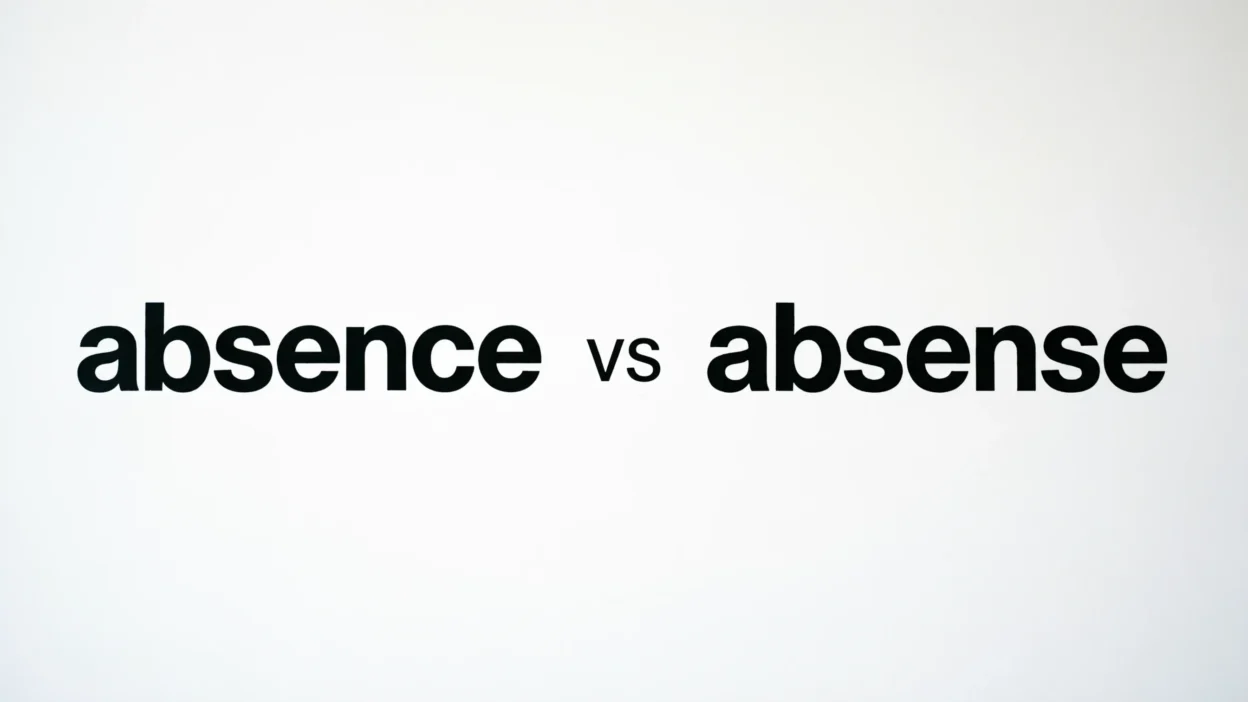
If you’ve ever paused mid-sentence wondering whether to write absence or absense, you’re not alone. This is one of those small spelling confusions that can quietly affect your writing—whether it’s an email, essay, or social media post.
The good news? The difference is simple once you understand it. In this friendly guide, we’ll break down absence vs absense in a clear, practical way so you can write with confidence every time.
Quick Answer
- ✅ Absence = Correct spelling
- ❌ Absense = Incorrect spelling (common mistake)
Use absence whenever you mean “the state of being away” or “not present.”
What Does “Absence” Mean?
The word absence is a noun that refers to the state of being away or not present in a particular place or situation.
Simple Definition
- The condition of being missing or not there
- Lack or unavailability of something
Examples in Sentences
- Her absence from the meeting was noticeable.
- The teacher marked his absence in the attendance register.
- The absence of clear rules caused confusion.
Common Contexts
You’ll often see absence used in:
- School or office attendance
- Emotional or physical absence
- Missing qualities (e.g., absence of trust)
What About “Absense”?
Let’s clear this up quickly:
👉 Absense is NOT a correct English word.
It’s a common spelling mistake caused by how the word sounds. Many people assume it follows a pattern like “sense” or “defense,” but that’s not the case.
Why People Write “Absense”
- Pronunciation confusion (it sounds like “sense”)
- Mixing it up with words like:
- “sense”
- “defense” (American spelling)
- Typing quickly without proofreading
Absence vs Absense: Side-by-Side Comparison
| Feature | Absence ✅ | Absense ❌ |
|---|---|---|
| Correct spelling | Yes | No |
| Meaning | State of being absent | None |
| Usage in English | Standard | Not used |
| Acceptable in exams | Yes | No |
| Appears in dictionaries | Yes | No |
👉 Always choose absence in formal and informal writing.
Why “Absence” Is the Correct Spelling
The word absence comes from Latin roots:
- absentia → meaning “being away”
This origin explains why the correct ending is -ence, not -ense.
Helpful Tip to Remember
Think of related words:
- absent
- absentee
- absenteeism
They all connect back to absence—not absense.
American vs British English Differences
Here’s something interesting:
Many words differ between American and British English, like:
- defense (US) vs defence (UK)
- license (US) vs licence (UK)
However, absence stays the same in both:
- 🇺🇸 American English: absence
- 🇬🇧 British English: absence
👉 There is no variation here—“absense” is incorrect everywhere.
Common Mistakes to Avoid
Even experienced writers sometimes slip up. Here are the most common errors related to absence vs absense:
1. Spelling It Phonetically
❌ “His absense was noted.”
✅ “His absence was noted.”
2. Confusing with Similar Words
Words ending in -sense can trick you:
- sense
- nonsense
But absence is different.
3. Relying Only on Pronunciation
English spelling doesn’t always match pronunciation—this is one of those cases.
4. Skipping Spell Check
Spell-check tools usually catch “absense,” so don’t ignore those red underlines.
Real-Life Examples for Better Understanding
In School
- “Students must provide a reason for their absence.”
At Work
- “Please inform HR in case of extended absence.”
In Writing
- “The absence of evidence is not evidence of absence.”
Emotional Context
- “Her absence left a void in the family.”
Synonyms of “Absence”
To expand your vocabulary, here are some useful alternatives:
- Lack
- Nonattendance
- Unavailability
- Vacancy
- Missing presence
Example
- “The lack of leadership” = “The absence of leadership”
25 Quick Usage Examples of “Absence”
Here are more sentence ideas to help reinforce correct usage:
- His absence surprised everyone.
- She explained her absence politely.
- The absence of light made it hard to see.
- Your absence was noticed.
- Prolonged absence affects performance.
- He apologized for his absence.
- The absence of noise was calming.
- Her absence created a gap in the team.
- Frequent absence may lead to penalties.
- His absence raised questions.
- The absence of support hurt morale.
- She returned after a long absence.
- His absence delayed the project.
- Absence makes the heart grow fonder.
- Their absence was deeply felt.
- Unexpected absence caused confusion.
- The absence of rules led to chaos.
- His absence didn’t go unnoticed.
- The absence of color made it dull.
- Absence from duty is unacceptable.
- Her absence worried her parents.
- The absence of trust broke the relationship.
- Temporary absence is allowed.
- His absence weakened the team.
- The absence of clarity created issues.
Idioms Related to “Absence”
Here are a few idiomatic expressions:
- Absence makes the heart grow fonder
→ Being away increases affection - In someone’s absence
→ While someone is not present
Example
- “Decisions were made in his absence.”
FAQs About Absence vs Absense
1. Is “absense” ever correct?
No, “absense” is always incorrect. The correct spelling is “absence.”
2. Why do people confuse absence with absense?
Because of pronunciation and similarity to words ending in “-sense.”
3. Is “absence” used in both formal and informal writing?
Yes, it is widely used in all types of writing.
4. Does British English use “absense”?
No, both British and American English use “absence.”
5. What is the verb form of absence?
There is no direct verb form. Use “absent” instead (e.g., “He was absent.”).
6. How can I remember the correct spelling?
Think of “absent” → “absence.” Both share the same root.
7. Is “absence” a noun or verb?
It is a noun.
8. Can “absence” be used metaphorically?
Yes, e.g., “absence of hope,” “absence of evidence.”
Final Summary
Understanding absence vs absense is simpler than it first appears. The correct spelling is absence, and it’s used to describe the state of being away or not present. On the other hand, absense is just a spelling mistake—one that’s easy to make but just as easy to fix once you know the rule.
To avoid errors, remember the connection to the word “absent” and ignore phonetic spelling traps. With a little awareness and practice, you’ll never second-guess this word again.
Actionable Takeaway
- Always use absence in writing
- Double-check spelling when unsure
- Link it mentally to “absent”
- Use spell-check tools to catch mistakes
Mastering small details like this can make your writing clearer, more professional, and more trustworthy.

Bret Lee writes educational and research-based content for Whygenix.com, focused on clarity, accuracy, and explaining why concepts matter through simple, engaging, reader-friendly writing.