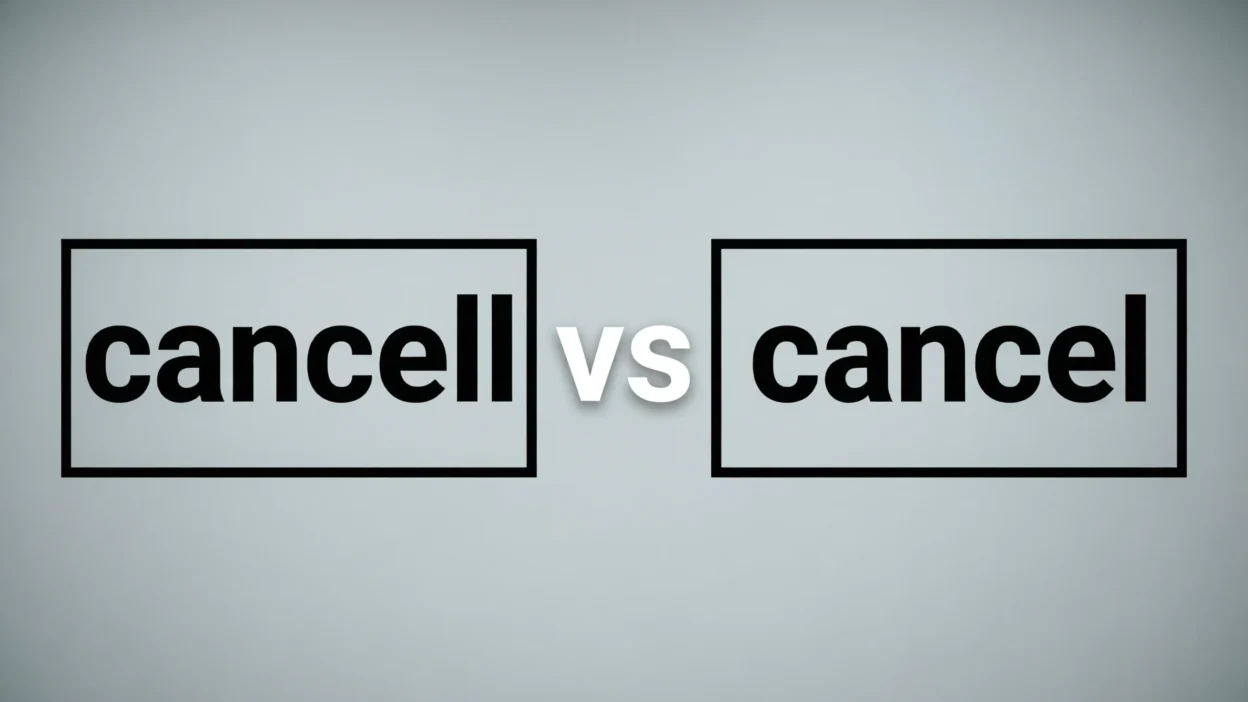
If you’ve ever typed “cancell” and hesitated, you’re not alone. This is a very common spelling confusion—especially because English often doubles letters in similar words like “travelled” or “stopped.”
The good news is that this one is easy to fix once you know the rule. In this guide, we’ll clearly explain the difference between cancell vs cancel, show correct usage, and help you avoid this mistake for good.
Quick Answer
- ✅ Cancel = Correct spelling
- ❌ Cancell = Incorrect spelling
Always use “cancel” with a single “l.”
What Does “Cancel” Mean?
The word cancel means to stop, call off, or decide not to continue something.
Common meanings:
- To call off an event
- To stop a service or subscription
- To invalidate or remove something
Examples:
- They decided to cancel the meeting.
- I need to cancel my subscription.
- The flight was cancelled due to bad weather.
Why “Cancell” Is Incorrect
“Cancell” may look right, but it’s a spelling mistake.
Here’s why:
- The base form of the word is always cancel (with one “l”).
- Adding an extra “l” at the end creates a nonstandard and incorrect word.
- No major dictionary accepts “cancell” as a correct spelling.
Correct vs incorrect:
- ❌ cancell
- ✅ cancel
Cancell vs Cancel: Key Differences
| Feature | Cancel ✅ | Cancell ❌ |
|---|---|---|
| Correct spelling | Yes | No |
| Dictionary status | Valid | Invalid |
| Usage | Standard English | Avoid completely |
| Base form | Yes | Incorrect form |
| Professional use | Recommended | Not acceptable |
Common Mistakes to Avoid
This error often happens because of confusion with related word forms.
1. Adding Extra Letters
Some writers mistakenly double the “l” in the base form.
- ❌ cancell
- ✅ cancel
2. Confusing Verb Forms
Here’s where it gets tricky:
- Base form → cancel
- Past tense → cancelled (British) / canceled (American)
So while “cancelled” may have two Ls, the base form never does.
3. Mixing Up Patterns
Words like “control → controlled” may influence your spelling, but not all verbs follow the same rule.
Examples of “Cancel” in Sentences
Let’s look at how “cancel” is used in real-life contexts:
Everyday Use:
- I had to cancel my plans.
- Please don’t cancel the order.
Business/Professional:
- The company may cancel the contract.
- Customers can cancel anytime.
Travel:
- They had to cancel the flight.
- The train was cancelled unexpectedly.
Online/Services:
- You can cancel your membership online.
- I forgot to cancel the trial subscription.
American vs British English
This is where things get interesting:
Base form:
- 🇺🇸 American English: cancel
- 🇬🇧 British English: cancel
✔ Same in both versions
Past tense:
- 🇺🇸 American English: canceled (one “l”)
- 🇬🇧 British English: cancelled (two “l”s)
👉 Key point:
The base word “cancel” always has one “l”, no matter the region.
Synonyms of “Cancel”
To improve your writing, you can also use these alternatives:
- Call off
- Stop
- Terminate
- Abort
- End
- Revoke
Example:
- They decided to call off the event.
- They decided to cancel the event.
When to Use “Cancel” (Quick Tips)
Use cancel when you want to:
- Stop a plan or event
- End a service or agreement
- Withdraw something
- Invalidate an action
Memory trick:
👉 Think: “Cancel = one L” (simple and clean)
FAQs About Cancell vs Cancel
1. Is “cancell” ever correct?
No, “cancell” is always incorrect. Use “cancel.”
2. Why do people write “cancell”?
Because related forms like “cancelled” (British English) have double “l,” which causes confusion.
3. Is “cancel” a verb or noun?
It can be both:
- Verb: I will cancel the meeting.
- Noun (informal): That’s a last-minute cancel.
4. What is the past tense of “cancel”?
- American English: canceled
- British English: cancelled
5. Is “cancel” formal or informal?
It works in both formal and informal contexts.
6. How can I avoid spelling mistakes?
Remember the base form rule: only one “l.”
7. Are there similar confusing words?
Yes—like “traveling vs travelling” and “labeling vs labelling.”
8. Does pronunciation change?
No, pronunciation stays the same regardless of spelling.
Final Summary
The difference between cancell vs cancel is simple: “cancel” is correct, and “cancell” is not a real word in standard English. The confusion usually comes from related forms like “cancelled,” but the base form always uses a single “l.”
Understanding this rule helps you avoid a very common mistake and improves your writing clarity—especially in professional or academic contexts.
Actionable Takeaway
Next time you write:
👉 Always use “cancel” with one “l”
To strengthen your spelling:
- Watch for patterns in related word forms
- Double-check tricky words
- Practice correct usage in sentences
With time, this will become second nature and boost your writing confidence.

Bret Lee writes educational and research-based content for Whygenix.com, focused on clarity, accuracy, and explaining why concepts matter through simple, engaging, reader-friendly writing.