If you’ve ever paused while typing “costumer” vs “customer,” you’re definitely not alone. These two words look almost identical, sound similar, and often get mixed up—even by experienced writers.
But here’s the truth: they mean completely different things, and using the wrong one can subtly change your message.
In this friendly, easy-to-follow guide, you’ll learn the exact difference between costumer vs customer, when to use each word, and how to avoid common mistakes.
Whether you’re writing emails, blog posts, or business content, this article will help you feel confident every time you choose between them.
Quick Answer: Costumer vs Customer
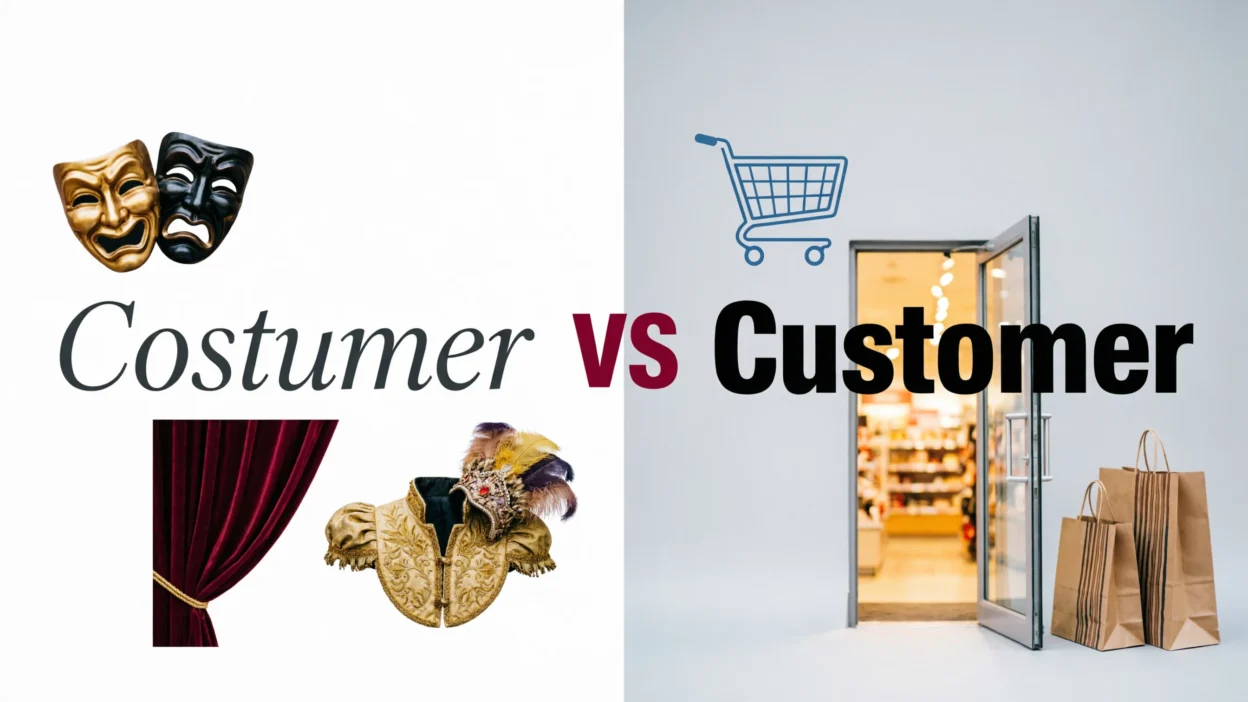
- Customer = A person who buys goods or services
- Costumer = A person who makes or sells costumes
👉 In most everyday situations, “customer” is the correct word.
Understanding the Meaning of “Customer”
The word customer is one of the most commonly used terms in business and daily life.
Definition
A customer is someone who purchases products or services from a business.
Examples
- She is a loyal customer of that online store.
- Good customer service keeps customers coming back.
- The company values every customer equally.
Related Terms (LSI Keywords)
- client
- buyer
- consumer
- shopper
- patron
In marketing, sales, and customer service, this is the word you’ll use 99% of the time.
Understanding the Meaning of “Costumer”
Now let’s look at costumer, which is much less common.
Definition
A costumer is someone who designs, makes, or sells costumes, especially for theater, film, or events.
Examples
- The costumer created beautiful outfits for the play.
- She works as a professional costumer in the film industry.
- The theater hired a skilled costumer for the production.
Related Terms
- costume designer
- wardrobe specialist
- stylist
- fashion designer
This word is mainly used in creative industries like theater, movies, and fashion.
Costumer vs Customer: Key Differences
Here’s a quick comparison to make things crystal clear:
| Feature | Customer | Costumer |
|---|---|---|
| Meaning | Buys goods/services | Makes or designs costumes |
| Usage Frequency | Very common | Rare |
| Context | Business, retail, services | Theater, film, fashion |
| Example | A happy customer leaves a review | The costumer prepared outfits |
👉 Tip: If you’re talking about buying or selling, always choose customer.
Why People Confuse Costumer vs Customer
It’s easy to mix these words up because:
- They differ by only one letter (u vs o)
- They sound almost identical in speech
- Spellcheck may not always catch the mistake
- Fast typing leads to small spelling errors
Memory Trick
Think of it this way:
- Customer → “Custom” (buying customized goods)
- Costumer → “Costume” (related to outfits)
Common Mistakes to Avoid
Here are some real-life mistakes people often make:
❌ Incorrect
- Our company values every costumer.
- The shop has many loyal costumers.
✅ Correct
- Our company values every customer.
- The shop has many loyal customers.
❌ Incorrect
- The customer designed costumes for the play.
✅ Correct
- The costumer designed costumes for the play.
Even a small typo can make your writing look unprofessional—especially in business communication.
When to Use Customer in Real Life
Use customer when talking about:
- Online shopping
- Business transactions
- Service industries
- Marketing and sales
- Client relationships
Example Sentences
- Customer satisfaction is our top priority.
- We offer discounts to returning customers.
- Every customer deserves respect and attention.
When to Use Costumer in Real Life
Use costumer only when referring to:
- Theater productions
- Film and TV wardrobe
- Costume design businesses
- Halloween or cosplay industries
Example Sentences
- The costumer worked late to finish the outfits.
- A talented costumer can bring characters to life.
American vs British English Differences
Good news—there’s no difference between American and British English for these words.
- Customer is spelled the same in both
- Costumer is also identical in both
So no matter where you are—USA, UK, or anywhere else—the meanings stay consistent.
SEO and Writing Tip: Why This Difference Matters
Using the correct word improves:
- Clarity – Your message is easy to understand
- Credibility – You sound more professional
- SEO performance – Correct keywords match user intent
- User trust – Readers take your content seriously
For example, if you run a business website, writing “costumer service” instead of “customer service” can hurt your brand image.
FAQs About Costumer vs Customer
1. Is “costumer” a real word?
Yes, “costumer” is a real word, but it’s rarely used outside costume-related professions.
2. Which is more commonly used: costumer or customer?
“Customer” is far more common and used in everyday language.
3. Can “costumer” ever replace “customer”?
No, they have completely different meanings and cannot be used interchangeably.
4. Why do people mistakenly write “costumer service”?
It’s usually a typo or confusion due to similar spelling and pronunciation.
5. How can I remember the difference easily?
Think:
- Customer = buying
- Costumer = costumes
6. Is “customer service” ever spelled with “costumer”?
No, the correct phrase is always customer service.
7. Are both words nouns?
Yes, both “customer” and “costumer” are nouns.
8. Is this mistake common in SEO writing?
Yes, especially among beginners or fast typists, but it should always be corrected.
Final Summary
Understanding the difference between costumer vs customer is simple once you break it down. A customer is someone who buys products or services, while a costumer is someone who creates or sells costumes. Although they look similar, their meanings are completely unrelated.
In everyday writing—especially in business, blogging, or marketing—you’ll almost always need the word customer. Using the wrong term can confuse readers and reduce your credibility, so it’s worth double-checking your spelling every time.
Actionable Takeaway
Before you hit publish or send that message, ask yourself:
👉 “Am I talking about buying something or making costumes?”
- If it’s about buying → use customer
- If it’s about costumes → use costumer
This simple check can instantly improve your writing accuracy and professionalism.

Sara Taylor is a content writer at Whygenix.com, creating clear, engaging articles that simplify complex ideas, helping readers understand the why behind topics in education, lifestyle, and personal development.