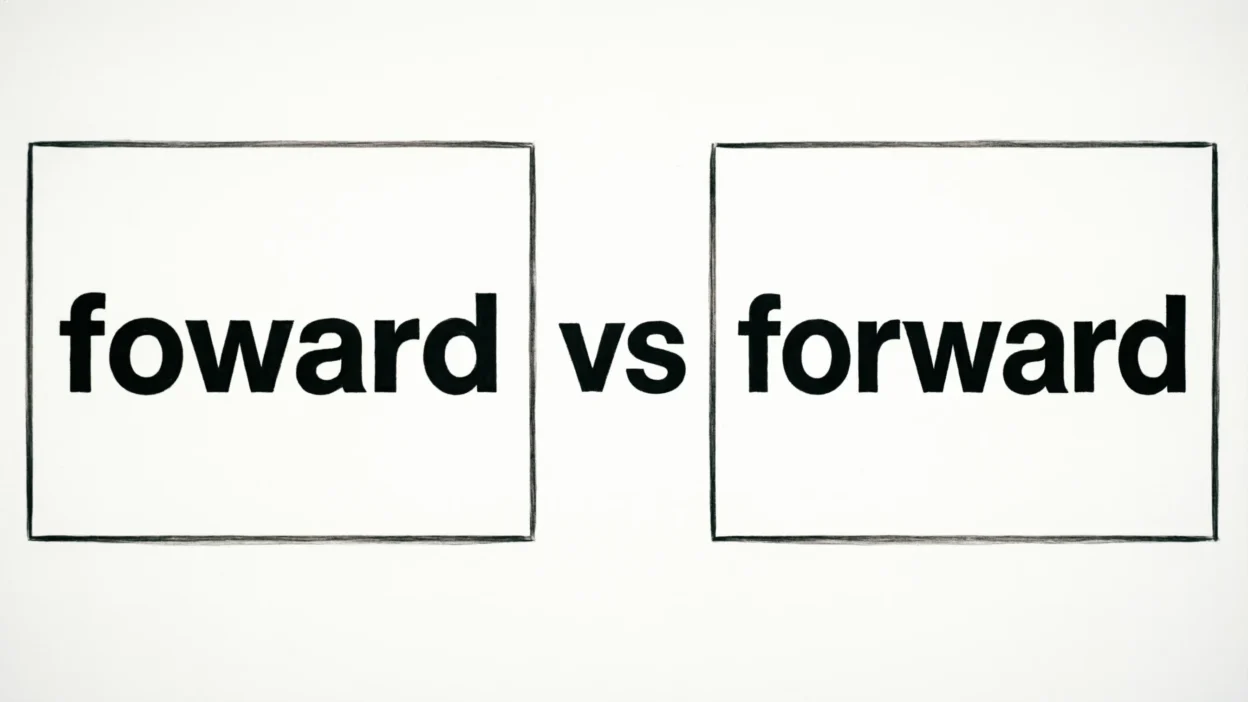
If you’ve ever typed “foward” and had a nagging feeling it might be wrong, you’re absolutely right to question it. This is one of the most common spelling mistakes in English—especially in emails, essays, and everyday writing.
In this guide, we’ll break down foward vs forward, explain the correct spelling, show real examples, and give you simple tricks to remember it for good.
Quick Answer: Foward vs Forward
- ❌ Incorrect spelling: Foward
- ✅ Correct spelling: Forward
“Forward” is the correct word and means ahead, onward, or in the direction in front.
“Foward” is a misspelling and should not be used.
What Does “Forward” Mean?
The word forward is versatile and can function as an adjective, adverb, verb, or noun depending on the context.
Simple Definition:
Moving or directed toward the front or ahead.
Common Meanings:
- Direction: moving ahead
- Progress: advancing or improving
- Communication: sending something onward (like an email)
Example Sentences:
- She stepped forward to speak.
- Please forward this message to your manager.
- The team is moving forward with the project.
Why Do People Write “Foward”?
The mistake foward happens more often than you might think.
Common Reasons:
- Missing “r”: People accidentally drop the second “r” while typing.
- Fast typing: It’s easy to skip letters in frequently used words.
- Pronunciation shortcuts: In speech, the second “r” isn’t strongly emphasized.
Foward vs Forward: Side-by-Side Comparison
| Feature | Foward ❌ | Forward ✅ |
|---|---|---|
| Spelling status | Incorrect | Correct |
| Meaning | None | Ahead or onward |
| Dictionary entry | Not recognized | Recognized word |
| Usage | Should be avoided | Standard English |
| Example | ❌ Move foward | ✅ Move forward |
How to Remember the Correct Spelling
Here’s a simple trick to lock it in your memory.
Easy Memory Tip:
Think of “forward” as:
Or remember:
- It has two “r” letters → forward
Visual Cue:
- forward ✔
- foward ✘
Common Mistakes with “Forward”
Even when spelled correctly, “forward” is sometimes used incorrectly.
1. Confusing “Forward” with “Forwards”
- 🇺🇸 American English: forward
- 🇬🇧 British English: forward or forwards
Both are correct in British English, but “forward” is more universally accepted.
2. Mixing Up “Forward” and “Forword”
- ❌ Forword
- ❌ Foward
- ✅ Forward
3. Incorrect Verb Usage
- ❌ I will forward to you the email.
- ✅ I will forward the email to you.
Examples of “Forward” in Different Contexts
Everyday Conversation:
- Let’s move forward with the plan.
Professional Writing:
- Please forward this document to the HR department.
Academic Context:
- The research is a step forward in science.
Technology & Email:
- I’ll forward you the meeting details.
Synonyms and Related Words
Using variations improves your writing and keeps it engaging.
Synonyms:
- ahead
- onward
- onwardly
- advancing
- progressing
Related Phrases:
- move ahead
- push forward
- go forward
Nuance Differences:
- Ahead → position in front
- Advance → move forward with purpose
- Progress → improvement over time
American vs British English
There’s a small variation worth noting:
- 🇺🇸 American English: forward
- 🇬🇧 British English: forward and sometimes forwards
However, “forward” is correct and accepted everywhere, making it the safest choice.
When Should You Use “Forward”?
Use forward when referring to:
- Movement in a direction
- Progress or advancement
- Sending messages or items
Ideal Use Cases:
- Physical movement (step forward)
- Business communication (forward an email)
- Personal growth (move forward in life)
Avoid Using It When:
- You mean a different direction (like backward)
- You accidentally drop letters (foward)
Real-Life Examples to Build Confidence
- ❌ Please foward this email.
- ✅ Please forward this email.
- ❌ We need to move foward quickly.
- ✅ We need to move forward quickly.
- ❌ He stepped foward to help.
- ✅ He stepped forward to help.
FAQs About Foward vs Forward
1. Is “foward” ever correct?
No, “foward” is always incorrect. The correct spelling is “forward.”
2. Why is “forward” commonly misspelled?
Because people often drop the second “r” when typing or speaking quickly.
3. What part of speech is “forward”?
It can be a noun, verb, adjective, or adverb depending on usage.
4. Is “forwards” wrong?
No, it’s mainly used in British English, but “forward” is more universal.
5. How do I remember the spelling?
Think: two “r” letters = foRwaRd
6. Can “forward” be used in emails?
Yes, it’s commonly used to mean sending a message to someone else.
7. Are there similar commonly misspelled words?
Yes—words like separate, definitely, and occurred are often misspelled.
8. Is “forward” formal or informal?
It works in both formal and informal writing.
Final Summary
The difference between foward vs forward is straightforward: only “forward” is correct. “Foward” is a common typo caused by missing a letter, but it has no place in proper English writing.
By remembering that “forward” contains two “r” letters and appears in many everyday contexts, you can avoid this mistake easily. Consistent practice and proofreading will help make the correct spelling automatic.
Actionable Takeaway
Before sending a message or publishing content, do a quick check:
👉 Does it have two “r” letters?
If yes, you’re using forward correctly. Small spelling fixes like this can instantly boost your writing quality and professionalism.

Sara Taylor is a content writer at Whygenix.com, creating clear, engaging articles that simplify complex ideas, helping readers understand the why behind topics in education, lifestyle, and personal development.