
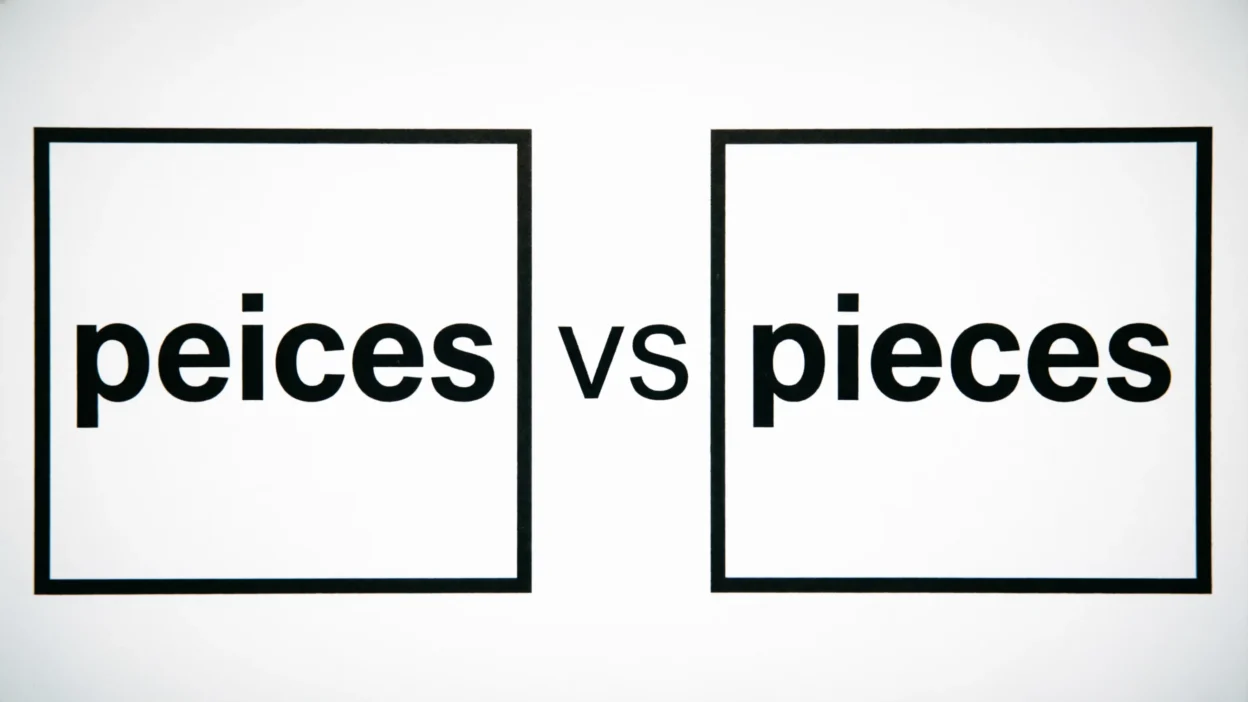
Spelling mistakes are common in English, especially when letters appear in a confusing order. One example many people struggle with is peices vs pieces. These two spellings look similar, but only one of them is correct in standard English.
If you’ve ever typed peices and wondered whether it’s right, you’re not alone. This mistake happens because English spelling rules like “i before e except after c” can feel tricky.
In this article, we’ll clearly explain the difference between peices and pieces, provide examples, highlight common mistakes, and give you easy memory tips so you never confuse them again.
Quick Answer
- Pieces → The correct spelling, meaning parts of something.
- Peices → Incorrect spelling and should be avoided.
Examples:
- “She cut the cake into small pieces.” ✔
- “The puzzle has 500 pieces.” ✔
- “The puzzle has 500 peices.” ❌
In short, pieces is always the correct word, while peices is simply a spelling mistake.
What Does “Pieces” Mean?
The word pieces is the plural form of “piece.” It refers to separate parts, portions, or sections of something.
Common meanings of pieces
- Parts of a whole object
- Portions of food
- Individual items within a group
- Works of art or music
Examples in sentences
- “She broke the chocolate into small pieces.”
- “The puzzle is missing a few pieces.”
- “The artist displayed several pieces in the gallery.”
- “Cut the paper into four equal pieces.”
Everyday contexts
The word appears in many situations:
Food
- “Two pieces of pizza.”
Objects
- “Furniture comes in several pieces.”
- “He wrote three musical pieces.”
Because it is such a common word, spelling it correctly is important in everyday writing.
Is “Peices” a Real Word?
No. Peices is not a correct word in English.
It is simply a misspelling of pieces, usually caused by reversing the letters i and e.
Incorrect example:
- “The puzzle has 200 peices.”
Correct version:
- “The puzzle has 200 pieces.”
Spell-check tools and dictionaries recognize pieces, but not peices.
Peices vs Pieces: Side-by-Side Comparison
| Feature | Pieces | Peices |
|---|---|---|
| Correct spelling | ✔ Yes | ❌ No |
| Meaning | Parts or portions of something | None |
| Dictionary entry | ✔ Yes | ❌ No |
| Common usage | Everyday English | Typing mistake |
| Example | “Three pieces of cake.” | “Three peices of cake.” |
This comparison shows clearly that pieces is the only correct spelling.
Why People Confuse Peices and Pieces
This mistake is extremely common, especially among learners and fast typists.
1. “I before E” confusion
Many people remember the rule:
“I before E except after C.”
But this rule can feel confusing in practice.
- p-i-e-c-e-s
Wrong spelling:
- p-e-i-c-e-s
2. Typing quickly
When typing fast, people may accidentally reverse i and e.
3. Visual memory errors
Because the word contains several letters, some writers remember the order incorrectly.
4. Lack of proofreading
If someone doesn’t double-check their writing, the mistake may go unnoticed.
Understanding the correct letter order solves the problem.
Examples of “Pieces” in Everyday Language
The word pieces appears in many everyday contexts.
Food
- “She ate two pieces of cake.”
- “Cut the sandwich into four pieces.”
Objects
- “The broken vase fell into several pieces.”
- “The furniture arrived in separate pieces.”
Games and puzzles
- “The puzzle contains 1000 pieces.”
- “Chess pieces were placed on the board.”
Art and writing
- “The museum displayed modern art pieces.”
- “The author published several short pieces.”
These examples show how widely the word is used.
American vs British English Differences
For peices vs pieces, there are no spelling differences between American and British English.
| Word | American English | British English |
|---|---|---|
| Pieces | Correct | Correct |
| Peices | Incorrect | Incorrect |
Both language styles follow the same spelling rule.
Common Mistakes People Make
Here are several common spelling errors involving this word.
1. Writing “peices”
Incorrect:
- “I bought three peices of cake.”
Correct:
- “I bought three pieces of cake.”
2. Mixing singular and plural incorrectly
Incorrect:
- “Two piece of bread.”
Correct:
- “Two pieces of bread.”
3. Forgetting plural usage
Incorrect:
- “The puzzle has many piece.”
Correct:
- “The puzzle has many pieces.”
4. Misspelling in academic writing
Mistakes like peices can reduce the professionalism of writing.
Proofreading prevents these errors.
Easy Tricks to Remember the Correct Spelling
Here are simple ways to remember the correct spelling.
Trick 1: “Piece of pie”
Think of the phrase:
“A piece of pie.”
Both words contain pie, which helps you remember the correct order.
Trick 2: Remember the “ie”
The correct spelling is always:
p-i-e-c-e-s
Trick 3: Visualize the word
Seeing the word frequently in books and articles strengthens memory.
Related Words and Synonyms
Understanding related vocabulary can improve your writing.
Words similar to pieces
- parts
- portions
- fragments
- sections
- segments
Example:
- “The glass shattered into tiny fragments.”
Singular form
- piece
Example:
- “Take one piece of candy.”
These words help describe parts of a larger whole.
FAQs About Peices vs Pieces
1. Which spelling is correct: peices or pieces?
The correct spelling is pieces.
2. Is peices ever correct?
No. Peices is always a spelling mistake.
3. What does pieces mean?
Pieces means parts or portions of something.
Example:
- “The cake was cut into small pieces.”
4. Why do people spell pieces as peices?
Because they accidentally reverse the letters i and e.
5. Is pieces used in both American and British English?
Yes. The spelling pieces is used the same way in both.
6. What is the singular form of pieces?
The singular form is piece.
Example:
- “One piece of chocolate.”
7. How can I remember the correct spelling?
Think of the phrase “piece of pie” to remember the ie order.
Final Summary
The difference between peices vs pieces is straightforward. Pieces is the correct spelling and refers to parts or portions of something, such as pieces of cake, puzzle pieces, or pieces of art. It is widely used in everyday English across many contexts.
On the other hand, peices is simply a misspelling caused by reversing the letters i and e. Although the mistake appears often in casual writing, it should always be corrected to maintain clear and professional communication.
Actionable takeaway
Whenever you write this word, remember the phrase “piece of pie.” It helps you remember the correct ie spelling in pieces, ensuring your writing stays accurate and polished.

Joy Root is a content writer at Whygenix.com, creating clear, engaging articles that explain complex ideas simply, helping readers understand why topics matter in everyday life and personal growth.


