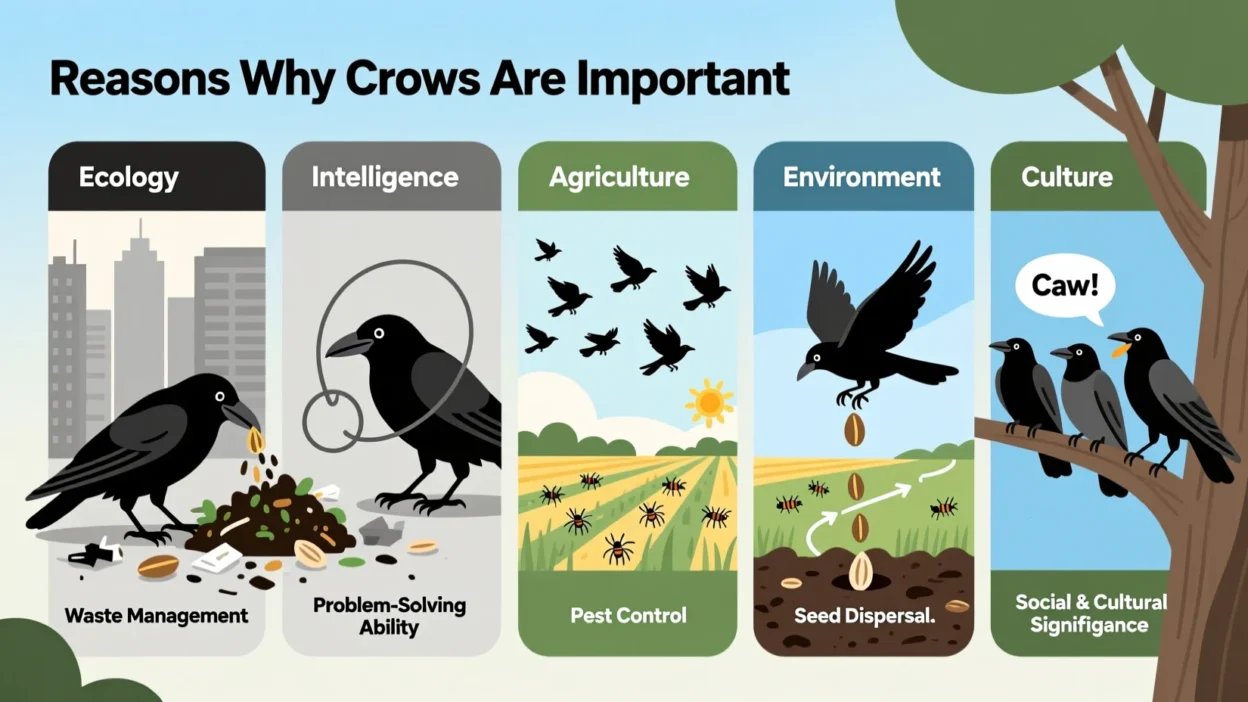
Crows are among the most intelligent and adaptable birds in the world. Found on nearly every continent, they’ve lived alongside humans for centuries — cleaning up waste, spreading seeds, and shaping ecosystems in surprising ways.
While some people see crows as noisy or mischievous, these dark-feathered birds play vital roles in agriculture, ecology, and even culture. Here are 25+ reasons why crows are important to nature and human society.
Crows Help Clean the Environment
Crows are natural scavengers. They feed on waste, carrion, and leftover food, helping to keep streets, fields, and forests clean.
They Prevent Disease Spread
By eating dead animals and decaying matter, crows reduce the spread of harmful bacteria and potential diseases in the environment.
Crows Control Pest Populations
Crows eat insects, rodents, and crop pests, naturally helping farmers protect their fields without chemical pesticides.
They Aid in Seed Dispersal
Crows eat fruits and drop the seeds elsewhere, helping new plants grow and restoring vegetation in damaged ecosystems.
Crows Are Important Decomposers
They speed up the decomposition process by feeding on dead organisms, supporting the natural recycling of nutrients.
They Support Agricultural Balance
By eating harmful insects like grasshoppers and beetles, crows contribute to pest control and balanced crop growth.
Crows Are Highly Intelligent Birds
Studies show that crows can use tools, solve puzzles, and recognize human faces — signs of advanced problem-solving abilities.
They Help Maintain Ecological Balance
As omnivores, crows fit into multiple levels of the food chain, helping regulate the populations of both prey and scavenger species.
Crows Adapt to Urban Environments
Crows thrive in cities, playing a crucial role in cleaning up urban waste and maintaining ecological order even in human-dominated areas.
They Serve as Environmental Indicators
Sudden changes in crow populations can signal shifts in ecosystem health, pollution, or food availability.
Crows Teach Us About Animal Intelligence
Scientists study crows to understand communication, memory, and social learning in non-human species.
They Strengthen Biodiversity
Crows support biodiversity by dispersing seeds, cleaning the environment, and keeping pest numbers balanced.
Crows Help Recycle Nutrients
By feeding on organic waste, crows help break down materials that eventually return to the soil as nutrients.
They Play a Role in Cultural Symbolism
Across cultures, crows symbolize intelligence, adaptability, and transformation — often appearing in folklore, art, and literature.
Crows Warn Other Animals of Danger
Crows produce loud alarm calls that alert other birds and animals of predators or human threats, promoting survival in shared habitats.
They Have Complex Social Structures
Crows live in family groups, care for their young cooperatively, and even mourn lost members — behaviors that show emotional depth and community bonding.
Crows Remember Human Faces
Crows can recognize and remember individual people who’ve treated them well or badly, showing remarkable long-term memory.
They Communicate Through Calls and Gestures
Crows use over 250 different sounds and gestures to share warnings, call others for food, or express emotions.
Crows Are Useful in Forensic Science
Because they feed on carrion, observing crow behavior can help forensic experts estimate the time of death in investigations.
They Inspire Scientific Research
Crows are studied for insights into evolution, intelligence, memory, and brain development among birds and mammals.
Crows Encourage Ecological Awareness
Learning about crows helps people appreciate the importance of scavengers and their role in keeping ecosystems balanced.
They Help in Waste Management
In some cities, crows have been trained to collect cigarette butts and small trash items, reducing pollution.
Crows Are Important to Mythology and Religion
In many traditions, crows symbolize wisdom, foresight, and change — from Norse mythology’s Odin’s ravens to Native American folklore.
They Support Scientific Observation in Urban Ecology
Studying crow behavior helps scientists understand how wildlife adapts to urbanization and climate change.
Crows Exhibit Cooperative Behavior
Crows often share food and defend each other against predators, showcasing social intelligence that’s rare among birds.
They Encourage Curiosity and Education
Because of their intelligence and mystery, crows are commonly featured in environmental education, helping students learn about bird behavior and ecology.
Quick Table: Importance of Crows
| Category | Contribution | Example |
|---|---|---|
| Ecological | Pest and waste control | Cleaning urban areas |
| Agricultural | Insect management | Protecting crops naturally |
| Scientific | Intelligence studies | Tool use and memory research |
| Environmental | Seed dispersal and decomposition | Ecosystem recycling |
| Cultural | Symbolism and folklore | Representing wisdom and change |
Common Idioms and Sayings About Crows
| Idiom or Saying | Meaning | Example |
|---|---|---|
| “As the crow flies” | In a straight line | The village is ten miles away as the crow flies. |
| “Eat crow” | Admit being wrong | He had to eat crow after the mistake. |
| “A murder of crows” | A group of crows | A murder of crows gathered in the field. |
| “Crow’s feet” | Wrinkles near the eyes | She smiled, and tiny crow’s feet appeared. |
| “Crow about” | To boast or brag | He wouldn’t stop crowing about his success. |
FAQs About Crows
Q1: Why are crows important to the environment?
They clean waste, control pests, disperse seeds, and maintain ecosystem balance.
Q2: How do crows help farmers?
By eating crop pests, crows reduce the need for harmful pesticides and protect yield.
Q3: Are crows dangerous to other animals?
Generally no. They only attack smaller animals if food is scarce or to protect their nests.
Q4: Why are crows considered intelligent?
They use tools, recognize human faces, and can plan future actions — rare skills in the animal world.
Q5: What can we learn from crows?
Crows teach us about communication, cooperation, and the intelligence of nature’s most overlooked creatures.
Conclusion
Crows are much more than black birds in the sky — they are nature’s cleaners, thinkers, and protectors. From maintaining environmental balance to teaching us about intelligence and community, crows are vital to both ecosystems and human understanding of the natural world.
They clean, recycle, warn, and adapt — proving that even the most common creatures can be the most crucial. Appreciating and protecting crows ensures that these remarkable birds continue their invaluable role in keeping our planet alive and balanced.

Bret Lee writes educational and research-based content for Whygenix.com, focused on clarity, accuracy, and explaining why concepts matter through simple, engaging, reader-friendly writing.