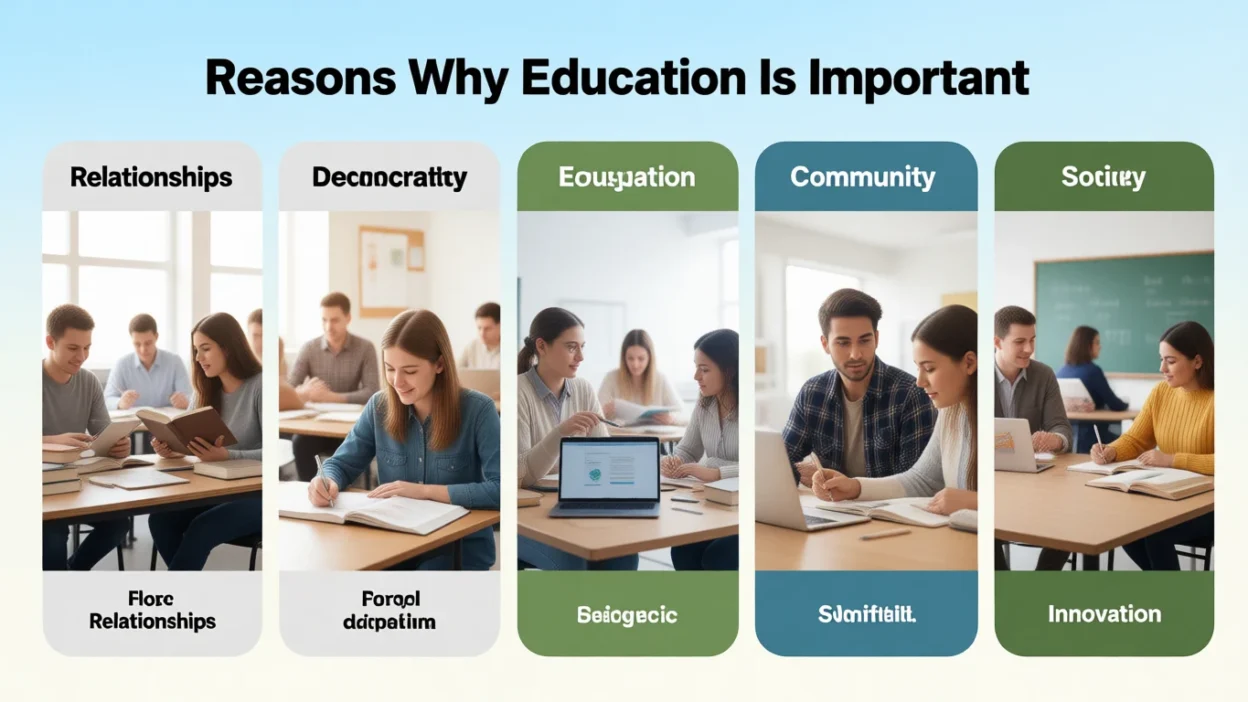
Education is one of the most powerful tools for personal, social, and global development. It shapes minds, builds character, opens opportunities, and strengthens entire communities. Whether gained in school, through life experiences, or self-learning, education expands possibilities and improves the quality of life.
Understanding why education is important helps us appreciate its impact on growth, leadership, careers, and the progress of society as a whole. Here are 25+ meaningful reasons that highlight the true value of education.
Builds Knowledge
Education provides the foundational knowledge needed to understand the world and make informed decisions.
Develops Critical Thinking
It encourages people to analyze, question, compare, and evaluate information rather than accept everything at face value.
Improves Communication Skills
Education strengthens reading, writing, speaking, and listening abilities — all essential for personal and professional success.
Opens Career Opportunities
A good education increases job options, income potential, and long-term career growth.
Reduces Poverty
Education is one of the strongest tools for breaking the cycle of poverty by empowering individuals with skills and opportunities.
Encourages Innovation
Classrooms and learning environments nurture creativity and inspire new ideas, inventions, and solutions.
Strengthens Social Skills
Students learn cooperation, teamwork, respect, and social responsibility through educational interactions.
Helps Build Confidence
Knowledge empowers people to feel capable, confident, and prepared for challenges.
Promotes Independence
Education teaches people how to think for themselves and make responsible, informed decisions.
Improves Health Awareness
Educated individuals are more likely to understand healthcare, nutrition, and hygiene, leading to healthier lifestyles.
Strengthens Economy
More educated workers increase a nation’s productivity, innovation, and economic stability.
Encourages Equality
Education helps reduce social discrimination and gives people from all backgrounds equal opportunities to succeed.
Develops Problem-Solving Skills
Students learn to identify problems, evaluate options, and create solutions — a skill needed in every aspect of life.
Builds Moral and Ethical Values
Education promotes honesty, discipline, respect, empathy, and responsibility, shaping character and behavior.
Expands Worldview
Exposure to history, cultures, and global issues helps individuals become more open-minded and understanding.
Supports Technological Advancement
Scientists, engineers, programmers, and innovators rely on education to develop modern technology.
Strengthens Communities
Educated citizens make better societal decisions, participate in civic duties, and contribute to community development.
Reduces Crime Rates
Studies consistently show that education lowers crime by increasing opportunities and improving decision-making.
Enhances Financial Literacy
Education teaches people how to save, invest, budget, and manage money responsibly.
Promotes Environmental Awareness
Students learn the importance of conservation, sustainability, and protecting the planet.
Helps Build Leadership
Education develops leadership qualities such as confidence, communication, planning, and decision-making.
Inspires Lifelong Learning
It builds curiosity and motivates individuals to continue learning throughout life.
Encourages Cultural Preservation
Through education, languages, traditions, and cultural values are passed down from generation to generation.
Improves Emotional Intelligence
Education fosters self-awareness, empathy, stress management, and interpersonal understanding.
Facilitates Social Mobility
Education gives individuals the opportunity to improve their social and economic standing.
Drives National Development
Educated societies progress faster in science, technology, healthcare, and governance.
Quick Table: Impact of Education
| Aspect | Benefit | Example |
|---|---|---|
| Personal Growth | Builds confidence and skills | Learning communication and decision-making |
| Economy | Increases productivity | Skilled workforce drives industry growth |
| Society | Improves equality | Education reduces discrimination |
| Health | Encourages awareness | Understanding nutrition and hygiene |
| Future | Supports innovation | New technologies and discoveries |
Common Expressions Related to Education
| Expression | Meaning | Example |
|---|---|---|
| Knowledge is power | Knowledge gives strength and advantage | Education empowers individuals |
| Learn the ropes | Understand how something works | Students learn the ropes in school |
| Hit the books | Start studying seriously | He needs to hit the books before exams |
| School of thought | A particular way of thinking | This school of thought supports creativity |
| Eye-opener | Something that increases understanding | The lecture was an eye-opener |
Real-Life Examples of Education’s Importance
- Doctors, engineers, lawyers, and teachers all rely on education to serve society.
- Countries with higher literacy rates have stronger economies and lower poverty levels.
- Technological breakthroughs in medicine, communication, and space exploration come from educated minds.
- Social reforms like human rights, equality, and justice develop through educated populations.
- Communities progress when children and adults continue learning and improving their skills.
FAQs About Education
Q1: Why is education important for personal growth?
It builds knowledge, confidence, and essential life skills that help individuals succeed.
Q2: How does education improve society?
It reduces inequality, strengthens the economy, promotes peace, and encourages innovation.
Q3: Can education reduce poverty?
Yes. Education opens doors to better jobs, higher income, and improved living standards.
Q4: Why is education important for children?
It shapes their thinking, social skills, values, and future opportunities.
Q5: Is self-education as valuable as formal education?
Both are important. Self-learning boosts creativity and exploration, while formal education provides structure and credentials.
Conclusion
Education is the foundation of progress, shaping individuals, communities, and nations. It strengthens character, expands opportunity, and empowers people to build better futures. Whether through schools, books, mentors, or personal experience, education remains the most valuable investment anyone can make.
When people learn, societies thrive — and the world becomes more peaceful, innovative, and equitable. That is why education is not just important; it is essential.

Bret Lee writes educational and research-based content for Whygenix.com, focused on clarity, accuracy, and explaining why concepts matter through simple, engaging, reader-friendly writing.