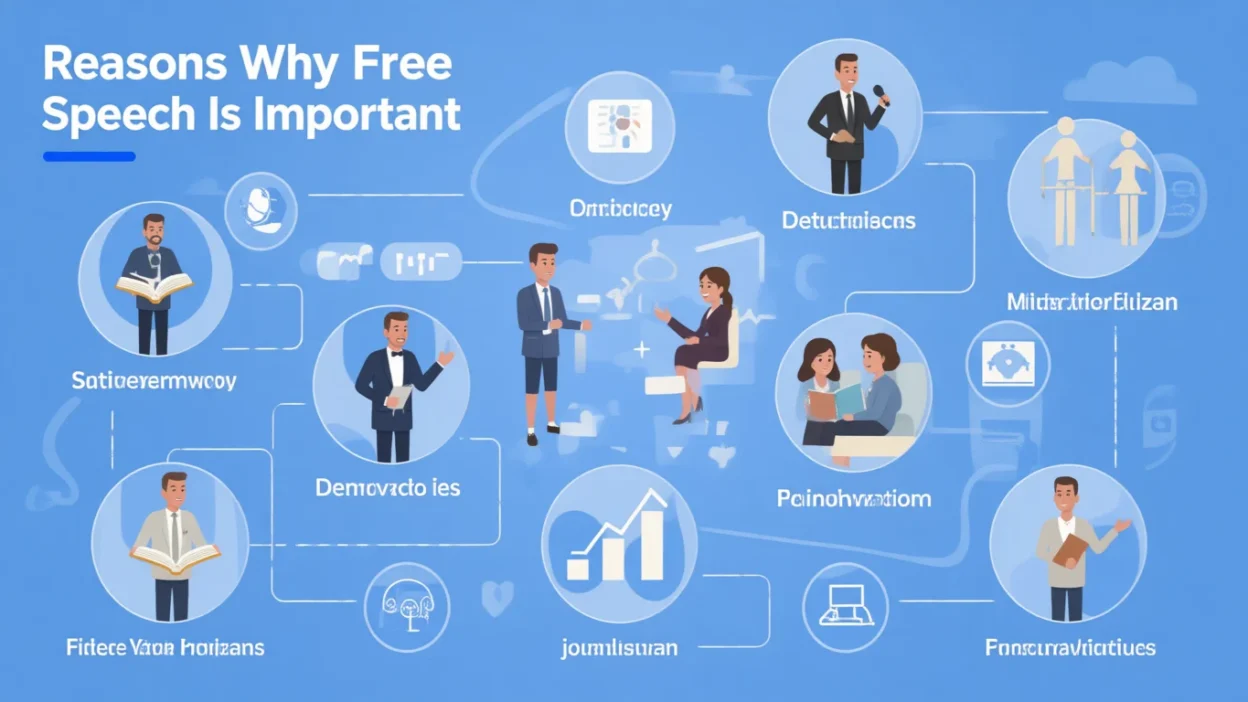
Free speech is the foundation of open societies, democratic systems, and individual freedom. It allows people to express their thoughts, challenge ideas, share knowledge, and participate in decision-making without fear.
When free speech is protected, creativity grows, truth surfaces, and societies progress. When it is restricted, corruption rises, injustice spreads, and innovation suffers.
Here are 25 powerful reasons why free speech is important and how it shapes the world we live in.
Protects Individual Freedom
Free speech ensures that people can express ideas, opinions, and beliefs without interference.
Encourages Open Discussion
It allows individuals to share thoughts, debate issues, and hear diverse viewpoints.
Supports Democracy
Free speech helps citizens participate in elections, public debates, and government accountability.
Exposes Corruption
Whistleblowers and journalists rely on free speech to reveal wrongdoing.
Strengthens Human Rights
Free speech protects other freedoms like freedom of thought, religion, and press.
Promotes Creativity
Artists, writers, filmmakers, and creators thrive when they can express themselves openly.
Drives Innovation
Sharing information freely leads to discoveries, solutions, and new technologies.
Protects Minorities
Free speech gives marginalized communities the power to speak against injustice.
Enables Social Change
Movements for equality, justice, and rights depend on the ability to speak freely.
Encourages Critical Thinking
Hearing different ideas helps people analyze information and form stronger opinions.
Prevents Abuse of Power
Governments stay accountable when people can question leaders and policies.
Strengthens Education
Students learn better when they can ask questions and explore controversial topics.
Supports Scientific Progress
Scientists must be free to publish research, share findings, and challenge incorrect assumptions.
Allows Peaceful Dissent
Free speech enables people to express disagreement without violence.
Builds Transparent Societies
Openness leads to trust, clarity, and honest communication.
Protects Journalistic Freedom
Media can investigate, report, and inform the public without censorship.
Encourages Personal Growth
People grow when exposed to new ideas and perspectives.
Reduces Fear
When people can speak openly, they feel safer and more confident.
Promotes Cultural Exchange
Free speech allows sharing of traditions, stories, and beliefs across communities.
Helps Resolve Conflicts
Talking openly helps settle disputes peacefully.
Prevents Extremism
Open dialogue reduces misinformation and allows harmful ideas to be challenged publicly.
Builds Strong Communities
Communication creates understanding, trust, and unity.
Preserves History
Sharing stories and experiences helps document events accurately.
Shapes Public Opinion
People can influence policies, movements, and decisions through open expression.
Defends Truth
Free speech allows truth to compete with falsehood and ultimately prevail.
Summary Table: Why Free Speech Matters
| Category | Importance | Example |
|---|---|---|
| Democracy | Participation, accountability | Voting, political debates |
| Society | Openness, justice, equality | Speaking against discrimination |
| Innovation | Ideas, creativity, research | Sharing scientific discoveries |
| Personal Freedom | Expression, identity | Writing, art, opinions |
| Conflict Resolution | Peaceful dialogue | Public discussions and mediation |
Idioms Related to Speech & Expression
| Idiom | Meaning | Example |
|---|---|---|
| Speak your mind | Say what you truly think | She wasn’t afraid to speak her mind. |
| Voice of reason | Calm and sensible viewpoint | He became the voice of reason in the debate. |
| Word on the street | Popular opinion or rumor | Word on the street is that reforms are coming. |
| Actions speak louder | What you do matters more than talk | His honesty showed; actions speak louder. |
| Speak volumes | Convey a message clearly | His silence spoke volumes. |
Real-Life Examples of Free Speech Importance
- Journalism exposing corruption in politics and business.
- Social movements like civil rights and women’s rights using free expression to create change.
- Scientists sharing research freely during global health crises.
- Students questioning educational systems and shaping school policies.
- Citizens voicing concerns that lead to improved laws or reforms.
FAQs
Q1: Why is free speech important in society?
It allows open discussion, holds leaders accountable, and protects personal freedoms.
Q2: Is free speech unlimited?
No. It should not include threats, violence, or harm to others.
Q3: Does free speech support democracy?
Yes. Democracy cannot function without open communication and debate.
Q4: How does free speech prevent corruption?
It allows journalists and citizens to expose misconduct.
Q5: How can free speech support innovation?
People can share ideas freely, challenge old beliefs, and create new solutions.
Conclusion
Free speech is a cornerstone of freedom, democracy, and human dignity. It protects individuals, supports creative expression, encourages innovation, and challenges corruption.
Societies progress when people can express their ideas openly and respectfully. Ensuring free speech means protecting the right to think, question, and speak without fear—an essential ingredient for a fair, strong, and transparent world.

Sara Taylor is a content writer at Whygenix.com, creating clear, engaging articles that simplify complex ideas, helping readers understand the why behind topics in education, lifestyle, and personal development.