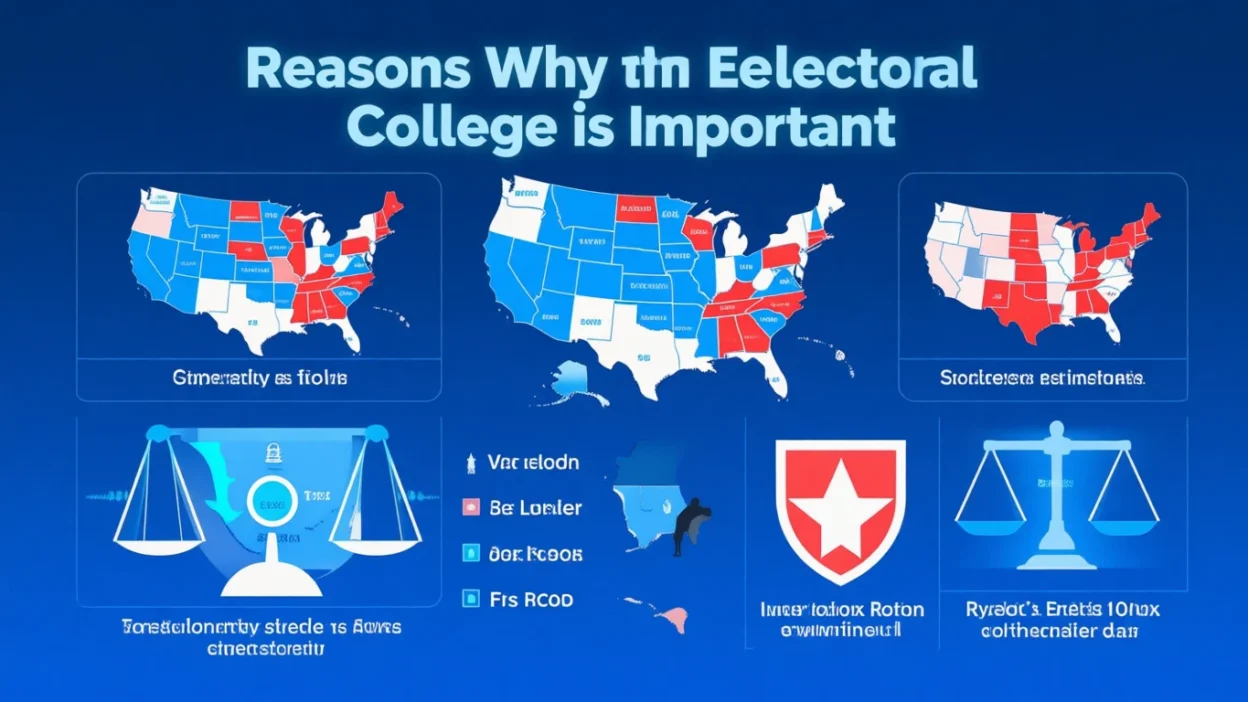
The Electoral College is a unique system used in the United States to elect the president. Instead of choosing the winner purely by popular vote, the Electoral College distributes voting power across states to balance the influence of large and small populations.
While often debated, the Electoral College plays a major role in shaping American democracy, elections, and political strategy.
Here are 25 important reasons why the Electoral College matters.
Balances Power Between Large and Small States
It prevents highly populated states from completely dominating presidential elections.
Protects Minority Interests
Smaller or less populated regions still have a meaningful voice in the election outcome.
Encourages National Campaigning
Candidates must focus on multiple states, not just major cities.
Prevents Pure Majority Rule
The system ensures that presidents represent broad regional support, not just concentrated populations.
Strengthens Federalism
It supports the U.S. federal structure by giving states an active role in elections.
Reduces Regional Dominance
No single region (like the East or West Coast) can control the election by itself.
Encourages Coalition Building
Candidates must appeal to diverse groups across the country to win.
Helps Maintain Political Stability
The system has produced peaceful transitions of power for centuries.
Makes Voter Fraud Harder
Fraud in one state cannot easily change the national result because each state controls its own electoral process.
Prevents Runoff Elections
The Electoral College usually produces a clear outcome without multiple election rounds.
Supports the Two-Party System
It discourages small parties from fragmenting the vote, which can stabilize political outcomes.
Encourages Focus on Swing States
While sometimes criticized, this forces candidates to address issues important to competitive regions.
Helps Maintain Traditional Electoral Structures
It preserves historical elements of the U.S. Constitution and its founding principles.
Speeds Up Election Results
The system helps determine results more quickly than nationwide recounts.
Avoids Nationwide Recounts
Close elections require recounts in only a few states, not the whole country.
Limits the Influence of Extreme Populations
Extremist views in specific regions cannot dominate a national election easily.
Promotes Geographic Diversity
Candidates must respect the needs of rural, suburban, and urban voters alike.
Reinforces State Sovereignty
States control how electors are chosen, protecting local authority.
Encourages Voter Turnout in Battleground Areas
Competitive states see higher civic engagement and participation.
Protects the Interests of Less Populated States
States like Wyoming, Vermont, or Alaska still hold meaningful electoral influence.
Reduces Concentration of Campaign Spending
Money and attention get spread across several states rather than just major cities.
Encourages Compromise
Candidates must moderate their positions to appeal to multiple regions.
Preserves Checks and Balances
It prevents any single part of the country from controlling the presidency.
Ensures Broad Support for the President
The winner typically receives nationwide backing, making their leadership more legitimate.
Supports Long-Term Democratic Stability
The structure has helped maintain a functioning democracy for over two centuries.
Summary Table: Why the Electoral College Matters
| Category | Importance | Example |
|---|---|---|
| Representation | Balances large and small states | California vs. Wyoming influence |
| Stability | Predictable outcomes, peaceful transfer | Clear results without nationwide recounts |
| Federalism | Preserves state powers | States control election procedures |
| Diversity | Encourages national campaigning | Candidates visit multiple regions |
| Legitimacy | Ensures broad support | Winner gains multi-state backing |
Common Idioms Related to Elections & Decision-Making
| Idiom | Meaning | Example |
|---|---|---|
| Every vote counts | Each vote is important | In swing states, every vote counts. |
| Ball is in your court | Decision is yours | The ball is in the voters’ court during elections. |
| Level playing field | Equal fairness | The system creates a level playing field for states. |
| In the long run | Over time | In the long run, the system promotes stability. |
| The final say | Ultimate decision | Electors have the final say in determining the winner. |
Real-Life Examples of the Electoral College’s Importance
- Candidates visit small states like Iowa or New Hampshire because their electoral votes matter.
- Elections often hinge on a few competitive states, driving national attention to their issues.
- Close elections are resolved with recounts in specific states, not nationwide chaos.
- Presidents must build coalitions across diverse regions to win.
- States maintain independence in how they run their elections.
FAQs
Q1: Why does the U.S. use the Electoral College?
To balance political power between states and protect federalism.
Q2: Is the Electoral College still relevant today?
Yes, it encourages national campaigning and ensures broad regional support.
Q3: Does the Electoral College help smaller states?
Yes. It gives them a stronger voice than they would have under a pure popular vote.
Q4: Can the popular vote and electoral vote differ?
Yes. But the system prioritizes state-by-state representation.
Q5: Is it possible to change the Electoral College?
Yes, but it would require a constitutional amendment, which is difficult to pass.
Conclusion
The Electoral College plays a central role in shaping American democracy. It balances the power of states, supports political stability, promotes national campaigning, and ensures that presidents gain broad regional support.
Understanding why the Electoral College is important helps us appreciate how the U.S. election system works and why it has remained a key part of the Constitution for so long.

Bret Lee writes educational and research-based content for Whygenix.com, focused on clarity, accuracy, and explaining why concepts matter through simple, engaging, reader-friendly writing.