Have you ever typed “scarry” and wondered if it looks right? You’re not alone. This is a very common spelling confusion, especially because English has many double-letter words that can trick even confident writers.
The good news is that this one is easy to fix once you understand the rule. In this guide, we’ll break down scarry vs scary, explain the correct spelling, and help you avoid this mistake forever.
Quick Answer
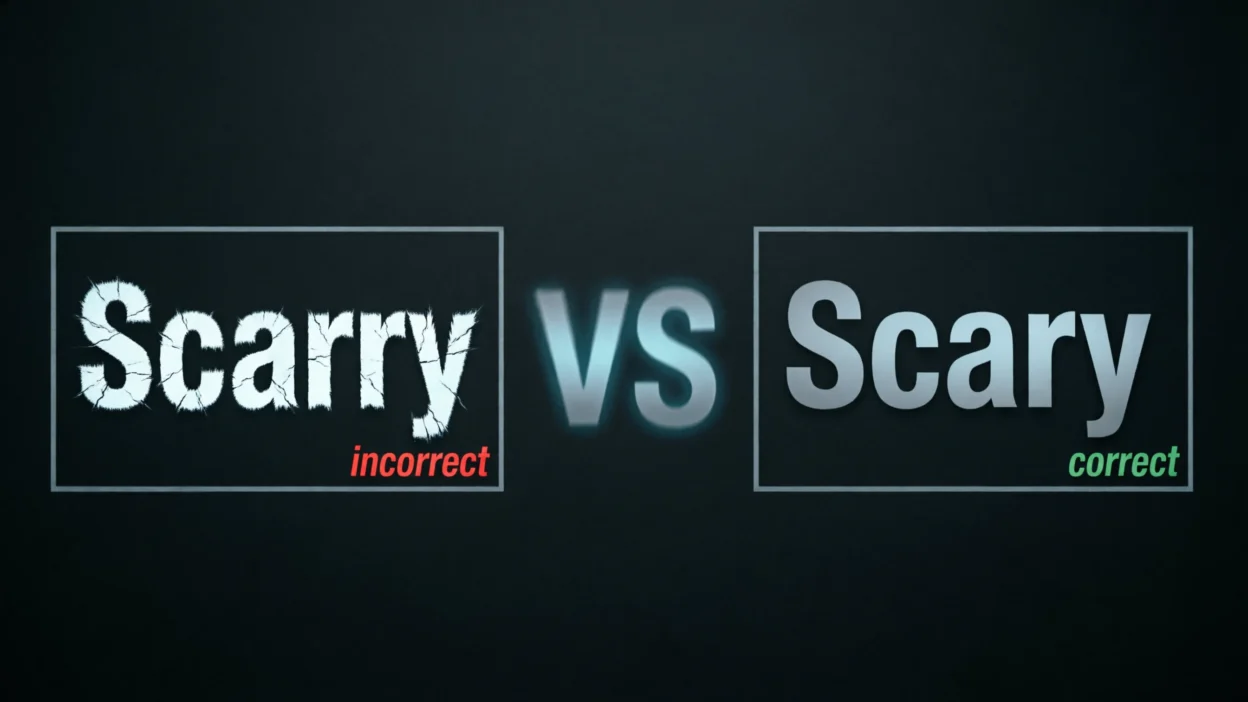
- ✅ Scary = Correct spelling
- ❌ Scarry = Incorrect spelling
👉 Always use “scary” when describing something that causes fear.
Understanding “Scarry vs Scary”
At first glance, both words might seem acceptable. But in standard English, only one is valid.
The Correct Word: Scary
“Scary” is an adjective that means something that causes fear, fright, or uneasiness.
Examples:
- That movie was really scary.
- I heard a scary noise last night.
- Roller coasters can be fun but also scary.
The Incorrect Word: Scarry
“Scarry” is not a real English word. It’s a common spelling mistake caused by overusing double letters.
Incorrect examples:
- ❌ That was a scarry story.
- ❌ The house looks scarry at night.
Why Do People Write “Scarry”?
This mistake usually happens for a few reasons:
- Confusion with double consonants (like “happy,” “running”)
- Pronunciation doesn’t clearly show spelling
- Habit of adding extra letters for emphasis
👉 But in this case, “scary” only has one “r.”
Spelling Rule Explained
The word “scary” comes from “scare.”
👉 When adding “-y”, we don’t double the “r” because:
- The base word ends in a silent “e”
- We drop the “e” and add “y” → scare → scary
Correct formation:
- scare → scary ✅
Incorrect formation:
- scare → scarry ❌
Comparison Table: Scarry vs Scary
| Feature | Scarry ❌ | Scary ✅ |
|---|---|---|
| Correct spelling | No | Yes |
| Dictionary word | No | Yes |
| Usage | Incorrect | Standard English |
| Meaning | None | Causes fear |
Real-Life Usage Examples
Correct Sentences
- The haunted house was very scary.
- That’s a scary situation.
- She told a scary story around the campfire.
Incorrect Sentences
- ❌ The movie was scarry.
- ❌ I had a scarry dream.
Common Mistakes to Avoid
Here are some related spelling errors people often make:
- Adding extra letters unnecessarily:
- ❌ scarry → ✅ scary
- ❌ funnny → ✅ funny
- Confusing similar-looking words:
- scar (a mark) vs scare (to frighten)
- Overgeneralizing double-letter rules
American vs British English
There’s no difference between American and British English here.
- Both use “scary”
- Both consider “scarry” incorrect
👉 The spelling rule is universal.
Synonyms and Related Words
To make your writing more expressive, try these alternatives:
- Frightening
- Terrifying
- Spooky
- Creepy
- Chilling
- Alarming
Memory Trick to Remember
Here’s a simple trick:
👉 Think of the base word “scare”
👉 Remove the “e” and add “y” → scary
No extra “r” needed!
FAQs About Scarry vs Scary
1. Is “scarry” ever correct?
No, “scarry” is always incorrect.
2. What is the correct spelling?
The correct spelling is “scary.”
3. Why isn’t there a double “r” in “scary”?
Because the word comes from “scare”, and we simply drop the “e” and add “y.”
4. Can I use “scarry” in informal writing?
No, it’s still incorrect—even in casual contexts.
5. Is “scary” an adjective?
Yes, it describes something that causes fear.
6. Are there similar words with one “r”?
Yes:
- scary
- very
- hairy
7. Does pronunciation affect spelling here?
Not really—this is purely a spelling rule.
8. How can I avoid this mistake?
Remember the base word: scare → scary.
Final Summary
When comparing scarry vs scary, the correct choice is clear: “scary” is the only correct spelling. The confusion usually comes from adding an unnecessary extra “r,” but once you understand the word comes from “scare,” the rule becomes easy to follow.
Using the correct spelling helps you write more clearly and professionally, whether you’re telling a story, writing an essay, or sending a message.
Actionable Takeaway
Next time you write this word:
👉 Think of “scare” → scary
👉 Use one “r” only
Simple, correct, and easy to remember.

Bret Lee writes educational and research-based content for Whygenix.com, focused on clarity, accuracy, and explaining why concepts matter through simple, engaging, reader-friendly writing.