You’re scrolling through a post, reading a comment, or chatting with a friend when you spot “e.g.” tucked inside a sentence.
It looks small, a little formal, and slightly confusing. You pause and think, “Wait… what does e.g. mean again?”
Maybe you’ve seen it in school notes, work emails, captions, or even Twitter threads. People use it casually, like everyone already knows what it means. If you’ve ever felt unsure but kept reading anyway, you’re not alone.
In today’s fast-moving texting culture, shortcuts like e.g. show up everywhere. Let’s break it down in the easiest way possible.
Quick Answer
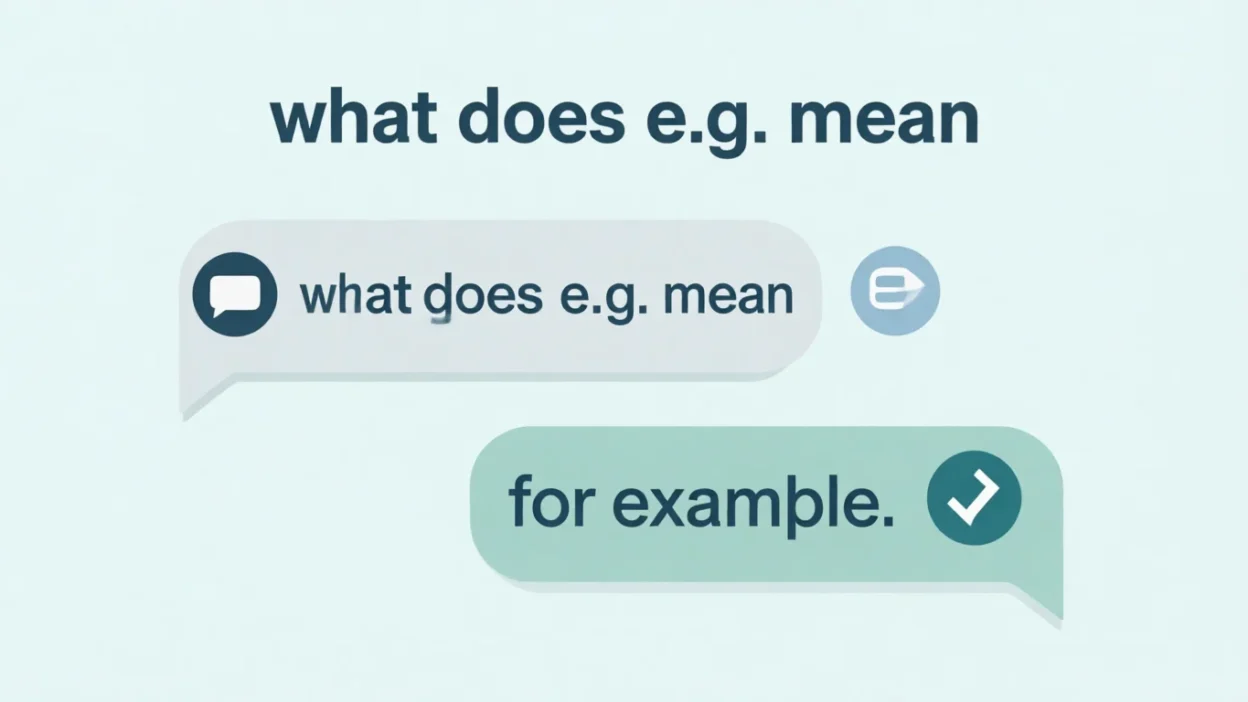
“e.g.” means “for example” and is used to introduce examples in a sentence.
What Does e.g. Mean in Text?
e.g. comes from Latin: exempli gratia, which means “for the sake of example.”
In plain English, it’s just a shorter way to say “for example.”
People use e.g. to:
- Give examples without listing everything
- Keep sentences short and clear
- Sound neat, organized, or slightly formal
Simple example sentence:
You’re not saying only hiking and biking—just giving examples.
Bold summary: e.g. means “for example” and is used to show sample ideas, not a full list.
Where Is e.g. Commonly Used?
You’ll see e.g. in many places online and offline. It’s popular because it saves time and space.
Common places you’ll find e.g.:
- Text messages (less common, but still used)
- Social media captions and comments
- DMs and replies
- School assignments
- Emails and work chats
- Online forums and Reddit threads
Tone of e.g.
- Neutral to slightly formal
- More common in writing than casual speech
- Sounds cleaner than slang, but not stiff
In texting culture, people sometimes replace it with “like” or “for example,” but e.g. is still widely understood.
Realistic Conversation Examples (Texting Style)
Here’s how e.g. actually shows up in real chats. All examples are written in lowercase, just like modern texting.
- “i’m free on weekdays, e.g., monday or tuesday”
- “you should bring snacks, e.g. chips or cookies”
- “some apps drain battery fast, e.g. games”
- “we need supplies, e.g., paper and markers”
- “i love old movies, e.g. black-and-white ones”
- “try relaxing activities, e.g. yoga”
- “i listen to podcasts, e.g., true crime”
- “he gets nervous in crowds, e.g. concerts”
Short, clean, and straight to the point.
When to Use and When Not to Use e.g.
Using e.g. correctly makes you sound clear and confident. Using it wrong can confuse people.
✅ Do use e.g. when:
- You’re giving examples, not a full list
- You want to keep writing short
- The reader already understands basic abbreviations
- You’re writing posts, notes, or comments
❌ Don’t use e.g. when:
- You mean “that is” (that’s i.e., not e.g.)
- You’re talking to someone who may not know abbreviations
- You’re speaking out loud (most people say “for example”)
- The situation is very casual and slang fits better
Quick Comparison Table
| Context | Example Phrase | Why It Works / Doesn’t |
|---|---|---|
| giving examples | bring fruits, e.g. apples | works because it shows examples |
| explaining meaning | it means happy, e.g. joyful | doesn’t work; explanation needs clarity |
| school writing | subjects like math, e.g. algebra | works well |
| casual talk | i’m tired e.g. today | doesn’t work; sounds awkward |
Similar Terms and Alternatives to e.g.
Sometimes e.g. isn’t the best choice. Here are common alternatives and when to use them.
Useful alternatives
| Term | Meaning | When to Use |
|---|---|---|
| for example | same meaning as e.g. | casual chats and speech |
| like | informal example | texting and social media |
| such as | introduces examples | neutral writing |
| including | part of a group | lists and explanations |
| for instance | same as e.g. | slightly formal tone |
Example swap:
- formal: bring tools, e.g., a hammer
- casual: bring tools, like a hammer
Both work—the tone just changes.
FAQs About “What Does e.g. Mean”
1. What does e.g. mean in simple words?
It means “for example.” It’s used to show sample ideas.
2. Is e.g. formal or informal?
It’s neutral. Slightly formal, but still common online.
3. Can I use e.g. in texting?
Yes, but many people prefer “like” or “for example” in casual texts.
4. Is e.g. the same as i.e.?
No.
- e.g. = for example
- i.e. = that is (exact meaning)
5. Do I need commas around e.g.?
Usually yes. Example:
6. Do people still use e.g. on social media?
Yes. It’s common in captions, threads, and comments.
7. Can kids or teens use e.g.?
Yes, especially in school writing or informative posts.
Why Understanding e.g. Matters in Texting Culture
In modern digital communication, small abbreviations carry big meaning. Knowing what e.g. means helps you:
- Read posts faster
- Avoid confusion
- Write more clearly
- Sound confident online
As texting culture mixes casual language with short forms, e.g. stays popular because it’s simple, useful, and widely understood.
Final Thought
So, what does e.g. mean?
It simply means “for example.”
It’s a clean, easy way to share examples without overexplaining. Whether you’re writing a comment, sending a message, or reading online content, understanding e.g. helps you keep up with modern communication.
Once you spot it, you’ll see it everywhere—and now, you’ll know exactly what it means.

Joy Root is a content writer at Whygenix.com, creating clear, engaging articles that explain complex ideas simply, helping readers understand why topics matter in everyday life and personal growth.