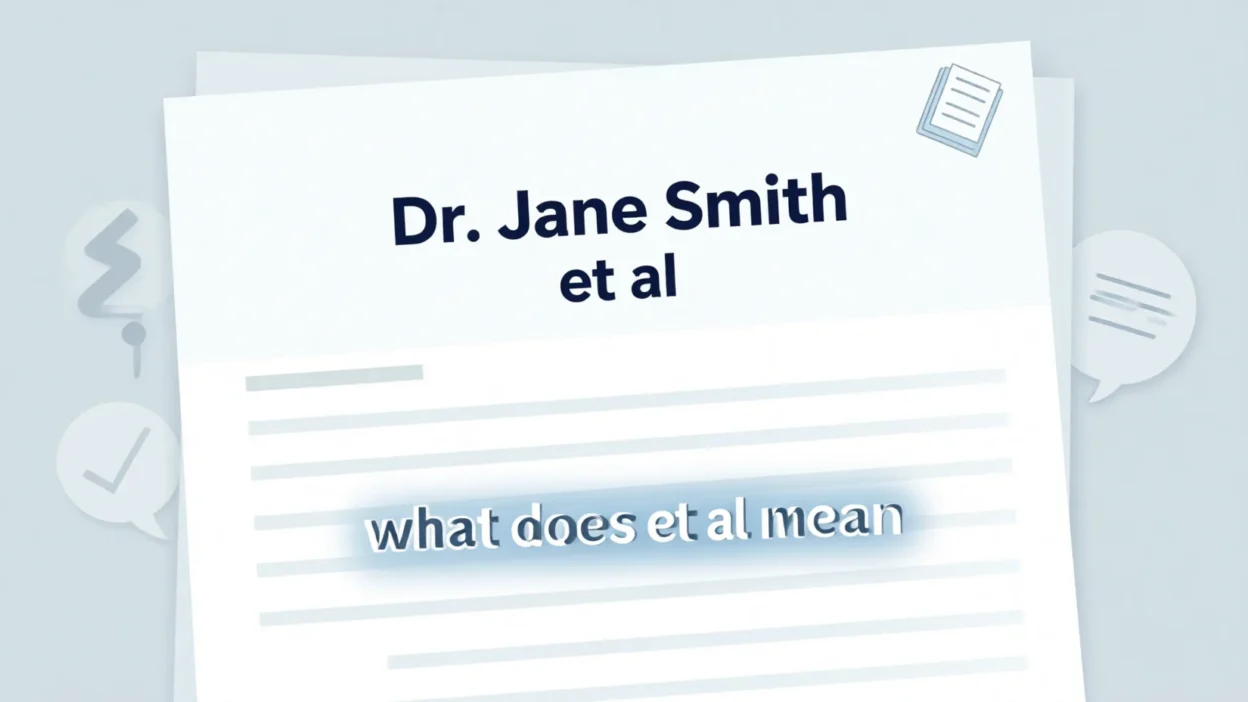
The first time I noticed “et al”, it wasn’t in a textbook. It was in a screenshot someone shared in a group chat. A long name was listed, followed by et al., and everyone acted like it was totally normal. I didn’t want to ask and sound clueless, so I did what most of us do—I Googled it later.
Turns out, this tiny phrase shows up way more than we realize, not just in school papers, but also in articles, captions, and even online conversations.
If you’ve ever paused and wondered, “what does et al mean?”—you’re definitely not alone.
Quick Answer:
Et al means “and others,” used to refer to additional people without listing every name.
What Does Et Al Mean? Plain-English Explanation
Et al comes from Latin. It’s short for “et alia”, which means “and others.”
In simple terms, people use et al when there are too many names to list, and they want to keep things short and clean.
Why people use et al
- To save space
- To avoid long lists of names
- To sound clear and professional
- To keep writing simple
You’ll usually see it after one person’s name when more people are involved.
Simple example sentence
“the study was written by smith et al.”
Bold summary:
Et al means “and others,” used to shorten lists of names in writing and online text.
Where Is “Et Al” Commonly Used?
Even though et al sounds formal, it pops up in more places than you might expect.
Common places you’ll see et al
- School papers and homework
- News articles and blogs
- Research summaries shared online
- Wikipedia pages
- Screenshots shared in group chats
- Comments discussing studies or reports
Tone of the term
The tone is mostly formal to neutral, but online, people often use it casually when talking about articles or studies.
So while et al isn’t slang, it still shows up in everyday digital conversations.
Et Al in Texting and Online Chat Meaning
In texting culture, et al is usually used in a reference way, not as casual slang.
People might say it when:
- Quoting an article
- Talking about a study
- Sharing a link
- Referring to a group without naming everyone
It’s not something people invent on the spot—it’s borrowed from writing and used in chat shorthand.
Realistic Conversation Examples (Lowercase Style)
Here are some natural, modern examples showing how et al appears in real online chats:
- “the article by johnson et al explains it really well”
- “i think that study was done by smith et al, right?”
- “this research (brown et al) keeps getting shared”
- “i saw a post quoting miller et al about sleep”
- “the paper from 2021 by lee et al said the same thing”
- “that graph is from a report by davis et al”
- “everyone keeps referencing wilson et al in the comments”
- “i don’t remember all the authors, just parker et al”
Notice how et al stays the same even in informal chat—it’s just dropped in naturally.
When to Use and When Not to Use Et Al
Using et al correctly matters, especially if you want to sound clear and confident.
Do use et al when
- Referring to multiple authors
- Talking about studies, reports, or articles
- You don’t need to list every name
- Writing or chatting about academic content
Don’t use et al when
- Referring to just one person
- Talking about friends in casual chat
- Writing personal messages
- Using it as a joke or slang
Quick comparison table
| context | example phrase | why it works / doesn’t |
|---|---|---|
| article discussion | “according to smith et al” | works, correct usage |
| group chat | “the study by lee et al” | works, clear reference |
| casual text | “me et al are coming” | doesn’t work, incorrect |
| single author | “john et al wrote it” | doesn’t work, misleading |
Similar Terms and Alternatives to Et Al
Sometimes people use alternatives instead of et al, depending on tone and setting.
| term | meaning | when to use it |
|---|---|---|
| and others | plain english version | casual explanations |
| and colleagues | group of professionals | semi-formal |
| plus others | informal wording | light conversation |
| team | group working together | casual or work chat |
| authors | unnamed writers | neutral tone |
Et al is still the most common choice when referencing written work or research.
Common Mistakes People Make With Et Al
Even though it’s short, et al is often misunderstood.
Mistake 1: Using it for people you know
“me, sarah, et al are going” ❌
This sounds awkward and incorrect.
Mistake 2: Thinking it’s slang
It’s not slang. It’s a formal abbreviation that just happens to appear online.
Mistake 3: Adding extra words
“and et al” ❌
Et al already means “and others.”
Frequently Asked Questions About Et Al
Is et al an abbreviation or slang?
It’s a Latin abbreviation, not slang.
Does et al always refer to people?
Yes. It refers to people, usually authors or contributors.
Is et al formal or informal?
It’s formal to neutral, but often used casually in online discussion.
Can et al be used in texting?
Yes, especially when talking about articles or studies, but it’s not casual chat slang.
Do younger people use et al?
Yes, mostly students, researchers, and people sharing academic content online.
Is it okay to use et al on social media?
Yes, especially when referencing sources or explaining research.
Why Et Al Is Still Popular Today
Even in a world of emojis and short texts, et al survives because it’s useful.
It helps people:
- Sound clear
- Avoid long lists
- Reference information quickly
- Keep posts clean and readable
That’s why it keeps showing up in blogs, comments, screenshots, and shared links across social media platforms.
Final Thought
So, what does et al mean in modern digital communication? It simply means “and others.”
While it comes from formal writing, it’s now part of everyday online language—especially when people talk about articles, studies, or shared information.
Once you know what it means, you’ll spot et al everywhere—and you’ll understand it instantly without stopping your scroll.

Bret Lee writes educational and research-based content for Whygenix.com, focused on clarity, accuracy, and explaining why concepts matter through simple, engaging, reader-friendly writing.