I still remember the first time I saw the word personification in a comment under a poem on social media. Someone wrote, “wow, that’s great personification!” I paused and thought, wait… what does personification mean?
Was it a fancy grammar rule? A type of metaphor? Or just one of those big English words teachers love to use?
If you’ve ever seen the term in class, in a book, or even in an online discussion and felt confused, you’re not alone. Let’s break it down in the simplest way possible.
Quick Answer
Personification means giving human qualities to animals, objects, or ideas.
What Does Personification Mean in Simple Words?
The word personification comes from the word “person.” It doesn’t have a texting abbreviation or short form. It’s a full English word used in writing and speech.
Plain-English Explanation
When we use personification, we make something that is not human act like a human.
That means:
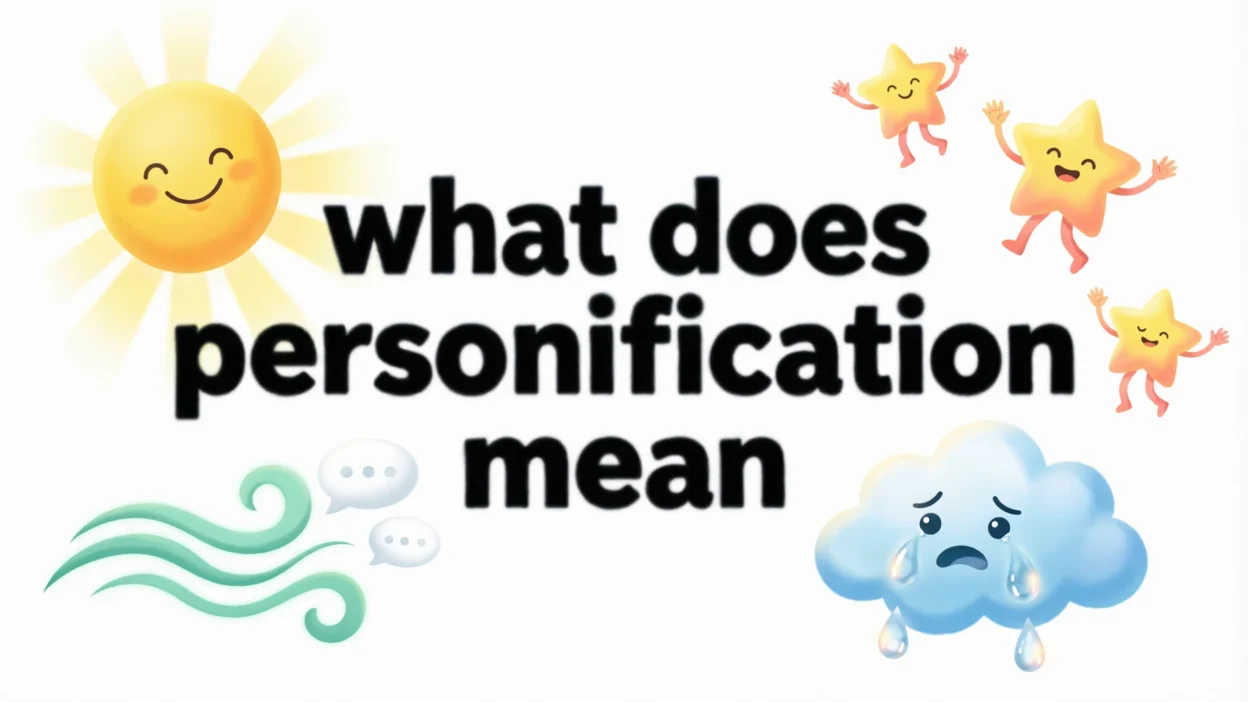
- An object can “talk”
- The wind can “whisper”
- The sun can “smile”
- Time can “fly”
Of course, these things don’t really do those actions. But we describe them as if they do.
Why Do People Use Personification?
People use personification to:
- Make writing more interesting
- Add emotion to a sentence
- Help readers imagine things better
- Make stories feel alive
It’s very common in:
- Poems
- Song lyrics
- Stories
- Speeches
- Even captions on social media
One Short Example
Stars don’t actually dance. But saying they “danced” makes the image more magical.
In simple terms: personification means describing non-human things as if they are human.
Where Is Personification Commonly Used?
Even though personification is a literary device (a writing tool), it shows up in many places.
1. School and Literature (Formal Tone)
In English class, teachers often talk about personification when studying:
- Poetry
- Short stories
- Classic novels
The tone here is usually formal or academic.
Example:
2. Social Media (Casual Tone)
On platforms like:
- TikTok
- X (Twitter)
You might see captions like:
Monday isn’t really attacking anyone. That’s personification. The tone here is casual and informal.
3. Texting and DMs (Informal Chat)
In texting culture, people use personification all the time without even thinking about it.
Examples:
- “my phone hates me.”
- “my bed is calling my name.”
- “time is running away from me.”
These are common in chat shorthand and informal conversations.
4. Advertising (Neutral to Persuasive Tone)
Brands often use personification to connect emotionally.
Example:
Skin can’t really drink. But it sounds powerful.
So while personification is not a slang word or texting abbreviation, it appears often in online chat meaning, social media slang style, and modern communication.
Realistic Conversation Examples (Modern Chat Style)
Here are some natural, lowercase chat-style examples where personification is used:
- “my alarm clock literally hates me 😭”
- “this weather is trying to ruin my plans”
- “my laptop is begging for a break”
- “the traffic was screaming today”
- “my coffee saved my life this morning”
- “this homework is attacking me”
- “my bank account is crying”
- “time is running so fast omg”
- “my phone decided to freeze at the worst time”
None of these are literal. They’re all examples of personification used in casual texting culture.
When to Use and When Not to Use Personification
Personification is powerful. But like any tool, it works best in the right situation.
✅ When to Use It
Do:
- Use it in creative writing
- Use it in poems and stories
- Use it in captions and casual chats
- Use it to express emotion
- Use it to make ideas more vivid
❌ When Not to Use It
Don’t:
- Use it in serious academic research papers
- Use it in legal documents
- Use it in formal business reports
- Overuse it in every sentence
Too much personification can make writing sound dramatic or childish.
Quick Comparison Table
| Context | Example Phrase | Why It Works (or Doesn’t) |
|---|---|---|
| Instagram caption | “the sun kissed my skin” | works well, sounds emotional and creative |
| Text message | “my bed is calling me” | casual and relatable |
| Science report | “the chemical wanted to react” | doesn’t work, not scientifically accurate |
| Legal contract | “the agreement promises fairness” | too informal for legal tone |
This table shows that context matters.
Similar Words and Related Terms
If you’re learning about what personification means, you might also hear these related terms.
1. Metaphor
A metaphor compares two things by saying one is the other.
Example:
It doesn’t use “like” or “as.” It’s direct.
2. Simile
A simile compares two things using “like” or “as.”
Example:
3. Anthropomorphism
This is similar to personification but slightly different.
Anthropomorphism gives full human traits to animals or objects, often in stories.
Example:
- Talking animals in cartoons
- Animals wearing clothes
Personification is usually just a small human action, like “the wind whispered.”
Simple Comparison Table
| Term | Meaning | When to Use |
|---|---|---|
| Personification | Giving human traits to non-humans | Creative writing, casual chat |
| Metaphor | Direct comparison | Strong, poetic effect |
| Simile | Comparison using “like” or “as” | Simple comparisons |
| Anthropomorphism | Making animals/objects fully human-like | Stories, cartoons |
Why Personification Is So Popular in Texting Culture
Even though personification is not a slang term, it fits perfectly into modern communication.
Why?
Because it:
- Adds humor
- Makes messages dramatic (in a fun way)
- Shows feelings quickly
- Makes content more relatable
When someone says:
We know their brain didn’t literally stop. But we instantly understand the feeling.
That’s why personification works so well in:
- Memes
- Online forums
- Gaming chats
- TikTok captions
- Comment sections
It’s emotional. It’s expressive. And it’s easy to understand.
Frequently Asked Questions (FAQ)
1. What does personification mean in simple terms?
Personification means giving human qualities to animals, objects, or ideas.
2. Is personification a slang word?
No. It’s a literary device used in writing. But it’s very common in informal chat and social media.
3. Is personification formal or informal?
It can be both. It’s formal in literature and school writing, but informal in texting and social media.
4. Do kids learn personification in school?
Yes. It’s often taught in elementary or middle school English classes.
5. Is saying “my phone hates me” personification?
Yes. A phone cannot hate. That’s giving it a human emotion.
6. Is personification the same as metaphor?
No. A metaphor compares two things directly. Personification gives human traits to non-human things.
7. Can personification be misunderstood?
Usually no, because context makes it clear. People understand it’s not literal.
Final Thought
So, what does personification mean?
It simply means describing non-human things as if they are human.
It’s not a texting abbreviation. It’s not internet slang. But it shows up everywhere — from poetry and books to memes and casual chats.
When you say:
- “my alarm clock hates me”
- “the wind is whispering”
- “time is running away”
You’re using personification.
It makes language more alive, emotional, and fun. And once you notice it, you’ll see it everywhere — in songs, stories, captions, and even your own messages.
Now the next time someone asks, “what does personification mean?” — you’ll have a clear, simple answer ready.

Bret Lee writes educational and research-based content for Whygenix.com, focused on clarity, accuracy, and explaining why concepts matter through simple, engaging, reader-friendly writing.