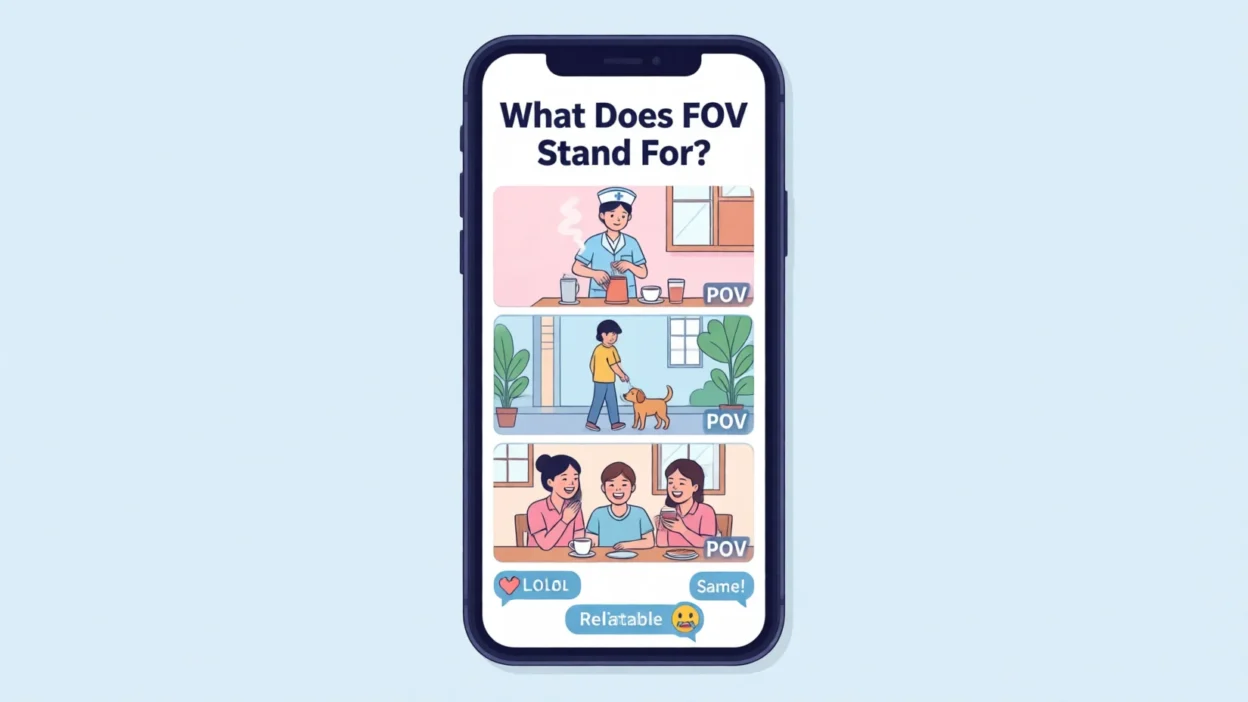
The first time I saw “pov”, it was under a TikTok video. The caption said something like, “pov: you realize it’s sunday night.” Everyone in the comments seemed to get it—except me.
I scrolled, reread it, and wondered if I was missing something obvious. Later, I noticed the same word popping up in Instagram captions, YouTube Shorts, group chats, and even gaming chats. No one explained it. They just… used it.
If you’ve ever paused mid-scroll and thought, “wait, what does pov stand for?”—you’re in the right place. Let’s break it down in a super simple, online-friendly way.
Quick Answer:
POV stands for “Point of View,” and it’s used online to show or describe a situation from a specific perspective.
What Does POV Stand For? Meaning Explained Simply
POV is short for Point of View.
In plain English, it means the way someone sees or experiences a moment. Online, people use POV to pull you into a situation, like you’re the one living it.
Why people use POV in texting and social media
POV makes posts feel more personal and relatable. Instead of just saying what happened, it puts you inside the moment.
It’s especially popular in:
- TikTok videos
- Instagram Reels
- YouTube Shorts
- Casual texting and DMs
Simple example sentence
“pov: you check the time and realize you’re already late.”
Bold summary:
POV means “Point of View,” used online to show a moment from someone’s personal perspective.
Where Is POV Commonly Used Online?
You’ll see POV all over the internet, especially in casual and informal spaces.
Common platforms and places
- TikTok: short videos acting out a situation
- Instagram: captions and reels
- Snapchat: story text
- YouTube Shorts: skit-style content
- Text messages and group chats
- Gaming chats and Discord servers
- Online forums and comments
Tone of the term
The tone is usually casual and informal. It’s not something you’d use in a formal email or school essay, but it fits perfectly in online chat culture.
Realistic POV Conversation Examples (Text Style)
Here are some natural, modern examples written the way people actually type online. All lowercase, just like real chats.
- “pov: you open the fridge for the 5th time hoping food appears”
- “that video was so accurate, major pov moment”
- “pov you said ‘one more episode’”
- “this feels like a pov from my life fr”
- “pov: you hear your alarm and instantly regret everything”
- “why is every pov video so relatable”
- “pov when the teacher says ‘this will be on the test’”
- “send me more pov memes pls”
These examples show how pov works naturally in texting culture and online chats.
When to Use and When Not to Use POV
Using POV the right way makes your message land better. Using it wrong can confuse people.
Do use POV when
- Sharing a relatable moment
- Posting short videos or memes
- Joking about everyday situations
- Writing casual captions or texts
Don’t use POV when
- Writing formal emails or essays
- Talking about serious topics without context
- Using it incorrectly (not actually a perspective)
- Explaining facts or instructions
Quick comparison table
| context | example phrase | why it works / doesn’t |
|---|---|---|
| tiktok caption | “pov: you forgot to save your work” | works, relatable |
| group chat | “this is a total pov moment” | works, casual |
| school essay | “pov: the character feels sad” | doesn’t work, informal |
| news article | “pov of the economy” | doesn’t work, unclear |
Similar Slang Words and Alternatives to POV
Sometimes people use words that feel similar to POV, even if they’re not exact matches.
| term | what it means | when to use it |
|---|---|---|
| perspective | someone’s viewpoint | more neutral or formal |
| mood | relatable feeling | casual social media |
| relatable | easy to connect with | comments or captions |
| scenario | imagined situation | storytelling |
| when you | sets up a moment | memes and jokes |
| that feeling | shared emotion | informal chat |
Each of these fits slightly different vibes, but POV is the go-to for quick, visual storytelling online.
POV in Texting vs POV in Videos
It helps to know that POV works a little differently depending on where it’s used.
In texting and chats
- Often reacts to something
- Used as shorthand for “this feels like me”
- Can stand alone or start a sentence
Example:
“pov this message is too accurate”
In videos and reels
- Sets up a scene
- The viewer becomes the main character
- Often acted out
Example:
“pov: you’re the quiet kid in class”
Both versions still mean point of view, just used slightly differently.
Frequently Asked Questions About POV
Does POV always mean Point of View?
Yes. In online slang, POV always stands for “Point of View.”
Is POV a slang word?
It’s more of a texting abbreviation that became slang through social media use.
Who uses POV the most?
Mostly Gen Z and Millennials, but anyone active on social media uses it now.
Is POV only for TikTok?
No. It started there, but it’s common on Instagram, YouTube, Snapchat, and in texts.
Can POV be misunderstood?
Yes. Sometimes people use it incorrectly, which can confuse the message.
Is POV formal or informal?
It’s informal and casual, best for online chat and social platforms.
Why POV Became So Popular Online
POV fits perfectly with short-form content. It’s:
- Fast to read
- Easy to understand
- Emotion-driven
- Highly relatable
In a world of quick scrolling, POV instantly tells you what the post is about. That’s why it spread so fast across platforms and became part of everyday texting culture.
Final Thought
So, what does POV stand for in today’s online world? It means Point of View, but more importantly, it’s a way to say, “this is what it feels like to be me right now.”
Whether it’s a funny meme, a relatable video, or a casual text, POV helps people connect through shared moments.
Once you understand it, you’ll start noticing POV everywhere—and probably using it yourself without thinking twice.

Bret Lee writes educational and research-based content for Whygenix.com, focused on clarity, accuracy, and explaining why concepts matter through simple, engaging, reader-friendly writing.