The first time many of us hear the word “nucleus” is in a science class, a textbook diagram, or maybe a quick explainer video shared in a group chat before an exam.
Someone says, “just remember, the nucleus is the brain of the cell,” and we nod—kind of understanding, but not fully.
Later, the term pops up again in quizzes, memes about biology students, or online discussions, and suddenly you realize you never actually paused to ask the basic question: what does the nucleus do?
If that sounds familiar, you’re not alone. Let’s break it down in the simplest way possible.
Quick Answer:
The nucleus controls the cell by storing DNA and telling the cell what to do and when to do it.
What Does the Nucleus Do? (Meaning Explained Simply)
The nucleus is a part of a cell found in most living things, like plants, animals, and humans.
Full form
The word nucleus doesn’t stand for initials. It comes from Latin and means “core” or “center.”
Plain-English explanation
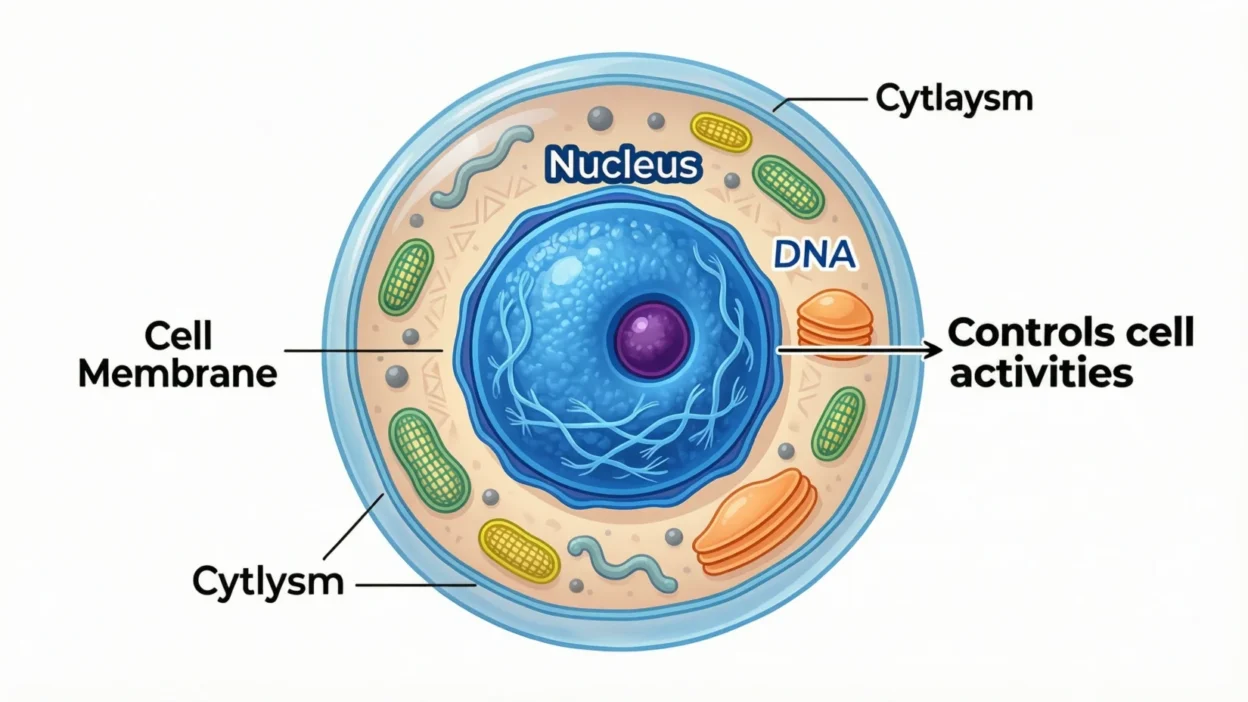
Think of the nucleus as the control center of the cell. It holds the cell’s instructions (DNA) and sends messages that tell the cell how to grow, work, and stay alive.
Inside the nucleus is DNA, which works like a rulebook. This rulebook decides things like:
- what the cell will look like
- what job the cell will do
- when the cell should divide
Without the nucleus, the cell would be confused and stop working properly.
Why people talk about it
People use this term mostly in biology, school lessons, exams, and science content online. It’s a key idea because the nucleus explains how life works at a tiny level.
Example sentence
“The nucleus tells the cell how to make proteins and when to divide.”
Bold summary:
The nucleus is the cell’s control center that stores DNA and manages all cell activities.
Where Is the Term “Nucleus” Commonly Used?
You’ll see and hear the word nucleus in places that talk about science and learning, including:
- school and college biology classes
- textbooks and exam notes
- educational YouTube videos and reels
- online forums and homework help sites
- student group chats before tests
- science blogs and explainer posts
Tone of usage
The tone is usually neutral to formal, but in student chats or social media explanations, it can feel casual and friendly.
It’s not slang or chat shorthand. Instead, it’s a standard science term that’s sometimes explained in simple language for easier understanding.
Realistic Conversation Examples (Modern & Natural)
Here are some realistic, lowercase examples of how people might talk about the nucleus online or in chats:
- “wait, what does the nucleus do again? i keep mixing it up 😭”
- “the nucleus is basically the brain of the cell, that’s how i remember it.”
- “if a cell didn’t have a nucleus, would it still survive?”
- “our bio teacher said the nucleus stores dna.”
- “this diagram makes it so clear what the nucleus does.”
- “nucleus = control center. easy marks.”
- “why does the nucleus matter so much in exams?”
- “finally understood what the nucleus does after watching that reel.”
- “is the nucleus in plant cells too or just animal ones?”
When to Use and When Not to Use the Term
✅ When to use “nucleus”
- when talking about cells and biology
- in schoolwork, exams, or notes
- while explaining how cells function
- in educational posts or discussions
❌ When not to use it
- in casual chats unrelated to science
- as a replacement for words like brain or leader (unless using a clear metaphor)
- in slang or meme talk without context
Quick comparison table
| Context | Example phrase | Why it works / doesn’t work |
|---|---|---|
| biology class | “the nucleus controls the cell” | correct scientific use |
| exam answer | “dna is stored in the nucleus” | clear and accurate |
| random chat | “he’s the nucleus of our friend group” | confusing without explanation |
| science post | “what does the nucleus do?” | fits learning context |
Similar Words or Related Terms You Might See
While nucleus has a specific meaning, these related terms often appear with it:
| Term | Meaning | When it’s used |
|---|---|---|
| dna | genetic instructions of life | explaining traits and heredity |
| cell membrane | outer layer of the cell | discussing protection and boundaries |
| cytoplasm | jelly-like part inside the cell | explaining where reactions happen |
| ribosomes | protein-making parts | talking about protein synthesis |
| control center | simple nickname for nucleus | casual explanations |
| organelle | small parts inside a cell | formal biology language |
These aren’t slang or abbreviations, but they help explain what the nucleus does in a complete way.
FAQs About What the Nucleus Does
1. What does the nucleus do in simple words?
The nucleus tells the cell what to do and keeps its DNA safe.
2. Is the nucleus found in all cells?
No. Most plant and animal cells have a nucleus, but some cells, like bacteria, do not.
3. Why is the nucleus important?
Without the nucleus, the cell can’t control its actions or make the right proteins.
4. Is the nucleus the same as the brain?
No, but it works like a brain for the cell by controlling activities.
5. Do plant and animal cells both have a nucleus?
Yes, both usually have a nucleus, though their cells also have different parts.
6. Is “nucleus” used in texting or slang?
Not really. It’s mainly a science term, though students talk about it casually online.
7. Can a cell live without a nucleus?
Some special cells can survive for a short time, but most need a nucleus to function.
Final Thought
So, what does the nucleus do? In short, it’s the boss of the cell. It stores DNA, gives instructions, and keeps everything running smoothly.
While it’s not slang or chat shorthand, the word nucleus shows up a lot in modern digital learning—through videos, posts, group chats, and online explanations.
Once you understand its role, biology suddenly feels less confusing and more logical. One small part, doing a very big job.

Bret Lee writes educational and research-based content for Whygenix.com, focused on clarity, accuracy, and explaining why concepts matter through simple, engaging, reader-friendly writing.