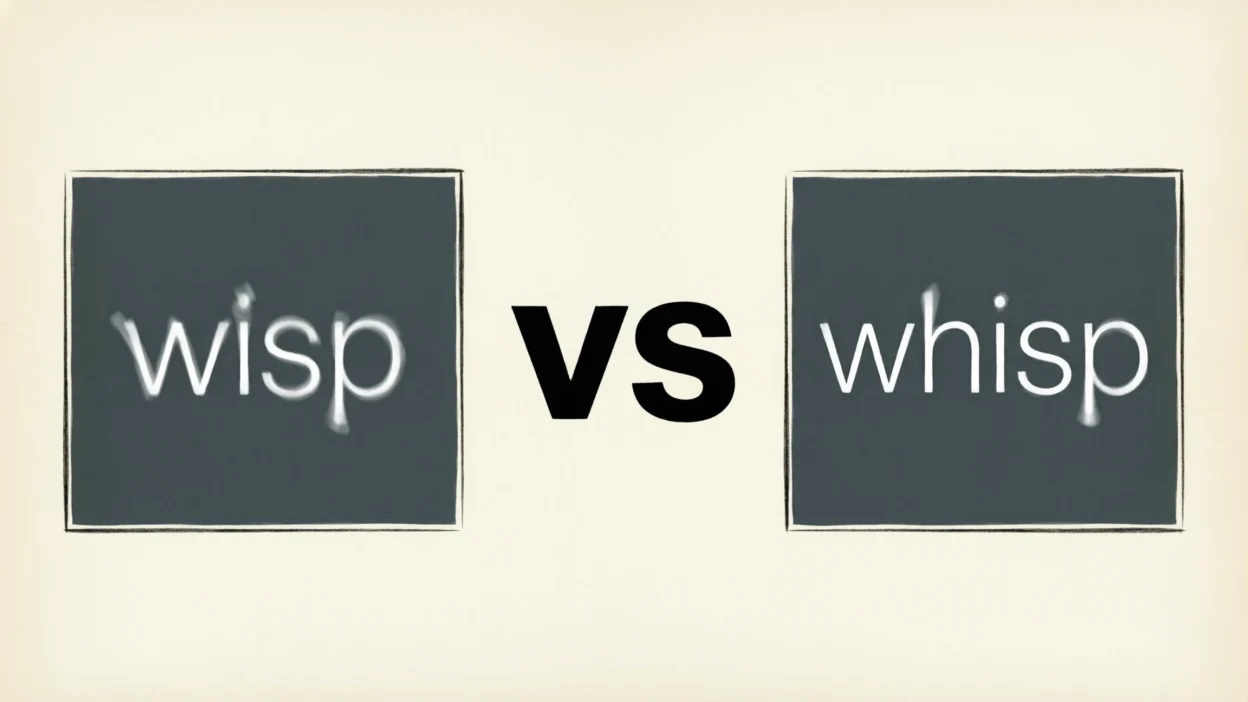
If you’ve come across “wisp” vs “whisp” and aren’t sure which one is correct, you’re not alone. English spelling can be tricky, especially when similar-looking words pop up in writing or autocorrect doesn’t catch mistakes.
Let’s clear this up right away so you can write confidently and avoid common errors in everyday communication.
Quick Answer: Wisp vs Whisp
- ✅ Correct spelling: Wisp
- ❌ Incorrect spelling: Whisp
“Wisp” is a real English word that refers to a small, thin, or delicate amount of something.
“Whisp” is not a correct spelling and should be avoided.
What Does “Wisp” Mean?
The word wisp is a noun that describes something very small, light, or thin—often something that can easily disappear or drift away.
Simple Definition:
A small, delicate strand, puff, or trace of something.
Common Uses:
- A wisp of smoke
- A wisp of hair
- A wisp of cloud
Example Sentences:
- A wisp of smoke rose from the chimney.
- She brushed a wisp of hair from her face.
- The fog appeared as a wisp over the lake.
Why Do People Write “Whisp”?
The confusion between wisp vs whisp usually comes from pronunciation habits and familiarity with “wh-” words in English.
Common Reasons:
- Influence of “wh” words: Words like what, when, and whisper make “whisp” seem plausible.
- Sound confusion: Some accents soften the “w” sound, making it feel like “whisp” could be correct.
- Typing mistakes: Fast typing or guessing spelling can lead to this error.
Wisp vs Whisp: Side-by-Side Comparison
| Feature | Whisp ❌ | Wisp ✅ |
|---|---|---|
| Spelling status | Incorrect | Correct |
| Meaning | None | Small, thin amount |
| Dictionary entry | Not recognized | Recognized word |
| Usage | Should be avoided | Standard English |
| Example | ❌ A whisp of smoke | ✅ A wisp of smoke |
How to Remember the Correct Spelling
A simple trick can help you avoid this mistake forever.
Easy Memory Tip:
Think of “wisp” as something small and simple—so the word is also short and simple (no extra “h”).
Visual Cue:
- wisp ✔
- whisp ✘
If it feels like the word is getting “heavier” with extra letters, it’s probably wrong.
Common Mistakes with “Wisp”
Even when spelled correctly, “wisp” can be misused in sentences.
1. Confusing with “Whisper”
- ❌ I heard a wisp in the room.
- ✅ I heard a whisper in the room.
Tip:
- Wisp = something you see (smoke, hair, cloud)
- Whisper = something you hear
2. Using It for Large Quantities
- ❌ A wisp of thick fog covered the entire city.
- ✅ A thick fog covered the entire city.
“Wisp” should only describe small or delicate amounts.
3. Overusing in Writing
While it’s a beautiful word, using “wisp” too often can sound repetitive in creative writing.
Examples of “Wisp” in Different Contexts
Everyday Conversation:
- There was a wisp of steam from the cup.
Descriptive Writing:
- A wisp of cloud drifted across the sky.
Storytelling:
- A lonely wisp of smoke curled into the cold air.
Nature Descriptions:
- The mountain peaks were hidden behind a wisp of fog.
Synonyms and Related Words
Using alternatives can make your writing richer and more engaging.
Synonyms:
- trace
- hint
- strand
- thread
- curl
Related Phrases:
- faint trace
- thin strand
- light puff
Nuance Differences:
- Trace → very small amount
- Strand → long and thin
- Curl → twisted shape
American vs British English
There’s no difference between American and British English for this word.
- 🇺🇸 American English: wisp
- 🇬🇧 British English: wisp
Both use the same spelling and meaning.
When Should You Use “Wisp”?
Use wisp when describing something that is:
- Light and delicate
- Small in quantity
- Thin or barely visible
Ideal Use Cases:
- Smoke, steam, or fog
- Hair strands
- Clouds or mist
- Subtle traces of something
Avoid Using It When:
- Describing large or heavy objects
- Referring to sounds (use “whisper” instead)
Real-Life Examples to Build Confidence
- ❌ A whisp of smoke filled the room.
- ✅ A wisp of smoke filled the room.
- ❌ She moved a whisp of hair aside.
- ✅ She moved a wisp of hair aside.
- ❌ There was a whisp of fog.
- ✅ There was a wisp of fog.
FAQs About Wisp vs Whisp
1. Is “whisp” ever correct?
No, “whisp” is not a valid English word. Always use “wisp.”
2. What does “wisp” mean exactly?
It refers to a small, thin, or delicate amount of something like smoke, hair, or cloud.
3. Is “wisp” a noun or verb?
It is primarily used as a noun.
4. What’s the difference between “wisp” and “whisper”?
“Wisp” refers to something visual and thin, while “whisper” refers to a soft sound.
5. Can “wisp” be used in formal writing?
Yes, especially in descriptive or literary contexts.
6. Are there regional spelling differences?
No, both American and British English use “wisp.”
7. What are some formal alternatives to “wisp”?
Words like trace, fragment, or strand can be used depending on context.
8. Why is “wisp” commonly misspelled?
Because of the influence of “wh-” words and pronunciation confusion.
Final Summary
The difference between wisp vs whisp is simple but important. “Wisp” is the correct spelling and refers to something small, light, and delicate, while “whisp” is just a common spelling mistake that should be avoided.
By remembering that “wisp” is short and simple—just like the thing it describes—you can easily avoid this error. With a little practice, using the correct spelling will become second nature in both casual and professional writing.
Actionable Takeaway
Before you hit send or publish, do a quick check:
👉 Is it short and clean—wisp?
Stick with the correct spelling, and your writing will instantly look more polished and professional.

Joy Root is a content writer at Whygenix.com, creating clear, engaging articles that explain complex ideas simply, helping readers understand why topics matter in everyday life and personal growth.