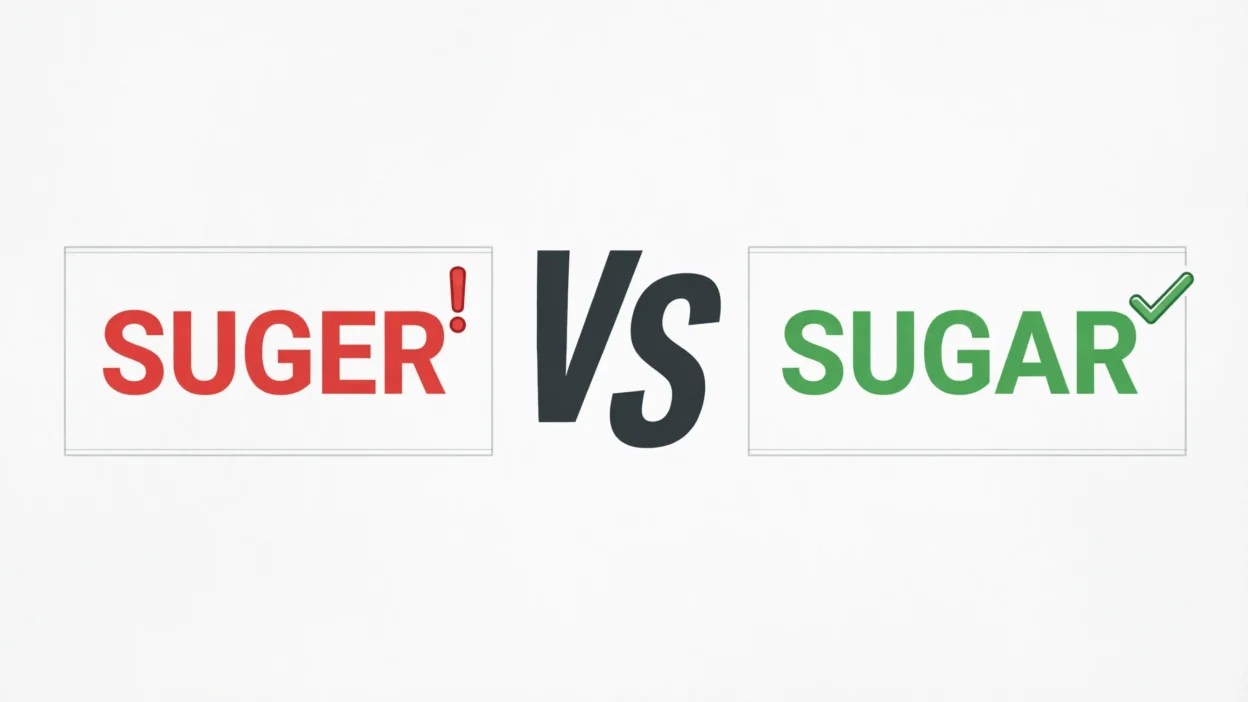
Have you ever typed “suger” and wondered whether it is actually a correct spelling? You’re not alone. Many English learners and even native speakers occasionally confuse suger vs sugar, especially because the pronunciation can make them sound similar.
Understanding the difference is important for clear communication, correct writing, and professional credibility. In this guide, we’ll explain exactly which spelling is correct, why the confusion happens, common mistakes to avoid, and how to remember the right word every time.
Quick Answer
Sugar is the correct spelling in English.
Suger is a misspelling and is not recognized as a standard English word in dictionaries.
✅ Correct: Please add some sugar to my coffee.
❌ Incorrect: Please add some suger to my coffee.
If you’re comparing suger vs sugar, always choose sugar in formal and informal writing.
What Does Sugar Mean?
The word sugar refers to a sweet substance commonly used in food and drinks. It can come from sugarcane, sugar beets, fruits, and other natural sources.
Definition of Sugar
Sugar (noun): A sweet crystalline substance used to sweeten foods and beverages.
Examples of Sugar in Sentences
- I put two teaspoons of sugar in my tea.
- Excess sugar consumption may affect health.
- The recipe requires one cup of sugar.
- Brown sugar gives cookies a richer flavor.
- Children often enjoy sugary snacks.
The word can also be used figuratively:
- She always adds a little sugar to her conversations.
- Don’t sugar-coat the truth.
Is Suger a Real Word?
No, suger is not considered a standard English word.
Most dictionaries classify suger as a spelling mistake of sugar. If you use “suger” in academic, professional, or everyday writing, spell-check tools will typically flag it as an error.
Examples of Incorrect Usage
❌ I need more suger for the cake.
❌ The tea tastes better with suger.
Correct Versions
✅ I need more sugar for the cake.
✅ The tea tastes better with sugar.
Suger vs Sugar: Side-by-Side Comparison
| Feature | Suger | Sugar |
|---|---|---|
| Correct English Word | ❌ No | ✅ Yes |
| Dictionary Recognition | ❌ Not Standard | ✅ Standard |
| Common Usage | Typographical Error | Correct Usage |
| Suitable for Formal Writing | ❌ No | ✅ Yes |
| Accepted Worldwide | ❌ No | ✅ Yes |
The comparison clearly shows that sugar is the only correct spelling.
Why Do People Confuse Suger and Sugar?
Several factors contribute to the confusion between suger vs sugar.
1. Pronunciation Similarities
In some accents, the pronunciation may sound closer to “suger” than “sugar,” leading people to spell the word phonetically.
2. Typing Errors
The letters “a” and “e” are commonly confused while typing quickly.
3. English Spelling Patterns
English contains many irregular spellings. Learners often assume words should be spelled exactly as they sound.
4. Influence of Other Languages
People whose native languages have more phonetic spelling systems may naturally write “suger” because it seems logical based on pronunciation.
Correct Usage of Sugar in Everyday English
Here are some common situations where the word sugar appears.
Food and Cooking
- Add sugar to the mixture.
- Reduce sugar in desserts.
- Use powdered sugar for decoration.
Drinks
- Coffee with sugar.
- Sweet tea contains sugar.
- Sugar-free drinks are becoming popular.
Health Discussions
- Blood sugar levels should be monitored.
- Excess sugar intake can be unhealthy.
- Many nutrition experts recommend limiting sugar consumption.
Idiomatic Expressions
English also uses “sugar” in various expressions:
- Sugar-coat the truth
- Sweet as sugar
- Sugar rush
- Sugar daddy
- Sugar-free lifestyle
Common Mistakes Related to Sugar
People often make the following mistakes.
Mistake 1: Writing Suger
❌ The suger jar is empty.
✅ The sugar jar is empty.
Mistake 2: Assuming Both Spellings Are Acceptable
Some writers think “suger” is a regional variation. It is not.
✅ Only “sugar” is correct.
Mistake 3: Ignoring Spell Check Warnings
Spell-check programs usually flag “suger” for a reason.
Always verify spelling before publishing content.
Memory Trick to Remember the Correct Spelling
A simple trick can help:
Think of the phrase:
“Sugar Adds Sweetness.”
Notice that both Sugar and Adds contain the letter A.
This can remind you that sugar uses A, not E.
Another easy reminder:
The word “sugar” starts with “sug” and ends with “ar.”
Repeating this pattern a few times helps build memory.
American vs British English
Unlike some English words that have different spellings in American and British English, sugar remains exactly the same in both versions.
| American English | British English |
| Sugar | Sugar |
There is no accepted British spelling “suger.”
Whether you’re writing in the United States, the United Kingdom, Canada, Australia, or elsewhere, sugar is always the correct spelling.
Examples of Sugar in Real-Life Sentences
Here are more examples to strengthen understanding:
- The baker measured the sugar carefully.
- Too much sugar can make the drink overly sweet.
- My grandmother keeps sugar in a glass container.
- Brown sugar works well in barbecue sauces.
- The nutrition label shows ten grams of sugar.
- He prefers coffee without sugar.
- Sugar crystals sparkled under the light.
- The recipe balances sugar and spice perfectly.
Related Words and LSI Keywords
When discussing suger vs sugar, you may also encounter related terms such as:
- Sweetener
- Granulated sugar
- Brown sugar
- Powdered sugar
- Cane sugar
- Sugar substitute
- Sugar crystals
- Sweet foods
- Sugar consumption
- Blood sugar
- Sugar-free
- Refined sugar
- Natural sweeteners
- Sugar content
Using these related keywords helps readers better understand the topic and improves SEO relevance.
FAQs
1. Is suger a correct spelling?
No. Suger is considered a misspelling. The correct spelling is sugar.
2. Why do people write suger instead of sugar?
People often write “suger” because of pronunciation, typing mistakes, or confusion about English spelling patterns.
3. Is suger accepted in British English?
No. British English uses sugar, just like American English.
4. Can I use suger in informal writing?
No. Even in informal writing, “suger” is generally viewed as a spelling error.
5. What does sugar mean?
Sugar is a sweet substance used in foods, drinks, and cooking.
6. Do dictionaries include the word suger?
Most dictionaries list it only as a misspelling or redirect readers to the correct word, sugar.
7. Is sugar a noun or an adjective?
Primarily, sugar is a noun, but it can sometimes function as a modifier in compound expressions like “sugar bowl” or “sugar cookies.”
8. How can I remember the correct spelling?
Use the memory trick: Sugar Adds Sweetness. The letter A helps you remember the correct spelling.
Summary
When comparing suger vs sugar, the answer is simple: sugar is the only correct spelling. The word refers to the sweet substance used in foods and beverages, while suger is merely a common spelling mistake. Understanding this distinction helps improve writing accuracy and prevents confusion in academic, professional, and everyday communication.
The next time you’re unsure, remember that sugar is the accepted spelling in both American and British English. Proofread your work, pay attention to spell-check suggestions, and use memory tricks to reinforce the correct form. Doing so will help you write with greater confidence and clarity.
Actionable Takeaway
Whenever you see suger, replace it with sugar. Save this simple rule:
Sugar = Correct ✅
Suger = Incorrect ❌
A quick spelling check can instantly improve the professionalism and accuracy of your writing.

Sara Taylor is a content writer at Whygenix.com, creating clear, engaging articles that simplify complex ideas, helping readers understand the why behind topics in education, lifestyle, and personal development.