Have you ever wondered whether panic or panick is the correct spelling? You’re not alone. Many English learners and native speakers alike get confused because some words add a k when taking certain endings, while others do not. As a result, it’s common to see panick appear in writing, even though it isn’t the standard spelling.
Understanding the difference between panic vs panick can help you avoid a common spelling mistake and improve your writing. Whether you’re writing an email, essay, blog post, business report, or social media caption, using the correct form will make your writing look more polished and professional.
Quick Answer
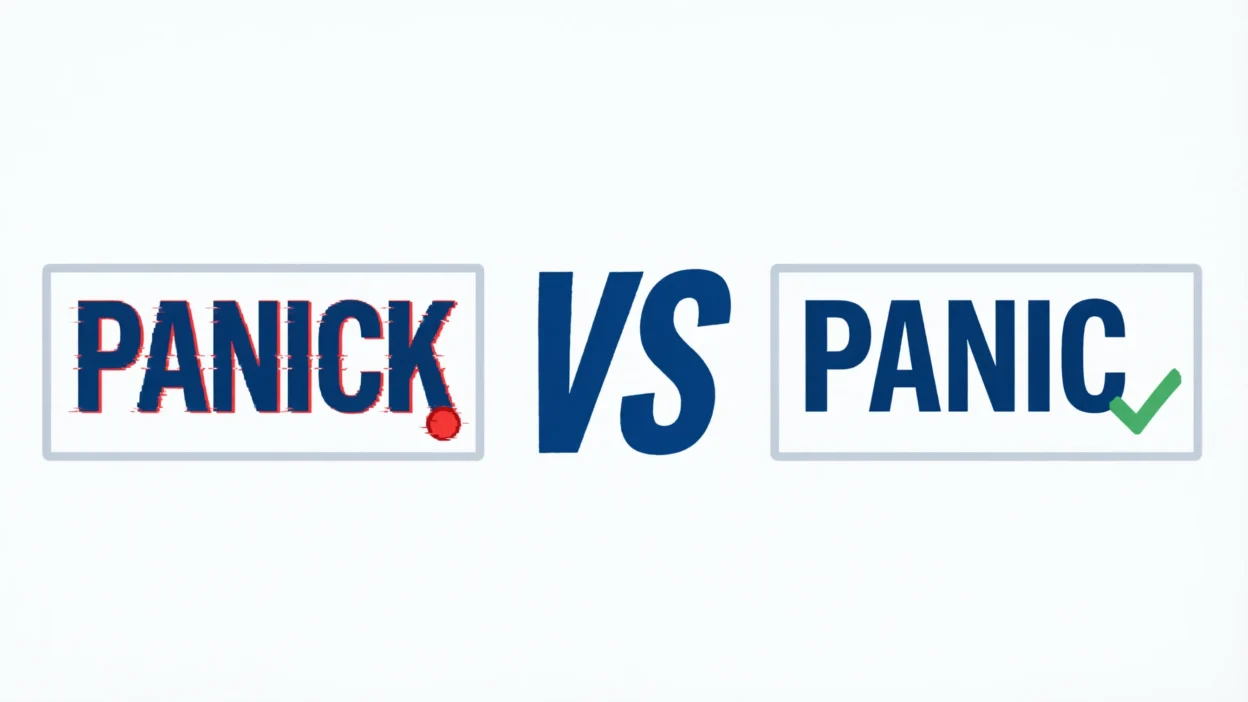
✅ Panic is the correct spelling.
❌ Panick is incorrect and considered a misspelling.
Examples
- Don’t panic during an emergency. ✅
- The sudden noise caused widespread panic. ✅
- Don’t panick during an emergency. ❌
Whenever you’re referring to sudden fear, anxiety, or alarm, use panic.
Panic vs Panick: Comparison Table
| Word | Correct? | Meaning | Example |
|---|---|---|---|
| Panic | ✅ Yes | Sudden fear, anxiety, or alarm | The crowd began to panic. |
| Panick | ❌ No | Misspelling | The crowd began to panick. |
What Does Panic Mean?
Panic can function as both a noun and a verb.
As a Noun
It refers to a sudden feeling of overwhelming fear or anxiety.
Examples:
- The announcement caused widespread panic.
- There was no reason for panic.
- Financial markets experienced panic selling.
As a Verb
It means to become frightened or anxious suddenly.
Examples:
- Don’t panic if things go wrong.
- She started to panic before the exam.
- People often panic during emergencies.
In both cases, panic is the correct spelling.
Is Panick a Real Word?
No.
Panick is not recognized as a standard English word. It is considered a misspelling of panic.
Most dictionaries, style guides, and grammar tools identify panick as incorrect and recommend panic instead.
Why Do People Write Panick?
The confusion often comes from English spelling patterns.
Many words ending in c add a k before certain suffixes.
For example:
| Base Word | New Form |
|---|---|
| Panic | Panicked |
| Panic | Panicking |
| Picnic | Picnicked |
| Mimic | Mimicked |
Because words like panicked and panicking contain a k, some writers incorrectly assume the base word should be spelled panick.
However, the root word remains:
✅ Panic
❌ Panick
Understanding the Spelling Rule
The base word is:
Panic
When adding endings such as -ed or -ing, English spelling rules insert a k to preserve the hard c sound.
Examples
| Correct Form | Usage |
|---|---|
| Panic | Base word |
| Panics | Present tense |
| Panicked | Past tense |
| Panicking | Present participle |
Notice that the k only appears when certain suffixes are added.
Correct Examples
- I panic easily. ✅
- I panicked yesterday. ✅
- She is panicking now. ✅
Incorrect Examples
- I panick easily. ❌
- She is panicing now. ❌
Common Uses of Panic
1. Emotional Reactions
Examples:
- Students sometimes panic before exams.
- New drivers may panic in heavy traffic.
- People often panic under pressure.
2. Emergency Situations
Examples:
- The fire alarm caused panic.
- Officials urged residents not to panic.
- Quick action prevented widespread panic.
3. Financial Contexts
Examples:
- Investors began to panic.
- Market panic led to heavy selling.
- Experts advised people not to panic.
4. Everyday Situations
Examples:
- I always panic when I lose my keys.
- Don’t panic if you’re running late.
- She tried not to panic during the interview.
Example Sentences Using Panic
Here are some practical examples:
- Don’t panic when challenges arise.
- The news created unnecessary panic.
- Parents often panic when children get lost.
- He started to panic after missing the deadline.
- The situation caused widespread panic.
- We should stay calm instead of panicking.
Notice that the root word remains panic.
Common Mistakes to Avoid
Mistake #1: Writing Panick
❌ Don’t panick.
✅ Don’t panic.
Mistake #2: Forgetting the K in Panicked
❌ I paniced yesterday.
✅ I panicked yesterday.
Mistake #3: Forgetting the K in Panicking
❌ She is panicing.
✅ She is panicking.
Mistake #4: Assuming the Base Word Uses K
Because forms like panicked and panicking contain a k, many writers mistakenly add one to the base word.
Remember: the root word is always panic.
Memory Trick to Remember Panic
Here’s an easy trick:
Panic Ends with C
Think:
“Keep calm, don’t panic.”
The phrase is commonly written with panic, not panick.
Another Helpful Reminder
Remember:
- Panic
- Panicked
- Panicking
The k appears only when adding endings.
This simple pattern makes the spelling easy to remember.
Related Words
Several words share a similar spelling pattern:
| Base Word | Past Tense |
|---|---|
| Panic | Panicked |
| Picnic | Picnicked |
| Mimic | Mimicked |
| Traffic | Trafficked |
These words often add k only before certain suffixes.
Synonyms of Panic
Depending on context, alternatives include:
- Fear
- Alarm
- Anxiety
- Distress
- Terror
- Worry
- Hysteria
- Apprehension
- Unease
- Nervousness
Examples
- Panic spread quickly.
- Fear spread quickly.
- She began to panic.
- She began to worry.
Using synonyms can improve variety in your writing.
Why Correct Spelling Matters
Using the correct spelling helps:
- Improve readability
- Increase credibility
- Avoid confusion
- Strengthen professional communication
- Enhance academic writing
Even a small spelling mistake like panick can distract readers from your message.
American vs British English
There is no difference between American and British English regarding this word.
Both varieties use:
✅ Panic
Both consider:
❌ Panick
to be incorrect.
Whether you’re writing for a US, UK, Canadian, Australian, or international audience, panic is always the correct spelling.
FAQs About Panic vs Panick
Is panick a real word?
No. Panick is a misspelling of panic.
What is the correct spelling?
Panic is the correct spelling.
Why does panicked have a k?
The k is added before -ed to preserve the hard c sound.
What does panic mean?
It means sudden fear, anxiety, alarm, or distress.
Is panic a noun or a verb?
It can be both a noun and a verb.
Is panicing correct?
No. The correct spelling is panicking.
Do British and American English spell it differently?
No. Both use panic.
How can I remember the correct spelling?
Remember: Panic is the base word. The k appears only in panicked and panicking.
Final Summary
When comparing panic vs panick, the correct spelling is panic. It can be used as both a noun and a verb to describe sudden fear, anxiety, or alarm. The spelling panick is not a standard English word and should be avoided.
The confusion usually occurs because related forms such as panicked and panicking include a k. However, the root word itself never uses the extra letter. Whether you’re writing professionally, academically, or casually, always choose panic.
Actionable Takeaway
Whenever you write this word, remember:
Panic is the root word.
The k only appears in:
- Panicked
- Panicking
So always write:
✅ Panic
❌ Panick
This simple rule will help you avoid a common spelling mistake and improve your writing accuracy.

Bret Lee writes educational and research-based content for Whygenix.com, focused on clarity, accuracy, and explaining why concepts matter through simple, engaging, reader-friendly writing.