Language can be tricky, especially when two phrases sound almost identical. One common confusion involves past away vs passed away. If you’ve seen both versions online or in everyday writing, you may wonder which one is correct and whether they mean the same thing.
The topic can feel sensitive because the phrase is often used when referring to someone’s death. Using the correct expression shows respect, clarity, and good communication. In this guide, we’ll explain the difference between past away and passed away, provide examples, discuss common mistakes, and help you remember the correct usage with confidence.
Quick Answer
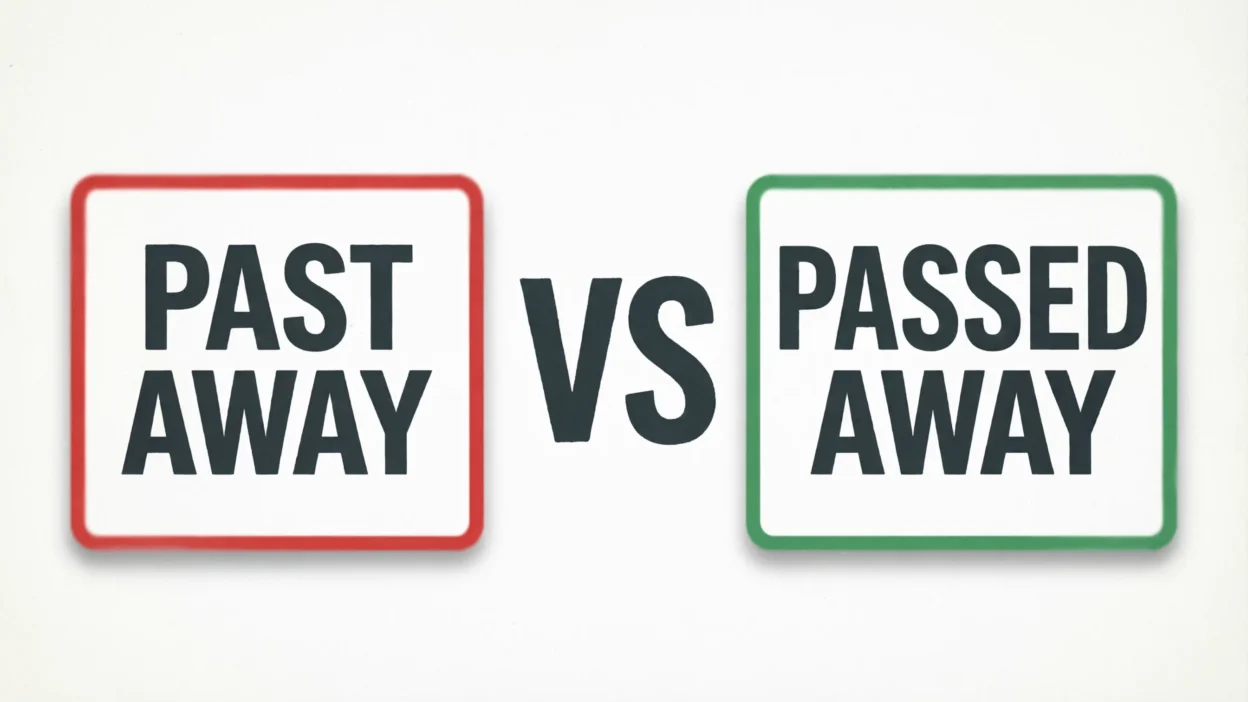
Passed away is the correct phrase when referring to someone’s death.
Past away is incorrect in standard English and should not be used in this context.
- ✅ Passed away = a polite and respectful way to say someone died.
- ❌ Past away = grammatically incorrect phrase.
Example:
- Correct: My grandfather passed away peacefully last year.
- Incorrect: My grandfather past away peacefully last year.
What Does “Passed Away” Mean?
Passed away is a common euphemism for death. A euphemism is a softer or gentler expression used instead of a more direct term.
Many people prefer saying “passed away” because it sounds more compassionate and respectful than simply saying “died.”
Definition of Passed Away
Passed away (verb phrase):
To die or cease living.
Examples of Passed Away
- Her grandmother passed away at the age of 92.
- We were saddened to hear that he passed away.
- The beloved author passed away after a long illness.
- Their family dog passed away peacefully.
- She passed away surrounded by loved ones.
Synonyms for Passed Away
- Died
- Departed
- Left us
- Lost their life
- Perished
- Went to rest
- Entered eternal rest
The phrase is commonly used in obituaries, memorials, condolences, and formal announcements.
What Does “Past Away” Mean?
In standard English, past away does not have a recognized meaning when referring to death.
The confusion occurs because past and passed sound very similar in speech.
Why Is It Incorrect?
The phrase requires the verb passed, which is the past tense of pass.
Since the expression describes an action, a verb is needed.
Past is usually a noun, adjective, adverb, or preposition—not a verb.
Therefore:
- ❌ Past away
- ✅ Passed away
Past Away vs Passed Away: Comparison Table
| Feature | Past Away | Passed Away |
|---|---|---|
| Correct English Usage | No | Yes |
| Refers to Death | No | Yes |
| Grammatically Correct | No | Yes |
| Used in Obituaries | No | Yes |
| Accepted in Formal Writing | No | Yes |
| Dictionary Recognition as Phrase | No | Yes |
| Recommended Usage | Avoid | Use |
Understanding the Difference Between Past and Passed
To fully understand the confusion, let’s examine the individual words.
Meaning of Passed
Passed is the past tense of the verb pass.
Examples:
- She passed the exam.
- The train passed the station.
- Time passed quickly.
In the phrase passed away, “passed” functions as a verb.
Meaning of Past
Past usually refers to time gone by or movement beyond a point.
Examples:
- Let’s leave the past behind.
- We walked past the store.
- The event is now in the past.
Because past is not functioning as a verb here, it cannot correctly replace passed in the phrase.
Why Do People Write “Past Away”?
There are several reasons why this mistake is common.
1. Similar Pronunciation
In many accents, past and passed sound nearly identical.
This makes it easy to choose the wrong spelling when writing.
2. Autocorrect and Typing Errors
Sometimes writers accidentally type “past” and fail to notice the error.
3. Lack of Grammar Awareness
Many people know the phrase verbally but haven’t considered its grammatical structure.
4. Informal Online Usage
Social media posts and comments occasionally contain incorrect spellings, leading others to assume they are acceptable.
Examples of Correct and Incorrect Usage
Incorrect Examples
❌ My uncle past away last winter.
❌ We heard that she past away peacefully.
❌ The actor past away yesterday.
Correct Examples
✅ My uncle passed away last winter.
✅ We heard that she passed away peacefully.
✅ The actor passed away yesterday.
Common Mistakes to Avoid
When using passed away, watch out for these frequent errors.
Mistake 1: Writing Past Instead of Passed
This is the most common mistake.
❌ She past away.
✅ She passed away.
Mistake 2: Using the Phrase in the Wrong Tense
Ensure the tense matches your sentence.
- He has passed away.
- He passed away.
- She had passed away before the ceremony.
Mistake 3: Confusing Similar Words
Remember:
- Passed = action (verb)
- Past = time or position
Mistake 4: Forgetting Context
Use “passed away” only when referring to death.
For other situations, use “passed” differently.
Example:
- She passed the test.
- The car passed us on the highway.
Easy Trick to Remember the Correct Phrase
A simple memory tip:
Passed Away = Pass + Ed
The ending -ed reminds you that it’s a verb describing an action.
Think:
Someone passed away because they “passed” from life.
Meanwhile:
Past relates to time.
Example:
- The past is behind us.
This distinction makes the correct phrase easier to remember.
Is There a Difference in American and British English?
No.
Both American English and British English use passed away as the standard expression.
American English
- My neighbor passed away last month.
British English
- My neighbour passed away last month.
The only difference is the spelling of unrelated words like “neighbor” and “neighbour.” The phrase passed away remains the same in both dialects.
When Should You Use “Passed Away”?
You can use passed away in situations where a respectful or gentle tone is appropriate.
Common Situations
- Obituaries
- Sympathy messages
- Funeral announcements
- Memorial tributes
- Family discussions
- News reports
Examples
- We are saddened to announce that our founder passed away.
- Her father passed away peacefully at home.
- The community mourns a leader who passed away yesterday.
Related Words and Phrases
Here are some LSI keywords and related terms often associated with passed away:
- Death
- Died
- Deceased
- Memorial
- Obituary
- Condolences
- Bereavement
- Mourning
- Funeral
- Tribute
- Loss
- Remembrance
- Sympathy
- Eternal rest
These related terms help provide context and improve understanding of the phrase.
Frequently Asked Questions (FAQs)
1. Is “past away” ever correct?
No. “Past away” is not considered correct in standard English.
2. Which is correct: past away or passed away?
Passed away is the correct phrase.
3. Why do people confuse past and passed?
Because the two words sound very similar when spoken.
4. Is passed away more polite than died?
Yes. Many people consider it a softer and more respectful expression.
5. Can I use passed away in formal writing?
Absolutely. It is commonly used in formal announcements, obituaries, and sympathy messages.
6. Is passed away used in British English?
Yes. It is widely used in both British and American English.
7. What part of speech is passed in passed away?
It is a verb—the past tense of “pass.”
8. What is another way to say passed away?
Alternatives include died, departed, entered eternal rest, or left us, depending on context.
Summary
The comparison between past away vs passed away is actually quite simple. Passed away is the correct phrase and is widely used as a respectful way to refer to someone’s death. It appears in formal writing, obituaries, memorials, and everyday conversations when people want to express sympathy and compassion.
On the other hand, past away is a common spelling mistake caused by the similarity in pronunciation between “past” and “passed.” Remember that the phrase requires the verb passed, making passed away the only correct choice in standard English.
Actionable Takeaway
Whenever you’re writing about someone’s death, pause for a moment and check the spelling.
Remember this rule:
Passed away = Correct
Past away = Incorrect
Using the correct phrase demonstrates respect, accuracy, and strong writing skills, especially in sensitive situations where words matter most.
Meta Description:
Confused about past away vs passed away? Learn the correct phrase, meanings, examples, grammar rules, and common mistakes.

Sara Taylor is a content writer at Whygenix.com, creating clear, engaging articles that simplify complex ideas, helping readers understand the why behind topics in education, lifestyle, and personal development.