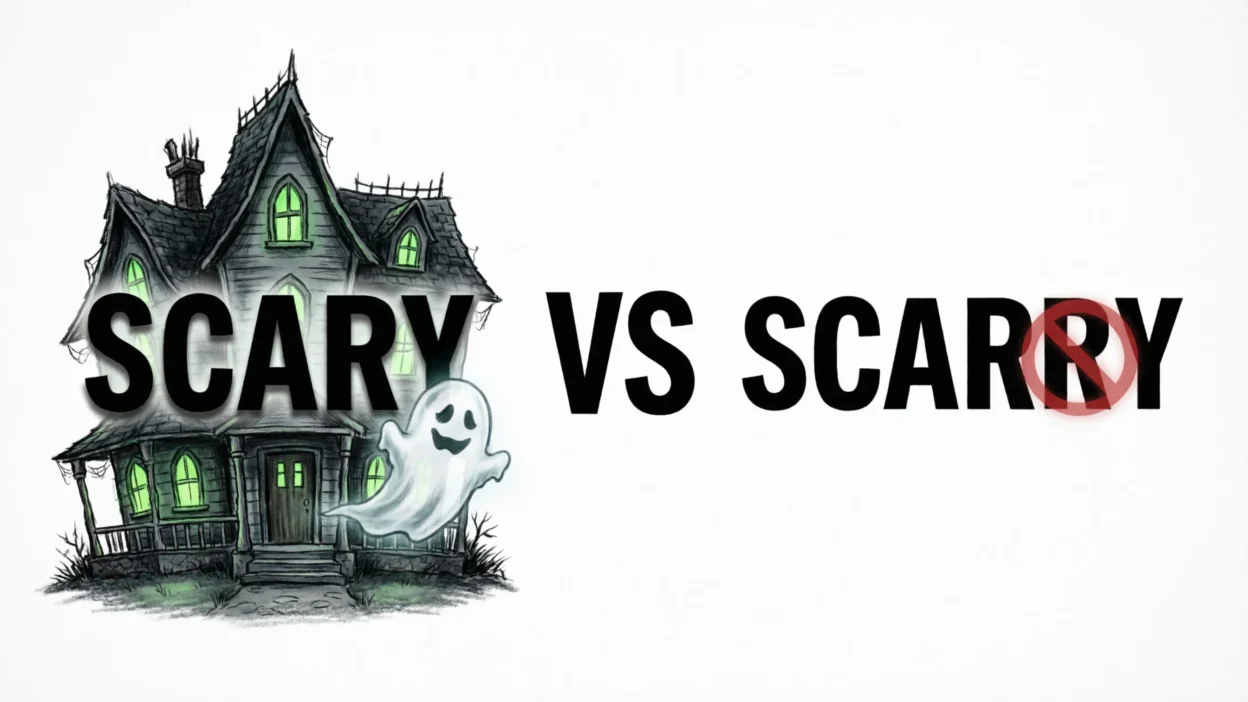
Have you ever typed “scarry” and wondered whether it was the correct spelling? You’re not alone. Many English learners and native speakers occasionally get confused between scary vs scarry because the words look similar and sound nearly identical when spoken quickly.
The good news is that the answer is simple. One spelling is correct and widely accepted in English, while the other is considered a spelling mistake. In this guide, you’ll learn the difference between scary vs scarry, see examples, discover common mistakes, and learn easy tricks to remember the correct spelling every time.
Quick Answer
✅ Scary is the correct spelling.
❌ Scarry is incorrect and is considered a misspelling in standard English.
Correct Example:
- The movie was very scary.
- That haunted house looks scary.
Incorrect Example:
- The movie was very scarry.
- That haunted house looks scarry.
If you are writing in formal, academic, professional, American, or British English, always use scary.
Scary vs Scarry Comparison Table
| Word | Correct? | Meaning | Usage |
|---|---|---|---|
| Scary | ✅ Yes | Causing fear or fright | Standard English |
| Scarry | ❌ No | No accepted meaning | Misspelling of scary |
The comparison is straightforward: scary is the only correct spelling.
What Does Scary Mean?
The word scary is an adjective that describes something that causes fear, anxiety, nervousness, or alarm.
It comes from the noun scare, which means to frighten someone.
Definition of Scary
Scary: Something that makes people feel afraid or frightened.
Examples of Scary
- The horror movie was extremely scary.
- Walking alone in the dark can be scary.
- The thunderstorm sounded scary.
- That ghost story was surprisingly scary.
- Heights are scary for some people.
In everyday English, scary is commonly used to describe people, situations, places, stories, movies, or experiences that create fear.
Why Do People Write “Scarry”?
The misspelling scarry usually happens because English spelling rules can sometimes be confusing.
Many writers assume that because words like:
- carry
- marry
- berry
- hurry
contain double consonants, scary should also contain two “r” letters.
However, English spelling does not work that way in this case.
The correct spelling remains:
✅ scary
Not:
❌ scarry
The Origin of the Word Scary
The adjective scary comes from the verb scare.
When “-y” is added to “scare,” the final “e” is dropped.
Formation
- Scare + y = Scary
Similar examples include:
- Taste → Tasty
- Noise → Noisy
- Shine → Shiny
Notice that no extra “r” is added.
This is why scary is correct and scarry is not.
Examples of Scary in Sentences
Here are some real-world examples showing how scary is correctly used.
Everyday Situations
- Flying during turbulence can feel scary.
- The abandoned house looked scary at night.
- The dog sounded scary, but it was friendly.
Entertainment
- That was the scary part of the movie.
- She loves reading scary novels.
- The Halloween attraction was incredibly scary.
Personal Experiences
- Starting a new job can be scary.
- Speaking in public feels scary for many people.
- Moving to a new country can be both exciting and scary.
Common Mistakes with Scary vs Scarry
Understanding these mistakes can help you avoid them.
Mistake 1: Adding an Extra “R”
❌ The haunted house was scarry.
✅ The haunted house was scary.
This is the most common error.
Mistake 2: Assuming Spell Check Will Catch It
Sometimes informal platforms or autocorrect settings may not immediately flag the mistake.
Always double-check your spelling.
Mistake 3: Copying Incorrect Social Media Usage
Many people write scarry online, especially in comments and casual messages.
Popularity does not make it correct.
Mistake 4: Confusing Pronunciation with Spelling
Because both spellings would be pronounced similarly, writers sometimes assume both are acceptable.
Only scary is recognized in standard dictionaries.
Scary in Different Contexts
Horror Movies
- A scary monster
- A scary ending
- A scary scene
Halloween
- Scary costumes
- Scary decorations
- Scary haunted houses
Real-Life Situations
- A scary accident
- A scary experience
- A scary moment
Emotional Experiences
The word doesn’t always describe literal fear.
For example:
- Making a major life decision can be scary.
- Asking for help can feel scary.
- Starting a business may seem scary at first.
Synonyms of Scary
Using synonyms can improve your writing and help avoid repetition.
Common Synonyms
- Frightening
- Terrifying
- Alarming
- Chilling
- Horrifying
- Creepy
- Spooky
- Fearsome
- Intimidating
- Startling
Example
Instead of:
- The movie was scary.
You could write:
- The movie was terrifying.
- The movie was creepy.
- The movie was chilling.
Related LSI Keywords
To better understand and use scary, here are some related terms often associated with the topic:
- scary meaning
- scary definition
- scary spelling
- frightening experience
- scary movie
- horror story
- spooky atmosphere
- creepy situation
- terrifying event
- fear-inducing
- scary or scarry
- correct spelling of scary
These related phrases frequently appear in discussions about spelling and vocabulary.
Scary vs Scarry in American and British English
Unlike some English words that differ between American and British spelling, there is no variation here.
American English
✅ Scary
❌ Scarry
British English
✅ Scary
❌ Scarry
Both versions of English use exactly the same spelling.
So regardless of where you live, scary is always the correct choice.
Easy Memory Trick
Need a simple way to remember?
Think of the root word:
Scare → Scary
Since scare contains only one “r,” scary also uses only one “r.”
Quick Formula
Scare + Y = Scary
Not:
Scare + R + Y = Scarry
Whenever you’re unsure, go back to the root word scare.
Why Correct Spelling Matters
Correct spelling improves:
- Professional writing
- School assignments
- Blog posts
- Social media credibility
- Search engine optimization
- Reader trust
Using the correct spelling shows attention to detail and strong communication skills.
Even small spelling mistakes can affect how readers perceive your writing.
Frequently Asked Questions
1. Is scary or scarry correct?
Scary is correct. Scarry is a misspelling.
2. Is scarry a real English word?
No. Standard English dictionaries do not recognize scarry as a correct spelling.
3. Why do people spell scary as scarry?
Many people mistakenly assume the word needs a double “r” because of similar-looking words such as carry and marry.
4. Is scarry accepted in British English?
No. British English uses scary, just like American English.
5. How do you spell scary correctly?
The correct spelling is:
S-C-A-R-Y
6. What part of speech is scary?
Scary is an adjective because it describes something that causes fear.
7. What is the noun form of scary?
The related noun is scare.
Example:
- The loud noise gave me a scare.
8. What are some synonyms for scary?
Common synonyms include frightening, terrifying, creepy, spooky, chilling, and horrifying.
Conclusion
When comparing scary vs scarry, the answer is clear: scary is the only correct spelling. It is an adjective used to describe something that causes fear, nervousness, or anxiety. The spelling scarry is simply a common mistake and should be avoided in formal and informal writing alike.
Remember that the word comes from scare, which contains only one “r.” Whether you’re writing an essay, a social media post, a blog article, or a professional document, choosing scary will ensure your writing is accurate and polished.
Actionable Takeaway
Whenever you are unsure, remember this simple rule:
Scare → Scary
If the word has one “r” in scare, it keeps one “r” in scary. Save this rule, practice it in your writing, and you’ll never confuse scary vs scarry again.

Sara Taylor is a content writer at Whygenix.com, creating clear, engaging articles that simplify complex ideas, helping readers understand the why behind topics in education, lifestyle, and personal development.