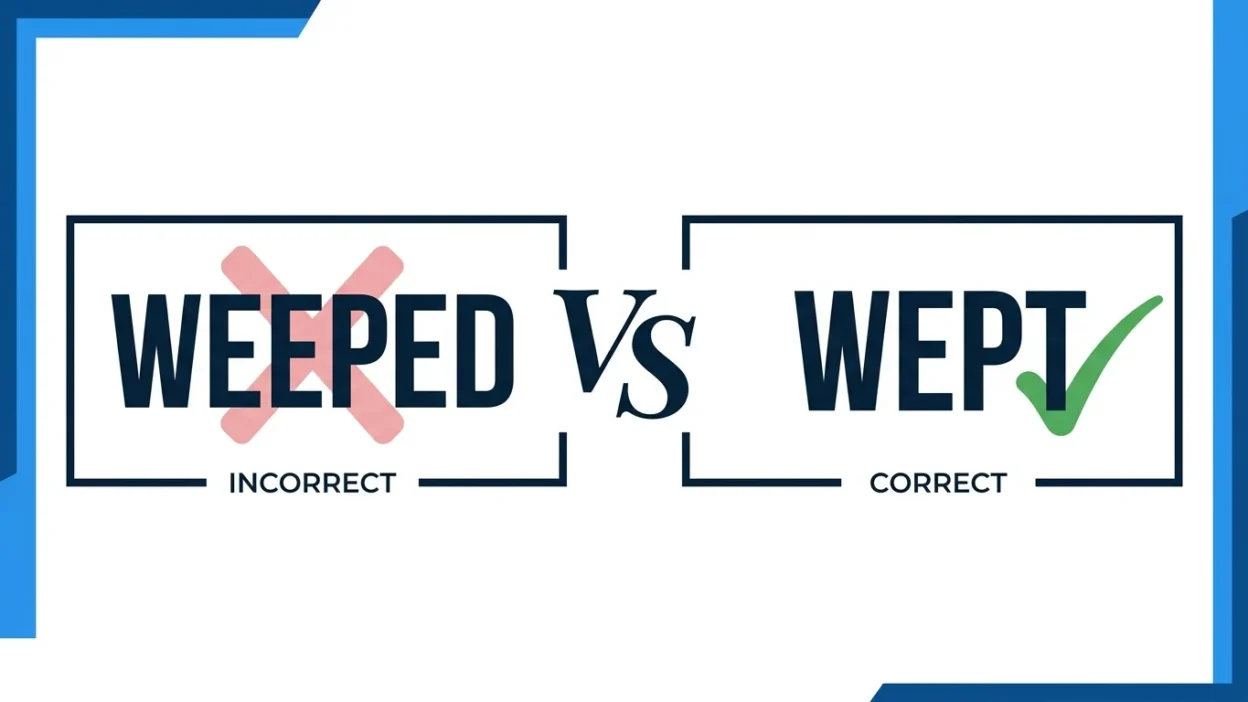
Have you ever wondered whether the correct past tense of weep is weeped or wept? English verbs can be tricky, especially when some follow regular patterns while others have irregular forms. Because many verbs simply add -ed to form the past tense, it’s easy to assume that weeped is correct.
However, when comparing weeped or wept, only one form is considered standard English. Understanding the difference will help you write more naturally and avoid a common grammar mistake. Whether you’re writing a story, essay, poem, article, or professional document, using the correct form makes your writing more accurate and polished.
Quick Answer
✅ Wept is the correct past tense and past participle of weep.
❌ Weeped is generally considered incorrect in modern standard English.
Examples
- She wept when she heard the news. ✅
- The child wept quietly in the corner. ✅
- She weeped when she heard the news. ❌
Whenever you’re referring to the past tense of weep, use wept.
Weeped or Wept: Comparison Table
| Word | Correct? | Meaning | Example |
|---|---|---|---|
| Weeped | ❌ No | Nonstandard form | She weeped after the movie. |
| Wept | ✅ Yes | Past tense of weep | She wept after the movie. |
What Does Weep Mean?
The verb weep means:
- To cry
- To shed tears
- To express deep sorrow or emotion
- To mourn
It is often used in literary, formal, or emotional contexts.
Examples of Weep
- They weep for their lost friend.
- Some people weep during emotional movies.
- She began to weep with joy.
- He couldn’t help but weep after hearing the speech.
What Does Wept Mean?
Wept is the correct past tense and past participle of weep.
Examples
- She wept throughout the ceremony.
- The family wept after receiving the news.
- He had wept before arriving home.
- They wept tears of happiness.
In each sentence, wept refers to crying in the past.
Is Weeped a Real Word?
In modern standard English, weeped is generally considered incorrect.
Although very rare historical uses have appeared in older texts, modern dictionaries and grammar guides overwhelmingly recognize wept as the proper past tense form.
For practical writing purposes:
✅ Wept
❌ Weeped
Why Is It Wept and Not Weeped?
The answer lies in English irregular verbs.
Many verbs form the past tense by adding -ed.
Regular Verbs
| Present | Past |
|---|---|
| Walk | Walked |
| Jump | Jumped |
| Play | Played |
| Work | Worked |
However, some verbs are irregular.
Irregular Verbs
| Present | Past |
|---|---|
| Sleep | Slept |
| Keep | Kept |
| Sweep | Swept |
| Weep | Wept |
Notice the pattern:
- Sleep → Slept
- Keep → Kept
- Sweep → Swept
- Weep → Wept
This is why wept is correct.
Understanding the Verb Forms
Present Tense
- I weep.
- They weep.
Past Tense
- I wept.
- They wept.
Past Participle
- She has wept.
- They had wept.
Present Participle
- She is weeping.
- They are weeping.
Common Uses of Wept
1. Emotional Sadness
Examples:
- She wept after losing her pet.
- The family wept at the funeral.
- He wept when he heard the tragic news.
2. Joy and Happiness
Examples:
- They wept tears of joy.
- The parents wept at their daughter’s wedding.
- She wept with relief.
3. Literature and Poetry
Examples:
- The queen wept for her kingdom.
- He wept beneath the moonlight.
- The hero wept over his fallen companions.
4. Religious and Historical Writing
Examples:
- The people wept in mourning.
- Followers wept during the ceremony.
- Crowds wept at the announcement.
Example Sentences Using Wept
Here are some practical examples:
- She wept silently throughout the evening.
- The audience wept during the emotional performance.
- He wept for the lives that were lost.
- They wept when they reunited after years apart.
- The mother wept with happiness.
- Many fans wept after hearing the farewell speech.
Notice that every correct sentence uses wept, not weeped.
Common Mistakes to Avoid
Mistake #1: Writing Weeped
❌ She weeped all night.
✅ She wept all night.
Mistake #2: Treating Weep as a Regular Verb
Because many verbs add -ed, writers sometimes assume weep follows the same pattern.
Mistake #3: Confusing Present and Past Forms
❌ Yesterday she weep.
✅ Yesterday she wept.
Mistake #4: Using Weeped in Formal Writing
Most editors and grammar checkers will flag weeped as incorrect.
Memory Trick to Remember Wept
Here’s an easy trick:
Weep Follows Sleep
Think:
- Sleep → Slept
- Weep → Wept
The pattern is nearly identical.
Another Helpful Reminder
Remember this phrase:
“People weep today and wept yesterday.”
This simple sentence helps reinforce the correct past tense.
Similar Irregular Verbs
Several English verbs follow a similar pattern.
| Present | Past |
|---|---|
| Keep | Kept |
| Sleep | Slept |
| Sweep | Swept |
| Weep | Wept |
| Creep | Crept |
Learning these groups makes irregular verbs easier to remember.
Why Do People Write Weeped?
Several reasons contribute to this mistake.
Influence of Regular Verbs
Most English verbs use -ed, so writers naturally expect weep to behave the same way.
Lack of Familiarity
The word weep is less common in everyday conversation than cry, so many people are unsure of its past tense.
Fast Writing
When writing quickly, people often apply the regular -ed rule automatically.
Language Learning
English learners frequently overgeneralize grammar rules before learning irregular forms.
Synonyms for Weep
Depending on context, alternatives include:
- Cry
- Sob
- Mourn
- Lament
- Grieve
- Shed tears
- Wail
- Whimper
- Sorrow
- Bawl
Examples
- She wept quietly.
- She cried quietly.
- They wept with grief.
- They mourned with grief.
Using synonyms can make your writing more varied and expressive.
American vs British English
There is no difference between American and British English regarding this verb.
Both varieties use:
✅ Wept
Both consider:
❌ Weeped
to be nonstandard or incorrect.
Whether you’re writing for a US, UK, Canadian, Australian, or international audience, wept is the accepted past tense.
FAQs About Weeped or Wept
Is weeped a real word?
In modern standard English, weeped is generally considered incorrect. Wept is the accepted form.
What is the past tense of weep?
The correct past tense is wept.
Is wept an irregular verb form?
Yes. Weep is an irregular verb.
What does wept mean?
It means cried or shed tears in the past.
Is wept formal?
It can be used in both formal and literary writing, though it also appears in everyday English.
What is the past participle of weep?
The past participle is wept.
Do British and American English use different forms?
No. Both use wept.
How can I remember the correct form?
Think of the pattern:
Sleep → Slept
Weep → Wept
Final Summary
When comparing weeped or wept, the correct choice is wept. It is the standard past tense and past participle form of weep, meaning to cry, mourn, or shed tears. The form weeped is generally considered incorrect in modern English and should be avoided in both formal and informal writing.
Like kept, slept, swept, and crept, the verb weep follows an irregular pattern. Learning this pattern makes it easier to remember and use the correct form naturally.
Actionable Takeaway
Whenever you need the past tense of weep, remember:
Sleep → Slept
Weep → Wept
✅ Wept
❌ Weeped
Using this simple memory trick will help you avoid a common grammar mistake and improve the accuracy of your writing.

Joy Root is a content writer at Whygenix.com, creating clear, engaging articles that explain complex ideas simply, helping readers understand why topics matter in everyday life and personal growth.