Have you ever typed “equipt” and wondered whether it was a correct English word? You’re not alone. Many English learners and native speakers alike get confused when spelling words that change form, especially verbs ending in -p. One of the most common spelling questions is equipt vs equipped.
If you’re searching for the correct spelling, pronunciation, meaning, and usage, this guide will clear up the confusion. By the end of this article, you’ll know exactly when to use equipped, why equipt appears occasionally, and how to avoid this mistake in your writing.
Quick Answer
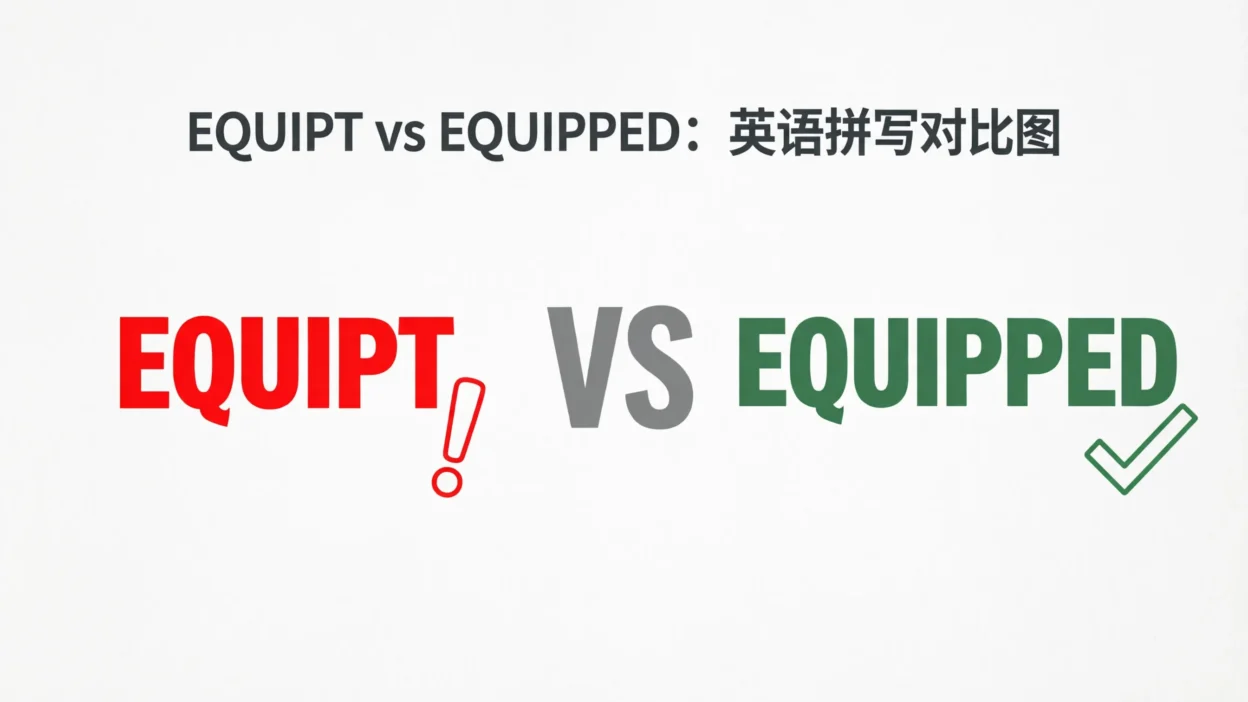
✅ Equipped is the correct spelling.
❌ Equipt is incorrect in modern English.
The verb equip becomes equipped in its past tense and past participle form by doubling the final p before adding -ed.
Correct: The laboratory was fully equipped with modern technology.
Incorrect: The laboratory was fully equipt with modern technology.
Equipt vs Equipped: The Difference at a Glance
| Word | Correct? | Meaning |
|---|---|---|
| Equipped | ✅ Yes | Supplied with necessary tools, skills, or resources |
| Equipt | ❌ No | Misspelling of equipped |
The confusion occurs because people often assume they can simply add -ed to equip. However, English spelling rules require the final consonant to be doubled.
What Does “Equipped” Mean?
The word equipped is the past tense and past participle of the verb equip.
It means:
- Supplied with necessary tools or equipment
- Prepared for a particular purpose
- Provided with skills or resources
- Ready to handle a situation
Examples of Equipped
- The classroom was equipped with smart boards.
- She is well equipped to manage the project.
- The rescue team was equipped with emergency supplies.
- Our kitchen is fully equipped for professional cooking.
- The soldiers were equipped with modern communication devices.
In all these examples, equipped indicates readiness, preparation, or provision of necessary resources.
Why Is “Equipt” Incorrect?
The spelling equipt violates standard English spelling rules.
When a one-syllable or stressed-syllable verb ends in:
- One vowel
- Followed by one consonant
the final consonant is usually doubled before adding -ed or -ing.
Examples
| Base Verb | Correct Form |
| Stop | Stopped |
| Plan | Planned |
| Slip | Slipped |
| Equip | Equipped |
Since equip ends with a stressed syllable and a single p, the p must be doubled.
Therefore:
- Equip + ed = Equipped ✅
- Equip + ed = Equipt ❌
The Spelling Rule Behind Equipped
A useful rule to remember is:
Double the final consonant before adding -ed when the stress falls on the last syllable.
Consider these examples:
| Verb | Past Tense |
| Permit | Permitted |
| Refer | Referred |
| Commit | Committed |
| Equip | Equipped |
Because the stress in equip falls on the second syllable (e-QUIP), the final p is doubled.
This same rule applies when adding -ing:
- Equipping ✅
- Equiping ❌
Examples of Equipped in Sentences
Here are some real-world examples showing proper usage.
In Education
- The school is equipped with advanced science laboratories.
- Students are equipped with the knowledge needed for success.
In Business
- Our office is equipped with high-speed internet.
- Employees are equipped to work remotely.
In Sports
- The athletes were equipped with protective gear.
- The gym is equipped with modern fitness equipment.
In Everyday Life
- She felt equipped to make the right decision.
- The vehicle was equipped with GPS navigation.
Common Mistakes People Make
Many writers accidentally use equipt because they misunderstand how English spelling changes work.
Mistake #1: Dropping the Extra P
❌ The room was equipt with air conditioning.
✅ The room was equipped with air conditioning.
Mistake #2: Using Equipt in Professional Writing
❌ Our staff is equipt to handle customer concerns.
✅ Our staff is equipped to handle customer concerns.
Mistake #3: Confusing Equip With Equipped
Remember:
- Equip = present tense
- Equipped = past tense or adjective
Examples:
- We equip our employees with training.
- Our employees are equipped with training materials.
Equipped as an Adjective
Interestingly, equipped often functions as an adjective.
Examples
- A fully equipped kitchen
- A well-equipped workshop
- A properly equipped laboratory
- A highly equipped research center
In these cases, the word describes something that already possesses necessary resources.
Synonyms of Equipped
Using related words can improve writing variety and SEO relevance.
Some common synonyms include:
- Prepared
- Furnished
- Outfitted
- Supplied
- Provisioned
- Armed
- Ready
- Capable
Example
Original:
- The facility is equipped with security cameras.
Alternative:
- The facility is outfitted with security cameras.
Equipped vs Equip
Many learners also confuse these forms.
| Word | Function |
| Equip | Base verb |
| Equipped | Past tense / adjective |
| Equipping | Present participle |
| Equipment | Noun |
Examples
- We equip our staff with resources.
- We equipped our staff last year.
- We are equipping new employees this week.
- The equipment has arrived.
American vs British English
Good news: there is no difference between American and British English for this word.
Both varieties use:
- Equipped ✅
- Equipping ✅
Neither accepts:
- Equipt ❌
Whether you’re writing for audiences in the United States, the United Kingdom, Canada, Australia, or elsewhere, equipped remains the standard spelling.
Memory Trick to Remember the Correct Spelling
A simple trick:
Think of the word equipment.
Notice that equipment contains a double sound relationship to the base word equip.
When forming the past tense, keep the strong p sound by doubling it:
Equip → Equipped
If you remember stopped, planned, and committed, you’ll naturally remember equipped as well.
Why Correct Spelling Matters
Using correct spelling helps:
- Improve credibility
- Enhance professional communication
- Increase readability
- Support SEO performance
- Avoid confusion among readers
A misspelling like equipt can make otherwise excellent writing appear less polished, especially in academic, business, and online content.
Frequently Asked Questions
Is equipt a real word?
No. Equipt is considered a misspelling of equipped in modern English.
Which is correct: equipt or equipped?
Equipped is the correct spelling.
Why does equipped have two P’s?
The final consonant is doubled because equip ends in a stressed syllable followed by a single consonant.
How do you spell equipped in British English?
British English uses equipped, exactly the same as American English.
Is equipping spelled with two P’s?
Yes. The correct spelling is equipping.
What does fully equipped mean?
It means having all necessary tools, resources, or facilities available.
Can equipped be used as an adjective?
Yes. Examples include well-equipped office and fully equipped kitchen.
What is the noun form of equip?
The noun form is equipment.
Summary
The debate over equipt vs equipped has a straightforward answer: equipped is the only correct spelling. It follows a standard English spelling rule that doubles the final consonant before adding -ed. The form equipt is simply a misspelling and should be avoided in both formal and informal writing.
Whether you’re writing emails, academic papers, business documents, or website content, using equipped ensures accuracy and professionalism. Understanding this rule will also help you spell similar words correctly, improving your overall English writing skills.
Actionable Takeaway
Whenever you use the past tense of equip, remember to double the p:
✅ Equip → Equipped
❌ Equip → Equipt
A quick proofreading check can help you catch this common mistake and keep your writing polished, professional, and grammatically correct.

Joy Root is a content writer at Whygenix.com, creating clear, engaging articles that explain complex ideas simply, helping readers understand why topics matter in everyday life and personal growth.