Have you ever typed recognization and wondered whether it was a real word or just a spelling mistake? You’re not alone. Many English learners and even native speakers get confused between recognization vs recognition because both seem logical and sound similar.
The good news is that the difference is straightforward. Understanding which word is accepted in standard English can improve your writing, help you avoid common grammar mistakes, and make your communication look more professional. In this guide, you’ll learn the meanings, correct usage, examples, common errors, and everything else you need to know about recognization vs recognition.
Quick Answer
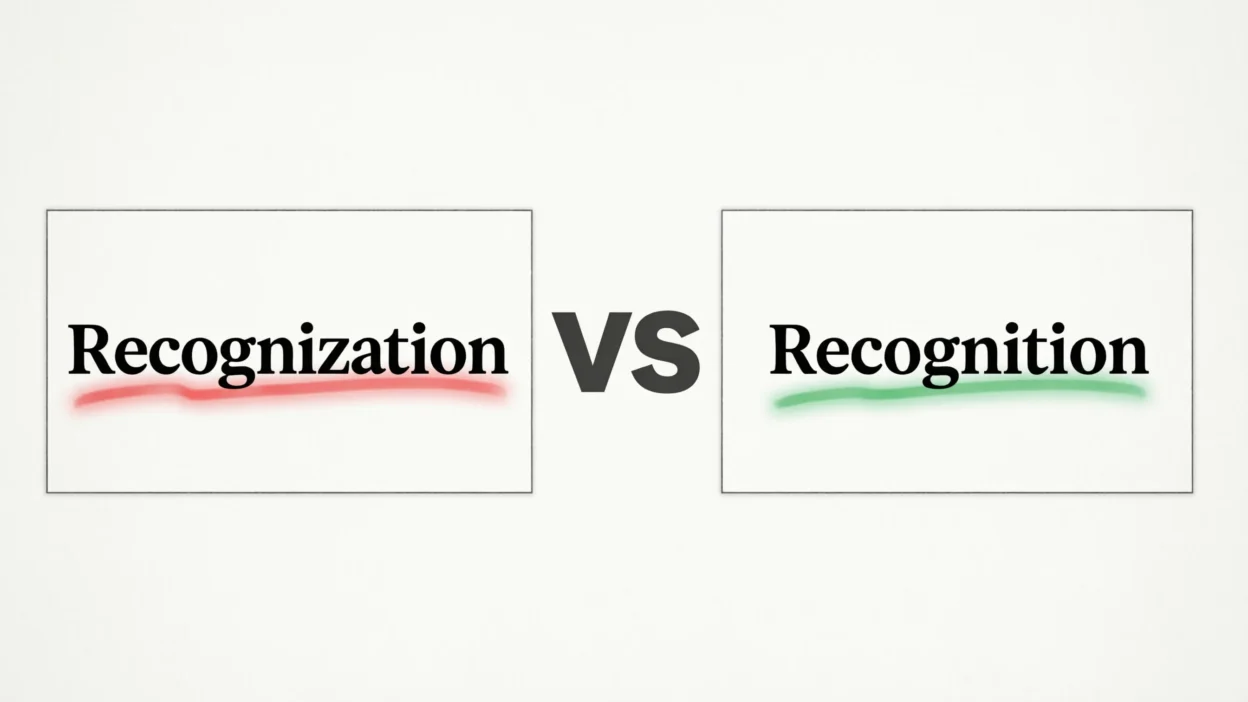
Recognition is the correct and widely accepted English noun.
❌ Recognization = Generally considered nonstandard or incorrect in modern English.
✅ Recognition = Correct word meaning acknowledgment, identification, appreciation, or acceptance.
Example:
- Correct: She received recognition for her hard work.
- Incorrect: She received recognization for her hard work.
What Does Recognition Mean?
Recognition is a noun derived from the verb recognize. It refers to the act of identifying, acknowledging, appreciating, or officially accepting someone or something.
It is commonly used in:
- Business communication
- Academic writing
- Legal documents
- Everyday conversation
- Professional awards and achievements
Examples of Recognition
- The company gave him recognition for his outstanding performance.
- Facial recognition technology is becoming more advanced.
- The artist gained international recognition.
- Her contributions deserve recognition.
- The country received diplomatic recognition from several nations.
What Does Recognization Mean?
Recognization is an uncommon variant that occasionally appeared in historical texts. However, it is not considered standard English today.
Most dictionaries, style guides, and professional editors recommend using recognition instead.
Examples of Incorrect Usage
- ❌ The employee received recognization from management.
- ❌ The project gained recognization worldwide.
Correct Versions
- ✅ The employee received recognition from management.
- ✅ The project gained recognition worldwide.
In modern writing, using recognization may make your content appear less polished or grammatically inaccurate.
Recognization vs Recognition: Side-by-Side Comparison
| Feature | Recognization | Recognition |
|---|---|---|
| Standard English | ❌ No | ✅ Yes |
| Accepted by Major Dictionaries | Rarely | ✅ Yes |
| Common in Professional Writing | ❌ No | ✅ Yes |
| Academic Usage | ❌ No | ✅ Yes |
| Business Communication | ❌ No | ✅ Yes |
| Recommended Word | ❌ No | ✅ Absolutely |
The clear winner is recognition.
Why Do People Use Recognization?
The confusion often happens because many English nouns end with -ization, such as:
- Realization
- Organization
- Modernization
- Specialization
Since the verb is recognize, some people naturally assume the noun should be recognization.
However, English does not always follow predictable patterns. The established noun form has long been recognition, not recognization.
The History Behind Recognition
The word recognition comes from Latin roots related to acknowledgment and identification. It entered English centuries ago and became the standard noun form connected to the verb recognize.
While rare historical examples of recognization can occasionally be found, modern English overwhelmingly favors recognition.
Today, major dictionaries, educational institutions, and professional publications use recognition exclusively.
Common Uses of Recognition
The word recognition appears in several contexts.
1. Acknowledgment of Achievement
When someone is praised or rewarded for their work.
Examples:
- She earned recognition for her volunteer efforts.
- The teacher received recognition from the school board.
2. Identification
When a person or object is identified.
Examples:
- Voice recognition software is improving rapidly.
- The witness made an immediate recognition of the suspect.
3. Official Acceptance
When an organization or government formally accepts something.
Examples:
- The new nation sought international recognition.
- The certificate gained official recognition.
4. Appreciation
When someone’s value or contribution is acknowledged.
Examples:
- Employees appreciate recognition from management.
- Recognition boosts workplace morale.
Examples of Recognition in Sentences
Here are more examples showing the correct usage:
- The scientist gained global recognition for her research.
- His talent deserves greater recognition.
- The award serves as recognition of excellence.
- Facial recognition systems enhance security.
- Recognition of customer needs is essential for business success.
- She smiled in recognition of an old friend.
- The charity received recognition from the community.
Common Mistakes to Avoid
Mistake 1: Using Recognization in Formal Writing
❌ The team received recognization for their success.
✅ The team received recognition for their success.
Mistake 2: Assuming Every Verb Ending in “-ize” Creates a Noun Ending in “-ization”
English has many exceptions.
Examples:
| Verb | Correct Noun |
|---|---|
| Recognize | Recognition |
| Realize | Realization |
| Organize | Organization |
| Authorize | Authorization |
Not all words follow the same pattern.
Mistake 3: Trusting Spellcheck Too Much
Some software may not immediately flag uncommon forms, but professional writing standards still favor recognition.
Recognition in Business and Professional Communication
Recognition plays an important role in workplace culture.
Organizations often use employee recognition programs to:
- Increase motivation
- Improve engagement
- Boost productivity
- Strengthen retention
- Encourage teamwork
Examples:
- Employee recognition awards
- Peer recognition programs
- Leadership recognition initiatives
- Customer recognition events
In all of these cases, recognition is the correct term.
Recognition in Technology
One reason the word appears so frequently today is technology.
Popular examples include:
- Facial recognition
- Voice recognition
- Speech recognition
- Pattern recognition
- Image recognition
These technologies help computers identify and process information more effectively.
Example
Modern smartphones use facial recognition to unlock devices securely.
American vs British English
One interesting aspect of recognization vs recognition is that there is no significant American vs British English difference.
Both varieties of English use:
✅ Recognition
Both generally avoid:
❌ Recognization
Whether you’re writing for an American audience, a British audience, or an international audience, recognition remains the preferred choice.
Synonyms for Recognition
Depending on the context, you may use these alternatives:
For Acknowledgment
- Appreciation
- Credit
- Praise
- Commendation
- Validation
For Identification
- Detection
- Identification
- Verification
- Authentication
For Official Acceptance
- Approval
- Acceptance
- Accreditation
- Endorsement
These synonyms can add variety to your writing while maintaining clarity.
Tips to Remember the Correct Word
A simple trick:
Think of these common phrases:
- Facial recognition
- Employee recognition
- Brand recognition
- International recognition
You’ve probably seen these expressions many times.
By repeatedly associating these familiar phrases with recognition, you’ll naturally remember the correct form.
Another helpful reminder:
Recognize → Recognition
Even though the spelling changes slightly, this is the accepted noun form.
Frequently Asked Questions (FAQs)
Is recognization a real word?
Technically, it has appeared in some historical texts, but it is not considered standard modern English. Recognition is the preferred form.
Which is correct: recognization or recognition?
Recognition is correct and widely accepted in professional, academic, and everyday English.
Why is recognition correct instead of recognization?
English developed recognition as the standard noun form of recognize, and it has remained the accepted version for centuries.
Is recognization grammatically wrong?
In modern English, it is generally viewed as nonstandard and should be avoided in formal writing.
Do dictionaries include recognization?
Some dictionaries may list it as a rare or obsolete variant, but they still recommend recognition as the standard word.
Is recognition used in business English?
Yes. It is commonly used in employee recognition programs, awards, performance reviews, and professional communication.
Is recognition used in technology?
Absolutely. Terms like facial recognition, speech recognition, and image recognition are widely used in technology fields.
Final Summary
When comparing recognization vs recognition, the answer is clear: recognition is the correct and standard English word. It is accepted in professional writing, academic work, business communication, technology, and everyday conversation. Although recognization occasionally appears in historical or rare contexts, it is not considered standard modern English.
If you want your writing to sound natural, polished, and grammatically correct, always choose recognition. Whether you’re discussing employee achievements, facial recognition technology, official acceptance, or personal appreciation, recognition is the word trusted by dictionaries, editors, educators, and professionals worldwide.
Actionable Takeaway
Before submitting any document, email, article, or report, do a quick search for recognization and replace it with recognition. This simple edit can instantly improve the professionalism and credibility of your writing.

Bret Lee writes educational and research-based content for Whygenix.com, focused on clarity, accuracy, and explaining why concepts matter through simple, engaging, reader-friendly writing.