Have you ever paused while writing and wondered whether “sitted” or “seated” is correct? You’re not alone. Many English learners and even native speakers occasionally get confused because both words seem related to the verb sit. However, only one is commonly accepted in standard modern English.
Understanding the difference between sitted vs seated can instantly improve your grammar and make your writing sound more natural. Whether you’re writing an email, an essay, a social media post, or simply having a conversation, knowing the right word will help you communicate with confidence.
Quick Answer
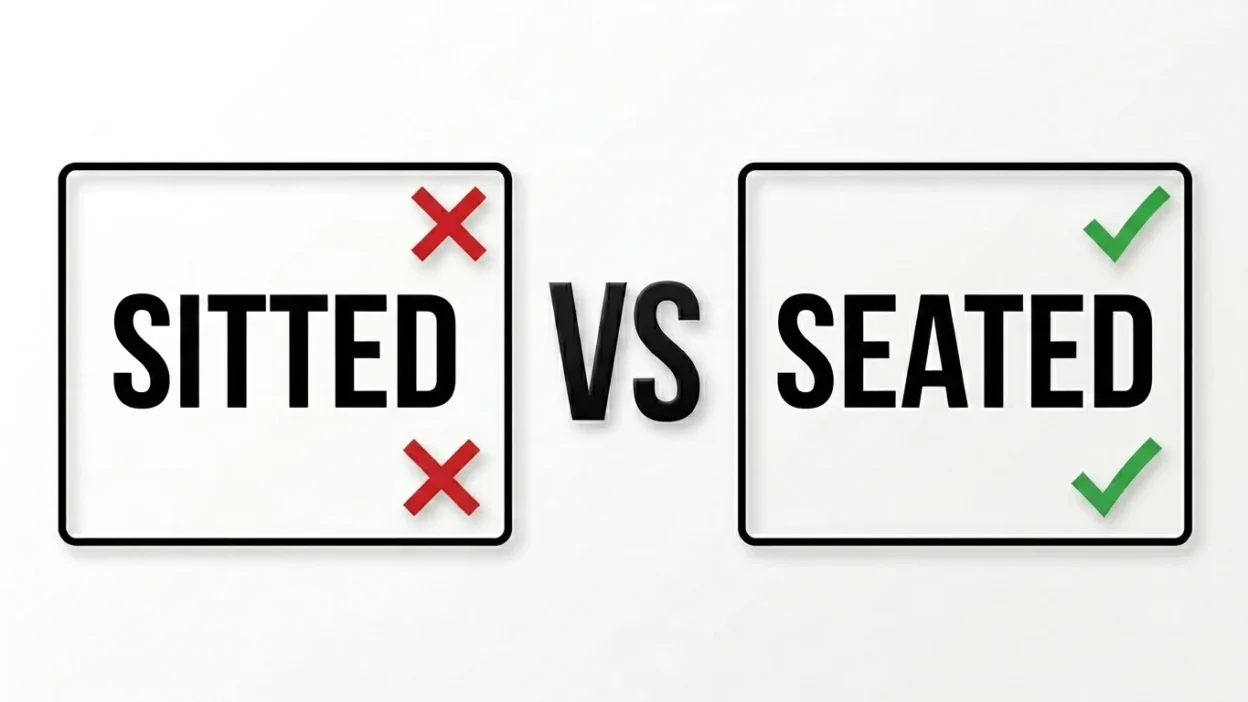
The correct word is usually seated, while sitted is generally considered incorrect in modern standard English.
- ✅ Seated = sitting down or placed in a seat.
- ❌ Sitted = not the standard past tense of sit.
Correct: She was seated near the window.
Incorrect: She was sitted near the window.
Remember: the past tense of sit is sat, not sitted.
What Does “Seated” Mean?
The word seated comes from the verb seat, which means to place someone in a sitting position or to be sitting somewhere.
It is commonly used in both formal and informal English.
Examples of Seated
- The guests were seated before dinner was served.
- Please remain seated until the plane comes to a complete stop.
- We were seated near the stage.
- The teacher seated the students according to their groups.
- She remained seated throughout the meeting.
In each example, seated sounds natural and grammatically correct.
What Does “Sitted” Mean?
In modern English, sitted is generally not accepted as the past tense of sit. Since sit is an irregular verb, its past tense form is sat.
Many people assume that adding -ed creates the past tense, but English irregular verbs don’t always follow that rule.
Incorrect Examples
- ❌ I sitted on the sofa.
- ❌ They sitted quietly during class.
- ❌ She has sitted here all day.
Correct Versions
- ✅ I sat on the sofa.
- ✅ They sat quietly during class.
- ✅ She has sat here all day.
Why Is “Sitted” Wrong?
The confusion happens because many English verbs are regular:
- Walk → Walked
- Jump → Jumped
- Talk → Talked
But sit is irregular.
Correct Verb Forms of Sit
| Verb Form | Correct Word |
|---|---|
| Base Form | Sit |
| Present Participle | Sitting |
| Past Tense | Sat |
| Past Participle | Sat |
Notice that sitted does not appear anywhere in the standard conjugation.
Sitted vs Seated: Key Differences
| Feature | Sitted | Seated |
|---|---|---|
| Standard English | No | Yes |
| Commonly Used | Rarely | Very Common |
| Grammatically Accepted | Generally No | Yes |
| Formal Writing | Avoid | Recommended |
| Professional Communication | Avoid | Preferred |
| Everyday Conversation | Rarely Heard | Frequently Used |
| Meaning | Incorrect past form of sit | Sitting or placed in a seat |
Seated vs Sat: Understanding the Difference
Many people comparing sitted vs seated are actually looking for the difference between sat and seated.
Use “Sat” for an Action
When talking about the act of sitting in the past:
- I sat near the door.
- She sat beside her friend.
- We sat under a tree.
- The cat sat on the couch.
Use “Seated” for Position or Arrangement
When describing someone’s seated position:
- We were seated near the stage.
- The audience remained seated.
- The guests were seated quickly.
- Passengers stayed seated during turbulence.
Quick Rule
If you’re describing what someone did, use sat.
If you’re describing where someone was positioned, use seated.
Common Mistakes with Sitted vs Seated
Mistake #1: Using Sitted as the Past Tense
❌ He sitted next to me.
✅ He sat next to me.
Mistake #2: Using Sitted Instead of Seated
❌ Guests were sitted at their tables.
✅ Guests were seated at their tables.
Mistake #3: Using Sitted in Professional Writing
❌ All participants were sitted according to registration order.
✅ All participants were seated according to registration order.
Mistake #4: Forgetting That Sit Is Irregular
❌ I have sitted here before.
✅ I have sat here before.
When Should You Use Seated?
Use seated whenever you want to describe a person who is already sitting or has been placed somewhere to sit.
In Restaurants
- We were seated immediately.
- The host seated us near the window.
At Weddings
- Guests were seated before the ceremony began.
- Family members were seated in the front row.
During Travel
- Please remain seated.
- All passengers must stay seated during takeoff.
In Business Settings
- The attendees were seated before the presentation started.
- Everyone remained seated during the discussion.
Examples in Everyday English
Correct Use of Seated
- She was seated beside her sister.
- The audience was seated quietly.
- We were seated in the front row.
- The children were seated alphabetically.
- They remained seated throughout the show.
Correct Use of Sat
- I sat on the bench.
- She sat by the fireplace.
- We sat together during lunch.
- The dog sat near the door.
- They sat silently for a moment.
American vs British English
One interesting point about sitted vs seated is that there is virtually no difference between American and British English.
American English
Preferred forms:
- Sat
- Seated
Examples:
- He sat on the chair.
- Guests were seated quickly.
British English
Preferred forms:
- Sat
- Seated
Examples:
- She sat by the window.
- Visitors were seated before the event.
In both countries, sitted is generally avoided.
Synonyms for Seated
Depending on the context, these words may work as alternatives:
- Sitting
- Settled
- Positioned
- Arranged
- Placed
- Stationed
Examples
- Everyone was seated.
- Everyone was sitting.
Both sentences are correct, although seated often sounds slightly more formal.
How to Remember the Difference
A simple trick is to memorize these patterns:
Sit
- Sit
- Sat
- Sat
Seat
- Seat
- Seated
- Seated
If you’re tempted to write sitted, replace it with either sat or seated depending on the sentence.
Frequently Asked Questions
Is sitted a real word?
Historically, sitted has appeared in some rare dialects and specialized uses, but it is not considered standard English today.
Which is correct: sitted or seated?
Seated is the correct and widely accepted form.
What is the past tense of sit?
The past tense of sit is sat.
Can I say “I was seated”?
Yes. This is completely correct and often sounds more formal than “I sat.”
Is “sitted down” correct?
No.
Use:
- ✅ I sat down.
Not:
- ❌ I sitted down.
Do native speakers use sitted?
Most native English speakers use sat or seated, not sitted.
Is seated formal?
Yes. Seated often sounds more formal and polished than sat.
Can sat and seated mean the same thing?
Sometimes. Both can describe being in a sitting position, but seated usually sounds more formal.
Conclusion
The confusion between sitted vs seated comes from the fact that many English verbs form their past tense with -ed. However, sit is an irregular verb, so its correct past tense is sat, not sitted. That’s why you’ll rarely see sitted in modern English grammar guides, professional writing, or everyday conversation.
On the other hand, seated is a completely correct and commonly used word. It refers to someone who is sitting or has been placed in a seat. Whether you’re writing formally or speaking casually, choosing sat or seated instead of sitted will make your English sound natural, accurate, and professional.
Actionable Takeaway
Whenever you’re unsure, remember this simple rule:
- Sit → Sat → Sat
- Seat → Seated → Seated
If you’re talking about a past action, use sat. If you’re describing someone’s position or arrangement, use seated. Following this easy guideline will help you avoid one of the most common grammar mistakes involving sitted vs seated..

Jozaf Jo is a content writer at Whygenix.com, crafting clear, engaging articles that simplify complex ideas, helping readers understand the why behind topics in education, lifestyle, and personal growth.