Have you ever typed “absense” and wondered if it was correct? You’re not alone. Many English learners, students, and even native speakers confuse absence vs absense because both words sound very similar when spoken.
The good news is that the difference is simple. One spelling is correct and widely accepted in English, while the other is a common misspelling. Understanding this distinction will help you write more confidently in emails, school assignments, professional documents, and everyday communication.
Quick Answer
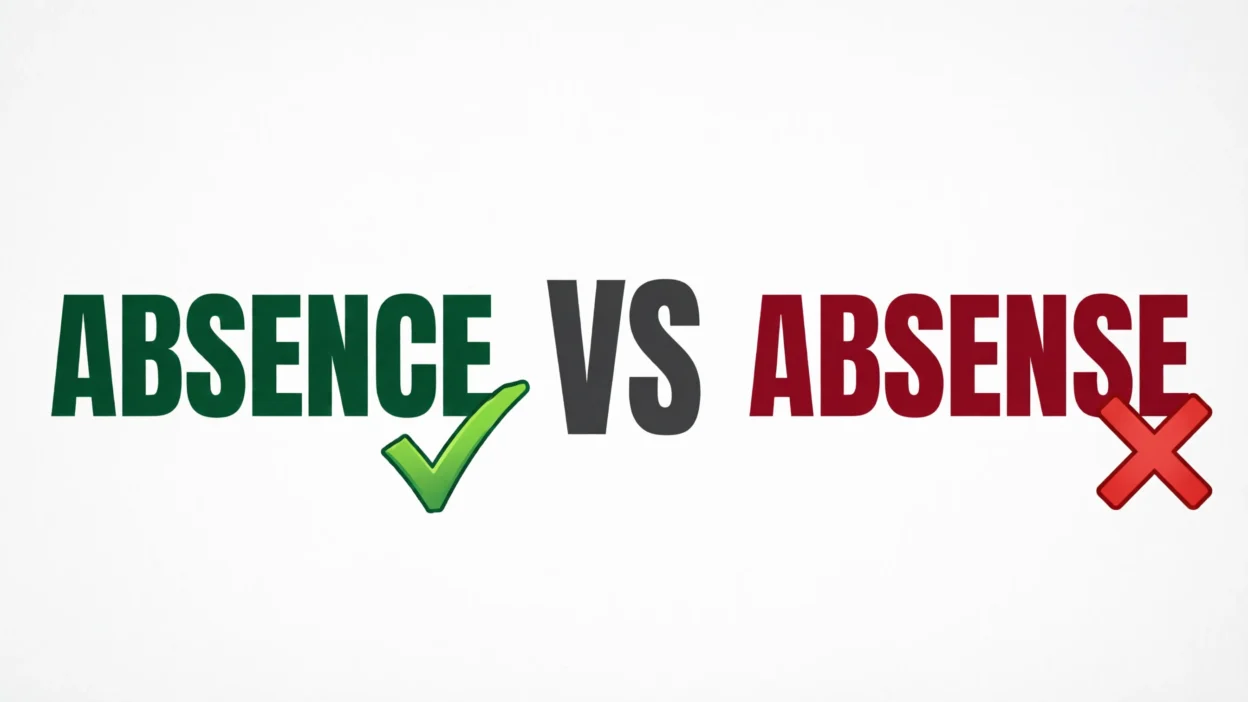
Absence is the correct spelling.
❌ Absense is incorrect and considered a spelling mistake.
Correct: Her absence from the meeting was noticed by everyone.
Incorrect: Her absense from the meeting was noticed by everyone.
If you’re choosing between absence vs absense, always use absence.
What Does “Absence” Mean?
The word absence is a noun that refers to the state of being away, missing, or not present in a particular place or situation.
Definition
Absence means:
- The condition of not being present
- A lack of something
- A period during which someone is away
Examples
- His absence from school worried his teachers.
- The manager explained her absence from work.
- There was an absence of evidence in the case.
- We noticed the absence of noise after the storm ended.
In all these examples, absence describes someone or something that is missing or not present.
Is “Absense” a Real Word?
No. Absense is not a correct English word.
It appears frequently because people often spell words based on pronunciation. Since the ending of absence sounds similar to “sense,” many writers mistakenly replace -ence with -ense.
Incorrect Examples
- ❌ Your absense was recorded.
- ❌ We discussed her absense yesterday.
- ❌ The absense of leadership caused problems.
Correct Versions
- ✅ Your absence was recorded.
- ✅ We discussed her absence yesterday.
- ✅ The absence of leadership caused problems.
Absence vs Absense: Comparison Table
| Feature | Absence | Absense |
|---|---|---|
| Correct spelling | ✅ Yes | ❌ No |
| Dictionary word | ✅ Yes | ❌ No |
| Used in formal writing | ✅ Yes | ❌ No |
| Accepted in academic writing | ✅ Yes | ❌ No |
| Accepted in business communication | ✅ Yes | ❌ No |
| Common spelling error | ❌ No | ✅ Yes |
The table makes it clear that absence is the only correct choice.
Why Do People Confuse Absence and Absense?
The confusion usually comes from pronunciation and spelling patterns in English.
Many English words end in -ense, such as:
- Sense
- Defense
- Expense
- Dense
Because of these familiar patterns, writers sometimes assume that absence should also end with -ense.
However, absence belongs to a different group of words ending in -ence, including:
- Presence
- Existence
- Innocence
- Patience
Remembering these similar words can help you avoid the mistake.
Easy Trick to Remember the Correct Spelling
A simple memory trick is:
Presence → Absence
Both words end with -ence.
Since presence is spelled with -ence, its opposite, absence, follows the same pattern.
Think:
- Presence = being there
- Absence = not being there
Both share the same ending.
Examples of Absence in Sentences
Here are more examples showing the correct use of absence.
School and Education
- The student’s absence was excused by the principal.
- Frequent absence can affect academic performance.
- She explained her absence during the examination period.
Workplace
- His absence from the office lasted two weeks.
- Employee absence increased during flu season.
- The company has a policy regarding unplanned absence.
Everyday Life
- The absence of sunlight made the room feel gloomy.
- Her absence was deeply felt by friends and family.
- There was a noticeable absence of traffic early in the morning.
Common Phrases Using “Absence”
The word absence appears in many common English expressions.
Absence from Work
Refers to not attending work.
Example: His absence from work was due to illness.
Absence from School
Refers to missing classes.
Example: The teacher recorded her absence from school.
In the Absence of
Means “when something or someone is not available.”
Example: In the absence of the manager, the assistant handled the meeting.
Leave of Absence
An approved period away from work or school.
Example: She took a leave of absence for personal reasons.
Common Mistakes to Avoid
When writing absence, watch out for these errors.
Mistake 1: Writing “Absense”
❌ The absense of evidence was surprising.
✅ The absence of evidence was surprising.
Mistake 2: Mixing Up Similar Endings
Some writers assume every similar-sounding word ends with -ense.
Remember:
✅ Absence
❌ Absense
Mistake 3: Relying Only on Pronunciation
English spelling often differs from pronunciation. Always verify spelling when you’re unsure.
Absence in Formal and Professional Writing
Because absence is commonly used in official communication, using the correct spelling is important.
Professional Example
“Please inform your supervisor if your absence will continue beyond three days.”
Academic Example
“The report analyzed student absence rates throughout the semester.”
Medical Example
“The doctor provided documentation explaining the patient’s absence from work.”
Using absense in professional writing can create a negative impression and make your work appear less polished.
American vs British English
Unlike some English words that have different American and British spellings, absence remains exactly the same in both varieties.
American English
✅ Absence
British English
✅ Absence
There is no regional variation.
Whether you’re writing in the United States, the United Kingdom, Canada, Australia, or elsewhere, absence is always the correct spelling.
Related Words and Synonyms
If you’re looking for alternatives to absence, consider these words depending on context:
Synonyms
- Nonattendance
- Unavailability
- Missing presence
- Lack
- Vacancy
- Omission
- Withdrawal
Related Terms
- Present
- Presence
- Attendance
- Attendee
- Attend
- Absent
- Absent-minded
These related terms can help expand your vocabulary and improve your writing.
Absent vs Absence
Another common point of confusion is the difference between absent and absence.
| Word | Part of Speech | Meaning |
|---|---|---|
| Absent | Adjective | Not present |
| Absence | Noun | The state of being absent |
Examples
- She was absent from class yesterday.
- Her absence from class was noted.
The first sentence uses an adjective, while the second uses a noun.
Frequently Asked Questions (FAQs)
1. Is absense a correct spelling?
No. Absense is a misspelling. The correct word is absence.
2. Which is correct: absence or absense?
Absence is the correct spelling in all forms of English.
3. Why do people write absense?
People often spell it incorrectly because the ending sounds similar to words ending in -ense, such as “sense.”
4. Is absence used in formal writing?
Yes. Absence is commonly used in academic, business, legal, and professional writing.
5. How do I remember the spelling of absence?
Think of the word presence. Since both words end with -ence, it’s easier to remember the correct spelling.
6. Is absence a noun or a verb?
Absence is a noun. The adjective form is absent.
7. Is absence spelled differently in British English?
No. British English and American English both use the spelling absence.
8. Can I use absense in any situation?
No. Absense is considered incorrect and should be avoided in all writing.
Summary
The debate over absence vs absense is actually very straightforward. Absence is the correct and accepted spelling in English, while absense is a common misspelling that should never be used in formal, academic, professional, or everyday writing. Whenever you want to describe someone or something that is not present, the correct word is absence.
To remember the spelling, connect it with presence. Both words end in -ence, making them easy to pair together. The next time you’re unsure, simply ask yourself: “Would I spell presence with -ense?” Since the answer is no, you’ll know that absence should also end with -ence.
Actionable Takeaway
Before submitting any email, essay, report, or message, quickly check for the spelling absense and replace it with absence. Adding this simple proofreading habit can help improve your writing accuracy and professionalism.
Featured Image Prompt
Create a clean, modern educational typography design. Split the image into two distinct frames. In the left frame, display the word “ABSENCE” in large bold English typography with a green checkmark. In the right frame, display the word “ABSENSE” in large bold English typography with a red cross mark. Place a large “VS” in the center between both frames. Use a professional white background, high-contrast text, modern infographic style, spelling comparison theme, SEO blog featured image design, sharp typography, visually engaging and easy to read.
Meta Description:
Learn the difference between absence vs absense, discover the correct spelling, examples, common mistakes, and easy memory tips.

Joy Root is a content writer at Whygenix.com, creating clear, engaging articles that explain complex ideas simply, helping readers understand why topics matter in everyday life and personal growth.