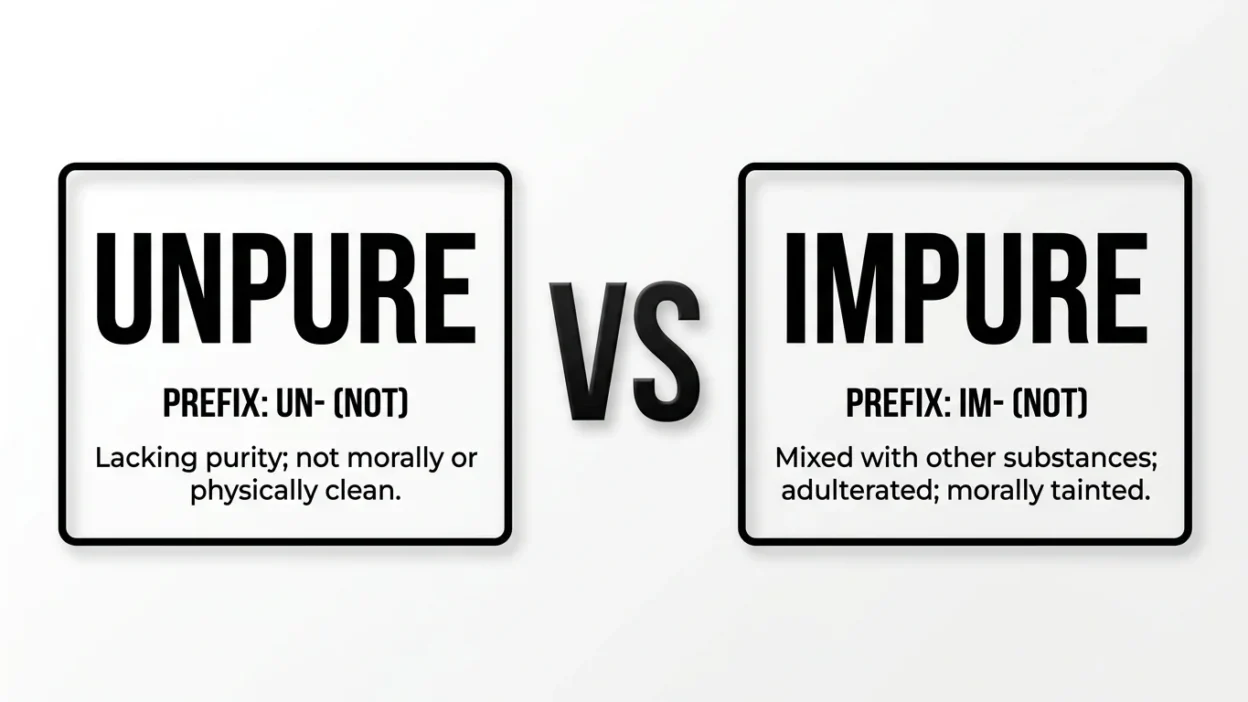
If you’ve come across unpure and impure, you may wonder whether both words are correct or if one is preferred over the other. Since many English opposites use the prefix un-—such as unhappy, unfair, and unclear—it’s easy to assume that unpure should be the correct opposite of pure.
In modern English, however, impure is the standard and widely accepted word. While unpure has appeared in some historical texts and older writings, it is considered nonstandard today. Understanding the difference can help you write more accurately and confidently in academic, professional, and everyday contexts.
Quick Answer
Impure is the correct and preferred word in modern English. Unpure is rare, outdated, and generally considered nonstandard.
| Word | Status | Recommendation |
|---|---|---|
| Unpure | Nonstandard/Archaic | Avoid in modern writing |
| Impure | Standard English | Use this form |
What Does “Impure” Mean?
The word impure means not pure, contaminated, mixed with unwanted substances, or sometimes morally tainted, depending on the context.
It is commonly used in science, religion, literature, and everyday conversation.
Examples of Impure
- The laboratory found that the sample was impure.
- The water became impure after the flood.
- The gold was impure because it contained other metals.
- She believed his motives were impure.
Synonyms of Impure
- Contaminated
- Polluted
- Tainted
- Adulterated
- Unclean
- Corrupted
These related terms are often used in similar contexts, though each carries slightly different shades of meaning.
What Does “Unpure” Mean?
Unpure literally means “not pure,” but it is not the form that modern English speakers typically use.
Historically, the word appeared in some older English writings. Today, however, it sounds unnatural to most native speakers because English adopted impure as the established opposite of pure.
Examples
❌ The water is unpure.
✅ The water is impure.
❌ The metal became unpure during processing.
✅ The metal became impure during processing.
For nearly all modern writing situations, impure is the better choice.
Unpure vs Impure: Comparison Table
| Feature | Unpure | Impure |
|---|---|---|
| Modern English Usage | Rare | Common |
| Accepted in Formal Writing | No | Yes |
| Used in Academic Writing | No | Yes |
| Dictionary Recognition | Limited | Widely recognized |
| Natural to Native Speakers | Usually not | Yes |
| Recommended Choice | No | Yes |
Why Is “Impure” Correct Instead of “Unpure”?
English negatives are not always formed with un-. Many words use prefixes such as:
- im-
- in-
- il-
- ir-
These prefixes often come from Latin roots.
Similar Examples
| Correct Form | Incorrect or Rare Form |
|---|---|
| impossible | unpossible |
| impatient | unpatient |
| imperfect | unperfect |
| impure | unpure |
Because English inherited the word impure through historical language development, it became the accepted opposite of pure.
Examples of Correct Usage
Scientific Context
- Researchers discarded the impure chemical sample.
- The medicine was considered impure due to contamination.
Environmental Context
- Industrial waste can make rivers impure.
- The filter removes many substances that make water impure.
Figurative Context
- His intentions seemed impure.
- The story warns against impure motives.
Common Mistakes to Avoid
1. Using “Unpure” in Professional Writing
Many learners assume that adding un- creates the correct opposite.
Incorrect:
- The substance is unpure.
Correct:
- The substance is impure.
2. Assuming All Opposites Use “Un-”
English contains many exceptions.
Examples:
- Happy → Unhappy
- Fair → Unfair
- Pure → Impure
Learning common word pairs helps avoid mistakes.
3. Confusing “Impure” With “Impurely”
Impure is an adjective.
- The water is impure.
Impurely is an adverb.
- The substance was processed impurely.
Is “Unpure” Ever Acceptable?
In rare situations, you may encounter unpure in:
- Historical literature
- Religious writings
- Poetry
- Creative works
Writers sometimes choose it for stylistic reasons or to match an older language style.
Even in these contexts, modern readers are generally more familiar with impure.
American vs British English
There is no significant difference between American and British English regarding these words.
| English Variety | Preferred Word |
|---|---|
| American English | Impure |
| British English | Impure |
| Australian English | Impure |
| Canadian English | Impure |
Across all major English varieties, impure remains the standard choice.
Related Words and Phrases
When discussing unpure vs impure, you may also encounter these related terms:
- Pure vs impure
- Contaminated substance
- Polluted water
- Adulterated food
- Tainted materials
- Chemical impurity
- Water contamination
- Purity level
- Refined vs impure
- Unclean substance
These LSI keywords help provide broader context and improve topic understanding.
How to Remember the Difference
A simple trick is to think about other words beginning with im-.
- Possible → Impossible
- Perfect → Imperfect
- Patient → Impatient
- Pure → Impure
If you remember these common word pairs, choosing impure becomes much easier.
Frequently Asked Questions
1. Which is correct: unpure or impure?
Impure is the correct and standard form in modern English.
2. Is unpure a real word?
It has existed historically, but it is considered nonstandard and uncommon today.
3. Why do people use unpure?
Many people assume the opposite of pure should use the prefix un-, following common English patterns.
4. Can I use unpure in creative writing?
Yes, but only if you intentionally want an archaic or unusual style.
5. What is the opposite of pure?
The accepted opposite is impure.
6. Is impure used in science?
Yes. Scientists frequently use impure to describe substances containing contaminants or additional materials.
7. Is impure negative?
Not always. It often simply describes a lack of purity without making a moral judgment.
8. Do British and American English use different forms?
No. Both use impure as the standard word.
Conclusion
When comparing unpure vs impure, the answer is straightforward: impure is the correct and accepted term in modern English. It appears in dictionaries, academic writing, scientific literature, and everyday communication. The word clearly conveys the idea of something that is not pure, contaminated, mixed, or tainted.
Although unpure has appeared in older texts and may occasionally surface in creative writing, it is not the preferred choice today. If your goal is clear, professional, and grammatically correct writing, impure should always be your default option. Choosing the standard form helps ensure that readers immediately understand your meaning and view your writing as credible and polished.
Actionable Takeaway
Whenever you’re unsure between unpure and impure, choose impure. It is the standard form recognized across all major varieties of English and suitable for formal, academic, professional, and casual writing. Remember the pattern: possible → impossible, perfect → imperfect, and pure → impure.

Sara Taylor is a content writer at Whygenix.com, creating clear, engaging articles that simplify complex ideas, helping readers understand the why behind topics in education, lifestyle, and personal development.