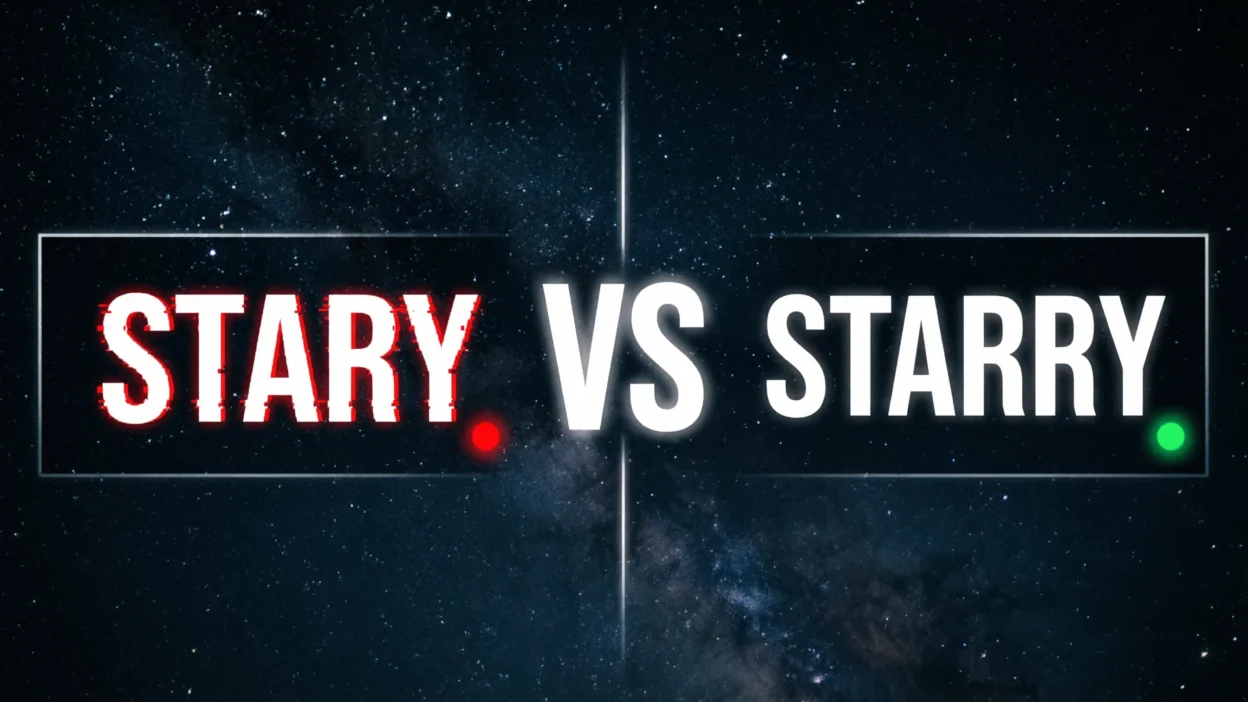
Have you ever typed “stary” and wondered whether it was a real word or simply a misspelling of “starry”? You’re not alone. Many English learners and native speakers alike get confused because the two words look very similar, but only one is commonly accepted in modern English.
Understanding the difference between stary vs starry can help you write more accurately and avoid common spelling mistakes. In this guide, you’ll learn the meaning of each term, see practical examples, discover common errors, and find out which spelling you should use in everyday writing.
Quick Answer
Starry is the correct and standard English word. It means filled with stars or resembling stars.
Stary is generally considered a misspelling of starry and is not accepted in standard modern English dictionaries.
✅ Correct: The starry night sky looked beautiful.
❌ Incorrect: The stary night sky looked beautiful.
What Does “Starry” Mean?
The word starry is an adjective used to describe something that is full of stars or looks like stars.
Definition
Starry (adjective):
- Covered with stars
- Bright like stars
- Relating to stars in the sky
Examples
- We spent the evening under a starry sky.
- The desert offers breathtaking starry views at night.
- She gazed at the starry heavens.
- The artist painted a starry landscape inspired by nature.
The word is commonly used in literature, poetry, travel writing, astronomy discussions, and everyday descriptions of the night sky.
What Does “Stary” Mean?
In modern English, stary is generally not considered a standard word.
Most of the time, when people write stary, they actually mean starry.
Why Does the Confusion Happen?
English often doubles consonants when adding certain suffixes. The noun star becomes starry by adding -ry and doubling the letter r.
Examples of similar patterns:
- Sun → Sunny
- Fog → Foggy
- Star → Starry
Because of this spelling rule, many writers accidentally leave out one r and write stary instead.
Stary vs Starry: Side-by-Side Comparison
| Feature | Stary | Starry |
|---|---|---|
| Standard English Word | No | Yes |
| Found in Modern Dictionaries | Rarely | Yes |
| Correct for Night Sky Descriptions | No | Yes |
| Common Usage | Misspelling | Widely Used |
| Recommended in Writing | No | Yes |
Why “Starry” Has Two Rs
One reason people struggle with stary vs starry is English spelling patterns.
When forming adjectives, English frequently doubles the final consonant before adding certain endings.
Examples
| Base Word | Adjective |
|---|---|
| Sun | Sunny |
| Fog | Foggy |
| Mud | Muddy |
| Star | Starry |
The double r in starry follows this common English spelling convention.
Examples of Correct Usage
Here are some natural sentences using starry correctly.
Nature and Travel
- We enjoyed a peaceful walk beneath the starry sky.
- The mountain campsite offered starry views every night.
- A starry evening made the trip unforgettable.
Literature and Creative Writing
- The poet described a starry horizon stretching endlessly.
- Her eyes reflected the starry beauty of the night.
- The novel opens on a quiet starry evening.
Everyday Conversation
- Tonight looks perfect for starry sky photography.
- I love watching meteor showers on starry nights.
- The countryside has much more starry skies than the city.
Common Mistakes People Make
Mistake #1: Writing “Stary” Instead of “Starry”
❌ The stary sky was beautiful.
✅ The starry sky was beautiful.
Mistake #2: Assuming Both Spellings Are Correct
Some people believe stary is simply an alternative spelling.
However, standard English dictionaries recognize starry, not stary, for normal usage.
Mistake #3: Ignoring Spell Check Warnings
Modern grammar and spell-check tools usually flag stary as an error because it is not the accepted spelling.
Is There an American vs British English Difference?
No.
Unlike some words that differ between American and British English, starry is spelled the same in both varieties.
American English
- starry sky
- starry night
British English
- starry sky
- starry night
There is no accepted British spelling of stary.
Popular Phrases Using “Starry”
The word starry appears in many common expressions and literary descriptions.
Examples
- Starry night
- Starry sky
- Starry heavens
- Starry-eyed dreamer
- Starry landscape
- Starry evening
One of the most famous uses is the painting The Starry Night by Vincent van Gogh.
Memory Trick to Remember the Correct Spelling
A simple trick:
Think about the word berry.
- Berry has two r’s
- Starry has two r’s
Both words need the double r sound in their spelling.
Another easy reminder:
Stars are many, so starry gets an extra R.
When Should You Use “Starry”?
Use starry whenever you want to describe:
- A sky filled with stars
- A night illuminated by stars
- Something that resembles stars
- A dreamy or celestial atmosphere
Examples
- A starry beach evening
- A starry mountain view
- A starry desert landscape
- A starry winter night
Related Words and Synonyms
Depending on context, these words may have similar meanings:
- Celestial
- Cosmic
- Astral
- Heavenly
- Starlit
- Sparkling
- Twinkling
- Luminous
Example:
- A starry night
- A starlit night
Both are correct, though starry is generally more common.
Frequently Asked Questions
Is “stary” a real English word?
In modern standard English, stary is generally not accepted as a standard spelling. Most often it is simply a misspelling of starry.
Which is correct: stary or starry?
Starry is the correct spelling.
Why does starry have two Rs?
English spelling conventions often double consonants in similar adjective forms, resulting in starry rather than stary.
Can I use stary in academic writing?
No. Academic, professional, and formal writing should use starry.
Is starry used in both American and British English?
Yes. Both American and British English use starry.
What does starry-eyed mean?
Starry-eyed describes someone who is idealistic, hopeful, dreamy, or overly optimistic.
Is “starry night” a common phrase?
Yes. It is one of the most common expressions containing the word starry.
Final Summary
The debate over stary vs starry is actually quite simple. Starry is the correct and widely accepted English spelling used to describe skies filled with stars, celestial scenes, and dreamy nighttime settings. It appears in dictionaries, books, academic writing, and everyday conversation.
On the other hand, stary is generally considered a spelling mistake rather than a legitimate alternative. If you’re writing about the night sky, astronomy, nature, travel, or literature, starry is the spelling you should choose every time.
Actionable Takeaway
Whenever you’re tempted to write stary, pause and remember: the correct word is starry—with two Rs. Using the proper spelling will make your writing look more polished, professional, and grammatically accurate.

Sara Taylor is a content writer at Whygenix.com, creating clear, engaging articles that simplify complex ideas, helping readers understand the why behind topics in education, lifestyle, and personal development.