Have you ever stopped mid-sentence and wondered whether to write whos or whose? You’re not alone. These two words are often confused because they look and sound similar. However, one is a standard English word, while the other is usually considered incorrect.
Understanding the difference between whos vs whose can help you avoid common grammar mistakes and write with more confidence. Whether you’re writing an email, essay, blog post, or social media caption, knowing when to use whose correctly will make your writing clearer and more professional.
Quick Answer
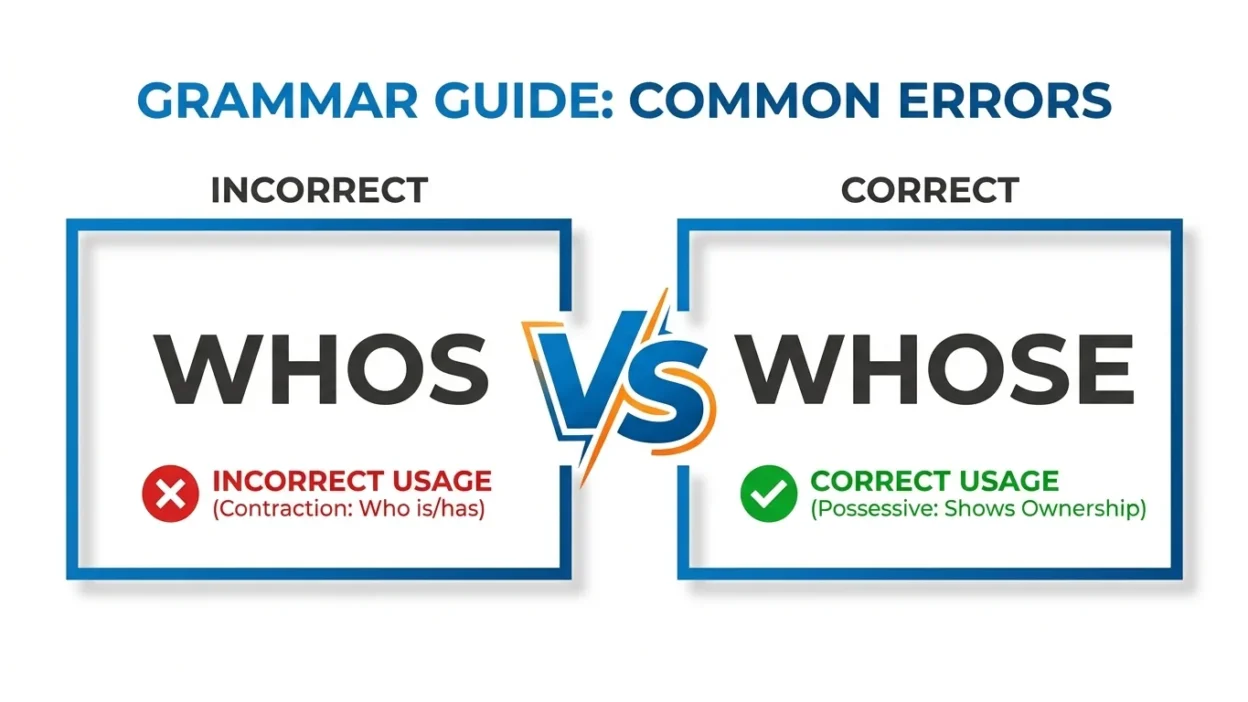
✅ Whose is the correct word in standard English.
❌ Whos is generally incorrect and is not accepted as a standard English word.
Examples
- Whose jacket is this? ✅
- I met a woman whose daughter is a doctor. ✅
- Whos jacket is this? ❌
If you’re asking about ownership or possession, whose is the word you need.
Whos vs Whose: Comparison Table
| Word | Correct? | Meaning | Example |
|---|---|---|---|
| Whose | ✅ Yes | Possessive form of who | Whose book is this? |
| Whos | ❌ No | Misspelling of whose or who’s | Whos book is this? |
What Does Whose Mean?
Whose is a possessive pronoun and determiner used to show ownership or relationship.
It answers questions such as:
- Who owns something?
- To whom does something belong?
- Which person is associated with something?
Examples of Whose
- Whose phone is ringing?
- Do you know whose car is parked outside?
- She is the author whose books became bestsellers.
- We visited a village whose history dates back centuries.
In all these examples, whose shows possession or connection.
Is Whos a Real Word?
In standard English, whos is generally considered incorrect.
Most of the time, people write whos when they actually mean:
- Whose (possessive)
- Who’s (contraction of who is or who has)
Examples
❌ Whos coming to the party?
✅ Who’s coming to the party?
❌ Whos bag is this?
✅ Whose bag is this?
Because of this confusion, whos is widely treated as a spelling mistake.
Understanding Whose
The easiest way to remember whose is to think about ownership.
Examples
- Whose keys are these?
- Whose idea was this?
- Do you know whose laptop is on the desk?
- The athlete whose performance impressed everyone won the race.
In every case, the word indicates possession.
Whose in Questions
One of the most common uses of whose is asking who owns something.
Examples
- Whose shoes are these?
- Whose notebook did you borrow?
- Whose turn is it?
- Whose responsibility is this?
These questions focus on ownership or association.
Whose in Relative Clauses
Whose can also connect two parts of a sentence.
Examples
- I know a teacher whose students consistently excel.
- We met a family whose house overlooks the ocean.
- She works for a company whose products are sold worldwide.
Here, whose links a person or thing to something they possess.
Whose vs Who’s
Many writers confuse whose and who’s, so it’s important to understand the difference.
Whose = Possession
Examples:
- Whose book is this?
- The writer whose novel won the award.
Who’s = Who Is / Who Has
Examples:
- Who’s coming to dinner?
- Who’s finished the project?
Comparison Table
| Word | Meaning | Example |
|---|---|---|
| Whose | Possession | Whose coat is this? |
| Who’s | Who is / Who has | Who’s ready to leave? |
| Whos | Incorrect | Whos ready to leave? |
This distinction helps eliminate many grammar mistakes.
Common Examples of Whose
At School
- Whose homework is missing?
- Whose project won first place?
At Work
- Whose presentation is scheduled next?
- Do you know whose desk this is?
In Everyday Life
- Whose dog is barking?
- Whose umbrella did you take?
In Writing
- The scientist whose research changed the field received an award.
- The musician whose songs inspired millions retired.
Common Mistakes to Avoid
Mistake #1: Writing Whos Instead of Whose
❌ Whos backpack is on the floor?
✅ Whose backpack is on the floor?
Mistake #2: Confusing Whose and Who’s
❌ Whose coming to the meeting?
✅ Who’s coming to the meeting?
Mistake #3: Using Whose for “Who Is”
❌ Whose ready to start?
✅ Who’s ready to start?
Mistake #4: Forgetting the Apostrophe in Who’s
Many writers accidentally remove the apostrophe.
❌ Whos going first?
✅ Who’s going first?
Memory Trick to Remember Whose
Here’s a simple trick:
Whose = Ownership
Think:
Whose = Possession
Ask yourself:
“Does this sentence involve ownership?”
If yes, use whose.
Examples
- Whose phone?
- Whose idea?
- Whose car?
All involve ownership.
Synonyms and Related Phrases
Depending on context, alternatives include:
- Belonging to whom
- Owned by whom
- Associated with whom
- Which person’s
- Of whom
Examples
- Whose bag is this?
- This bag belongs to whom?
While not always natural replacements, they help clarify meaning.
Why Do People Confuse Whos and Whose?
Several factors contribute to the confusion.
Similar Pronunciation
The words sound almost identical.
Missing Apostrophes
People often omit apostrophes when typing quickly.
Possessive Pronoun Patterns
Words like:
- His
- Hers
- Yours
do not contain apostrophes, making some writers uncertain about whose.
Auto-Correct and Informal Writing
Fast texting and social media habits sometimes lead to spelling shortcuts.
American vs British English
There is no significant difference between American and British English regarding whose.
Both varieties use:
✅ Whose
Both consider:
❌ Whos
to be incorrect in standard writing.
The same rules apply whether you’re writing for a US, UK, Canadian, Australian, or international audience.
FAQs About Whos vs Whose
Is whos a real word?
No. In standard English, whos is generally considered a misspelling.
What does whose mean?
Whose is a possessive word that indicates ownership or association.
Is whose the possessive form of who?
Yes. Whose is the possessive form of who.
What’s the difference between whose and who’s?
Whose shows possession, while who’s means who is or who has.
Is whose used in formal writing?
Yes. It is common in academic, business, and professional writing.
How can I remember whose?
Ask yourself whether the sentence involves ownership. If it does, use whose.
Can whose refer to things as well as people?
Yes. It can refer to both people and things.
Do British and American English use different spellings?
No. Both use whose.
Final Summary
When comparing whos vs whose, the correct choice is almost always whose. It is the possessive form of who and is used to show ownership, association, or relationship. The spelling whos is generally considered incorrect and usually results from confusing whose with who’s.
Mastering the difference is simple once you remember that whose relates to possession. Whether you’re asking about someone’s belongings, identifying a person’s connection to something, or writing a relative clause, whose is the word you need.
Actionable Takeaway
Before using whose, ask yourself:
“Am I talking about ownership or possession?”
If the answer is yes, use whose.
Also remember:
- Whose = Possession
- Who’s = Who is / Who has
- Whos = Usually incorrect
Keeping this rule in mind will help you write more accurately and confidently.

Joy Root is a content writer at Whygenix.com, creating clear, engaging articles that explain complex ideas simply, helping readers understand why topics matter in everyday life and personal growth.