Have you ever paused while writing and wondered whether occurring or occuring is the correct spelling? You’re not alone. This is one of the most common spelling mistakes in English because the word occur follows a consonant-doubling rule that many writers overlook.
Whether you’re writing an email, academic paper, blog post, business report, or social media update, using the correct spelling helps your writing appear professional and trustworthy. In this guide, you’ll learn the difference between occurring vs occuring, discover the grammar rule behind the correct form, see real-world examples, and pick up simple memory tricks to avoid this mistake in the future.
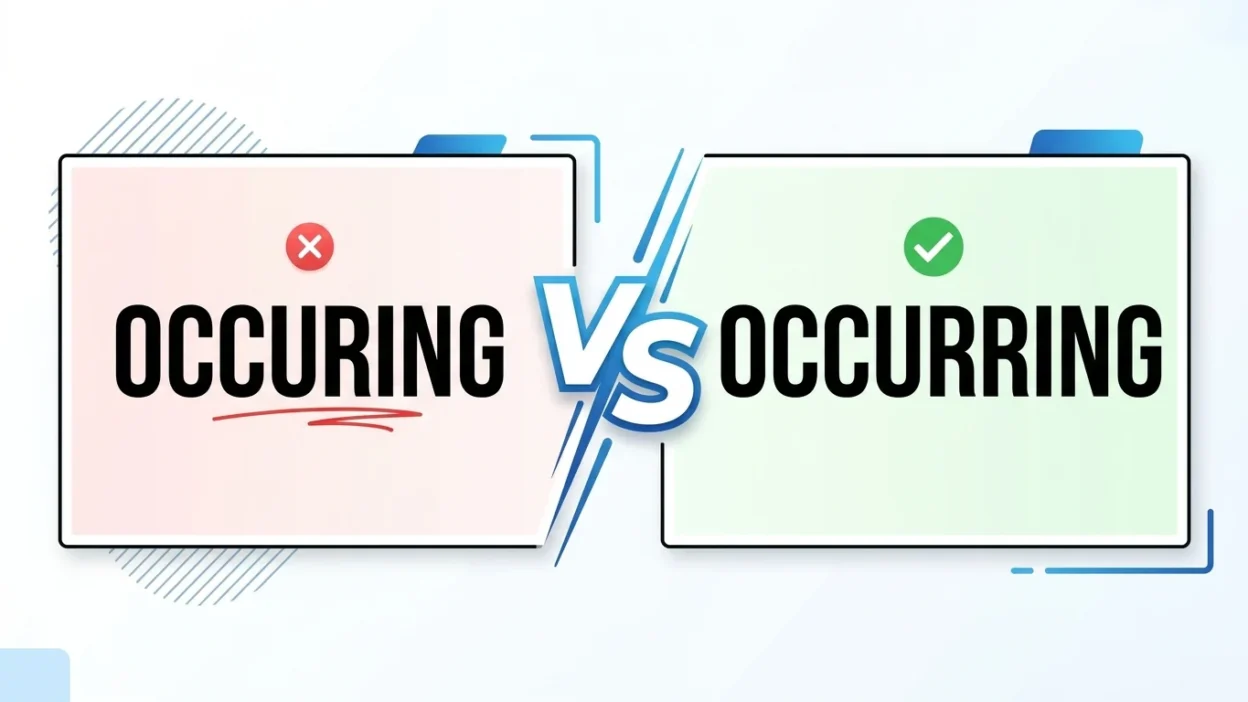
Quick Answer
✅ Occurring is the correct spelling.
❌ Occuring is incorrect and considered a spelling mistake.
Examples
- The meeting is occurring tomorrow. ✅
- Several changes are occurring within the company. ✅
- The meeting is occuring tomorrow. ❌
Whenever you add -ing to the verb occur, you must write occurring with two r letters.
Occurring vs Occuring: Comparison Table
| Word | Correct? | Meaning | Example |
|---|---|---|---|
| Occurring | ✅ Yes | Happening or taking place | The event is occurring today. |
| Occuring | ❌ No | Misspelling | The event is occuring today. |
What Does Occurring Mean?
Occurring is the present participle and gerund form of the verb occur.
The verb occur means:
- To happen
- To take place
- To exist
- To come to mind
- To arise
Examples of Occurring
- A festival is occurring downtown this weekend.
- Significant changes are occurring in the industry.
- The problem keeps occurring despite our efforts.
- Several meetings are occurring simultaneously.
- A new idea is occurring to me.
In each example, occurring means happening, taking place, or arising.
Is Occuring a Real Word?
No.
Occuring is not considered a correct English spelling. It appears frequently because people forget to double the final r before adding -ing.
Most dictionaries, grammar checkers, and style guides recognize only:
✅ Occurring
and reject:
❌ Occuring
Why Is It Occurring and Not Occuring?
The answer comes from a standard English spelling rule.
When a verb ends in:
- A stressed syllable
- One vowel
- Followed by one consonant
The final consonant is usually doubled before adding -ing.
Examples
| Base Verb | Correct -ing Form |
|---|---|
| Occur | Occurring |
| Refer | Referring |
| Begin | Beginning |
| Admit | Admitting |
| Prefer | Preferring |
Because occur ends with a stressed syllable (cur) and a final consonant (r), the r must be doubled.
Therefore:
Occur + ing = Occurring
Not:
Occur + ing = Occuring
Understanding the Grammar Rule
Let’s break the word down.
The verb occur has two syllables:
Oc-cur
The stress falls on the second syllable:
oc-CUR
Because the final syllable is stressed and ends with a vowel followed by a consonant, English spelling rules require doubling the final consonant.
Formula
Occur → Occurr → Occurring
This same pattern appears in many commonly used English words.
Common Uses of Occurring
1. Describing Events
Examples:
- The conference is occurring next month.
- The ceremony is occurring at noon.
- The accident is occurring near the city center.
2. Discussing Changes
Examples:
- Rapid growth is occurring across the industry.
- Significant improvements are occurring every year.
- Technological advancements are occurring worldwide.
3. Referring to Repeated Situations
Examples:
- The issue keeps occurring repeatedly.
- Errors are occurring in the system.
- Delays are occurring more frequently.
4. Ideas Coming to Mind
Examples:
- A solution is occurring to me now.
- The thought keeps occurring in my mind.
- New possibilities are occurring to the team.
Example Sentences Using Occurring
Here are some practical examples:
- A major event is occurring this weekend.
- Changes are occurring faster than expected.
- Several discussions are occurring at the same time.
- The phenomenon is occurring naturally.
- Construction work is occurring throughout the city.
- Similar incidents are occurring across the country.
Notice that every correct example uses occurring, never occuring.
Common Mistakes to Avoid
Mistake #1: Writing Occuring
❌ The event is occuring tonight.
✅ The event is occurring tonight.
Mistake #2: Forgetting the Double-R Rule
❌ Several changes are occuring.
✅ Several changes are occurring.
Mistake #3: Assuming Occur Is an Exception
Some writers believe occur simply takes -ing.
However, English spelling rules require doubling the final r.
Mistake #4: Confusing Pronunciation and Spelling
Although the extra r isn’t strongly emphasized in speech, it must appear in writing.
Memory Trick to Remember Occurring
Here’s an easy trick:
Occur Needs Another R Before ING
Think:
“Important events require an extra R.”
Visualize it like this:
- Occur
- Occurr
- Occurring
Another memory aid:
If something keeps recurring, remember the extra R in occurring.
Related Words That Follow the Same Rule
Many English words use the same consonant-doubling pattern.
| Base Word | Correct Form |
|---|---|
| Occur | Occurring |
| Refer | Referring |
| Prefer | Preferring |
| Admit | Admitting |
| Begin | Beginning |
| Regret | Regretting |
Learning these patterns makes English spelling much easier.
Why Do People Misspell Occurring?
Several factors contribute to the confusion.
Fast Typing
People often accidentally leave out one r.
Complex Spelling Rules
Consonant doubling isn’t always intuitive.
Pronunciation Differences
The doubled consonant isn’t always obvious when spoken.
Lack of Proofreading
Many instances of occuring are simple typing errors.
Fortunately, understanding the rule makes the correct spelling easier to remember.
American vs British English
There is no difference between American and British English regarding this word.
Both varieties use:
✅ Occurring
Both consider:
❌ Occuring
to be incorrect.
Whether you’re writing for a US, UK, Canadian, Australian, or international audience, occurring is always the correct spelling.
FAQs About Occurring vs Occuring
Is occuring ever correct?
No. Occuring is not considered a correct English spelling.
What is the correct spelling?
Occurring is the correct spelling.
Why does occurring have two r’s?
Because the verb occur follows the consonant-doubling rule before adding -ing.
Is occurring a verb?
It is the present participle and gerund form of the verb occur.
What does occurring mean?
It means happening, taking place, existing, or arising.
Do British and American English spell it differently?
No. Both use occurring.
How can I remember the correct spelling?
Remember: Occur needs another R before ING.
Is occurring used in formal writing?
Yes. It is common in academic, professional, scientific, and everyday writing.
Final Summary
When comparing occurring vs occuring, the correct spelling is occurring. The word comes from the verb occur, and English grammar requires doubling the final r before adding -ing. As a result, occurring is the only standard spelling accepted in formal and informal writing.
Although occuring is a common mistake, it’s easy to avoid once you understand the rule. Whether you’re describing an event, a change, a situation, or an idea that comes to mind, always use occurring with two r letters.
Actionable Takeaway
Whenever you write the word occur with -ing, remember this formula:
Occur + ing = Occurring
Never write occuring. Keeping the extra r will make your writing more accurate, professional, and grammatically correct.

Bret Lee writes educational and research-based content for Whygenix.com, focused on clarity, accuracy, and explaining why concepts matter through simple, engaging, reader-friendly writing.