Have you ever typed “compair” and wondered whether it is a correct English word? You’re not alone. Many English learners and even native speakers occasionally confuse compair vs compare because the words sound somewhat similar when spoken quickly.
The good news is that the answer is simple. In modern English, compare is the correct spelling, while compair is generally considered a misspelling. Understanding the difference can help you write more accurately in emails, essays, business documents, and everyday communication.
Quick Answer
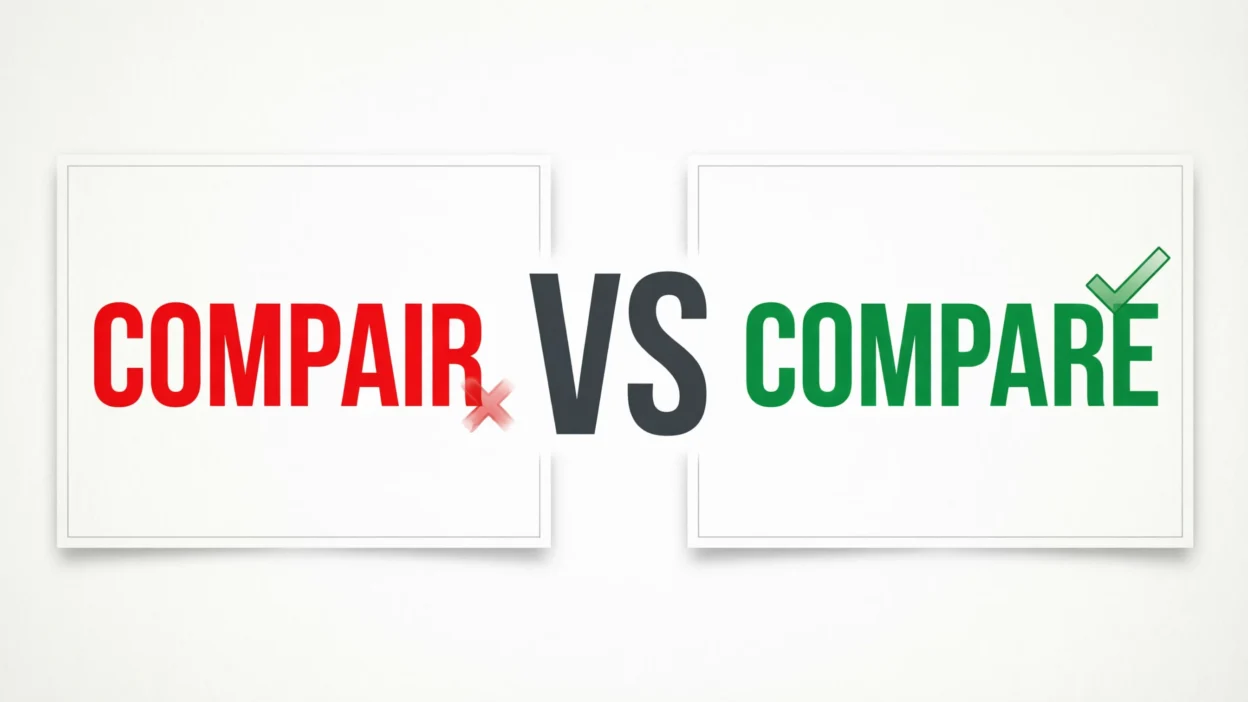
✅ Compare = Correct English spelling
❌ Compair = Incorrect spelling (common typo or misspelling)
Example:
- Correct: Please compare the two products before buying.
- Incorrect: Please compair the two products before buying.
If you’re choosing between compair vs compare, always use compare.
What Does “Compare” Mean?
The word compare is a verb that means to examine two or more things to identify similarities and differences.
People compare things every day, such as:
- Products
- Prices
- Cars
- Schools
- Job offers
- Ideas
- Performance results
Examples of Compare in Sentences
- I need to compare these two laptops before making a decision.
- Teachers often compare student performance over time.
- Let’s compare the prices from different stores.
- The report compares last year’s sales with this year’s results.
- It is helpful to compare several options before investing money.
In each example, compare means evaluating similarities or differences between things.
Is “Compair” a Real Word?
In standard modern English, compair is not considered the correct spelling of the verb.
Most dictionaries recognize compare as the proper form. When people write compair, it is usually because:
- They are spelling the word based on pronunciation.
- They accidentally swap the letters.
- English is not their first language.
- It is a typing mistake.
Example
❌ Can you compair these documents?
✅ Can you compare these documents?
Therefore, if you’re writing formal or informal English, compare is always the spelling you should use.
Compair vs Compare: Side-by-Side Comparison
| Feature | Compair | Compare |
|---|---|---|
| Correct English spelling | ❌ No | ✅ Yes |
| Found in modern dictionaries | ❌ No | ✅ Yes |
| Accepted in academic writing | ❌ No | ✅ Yes |
| Accepted in business writing | ❌ No | ✅ Yes |
| Meaning | Misspelling | Examine similarities and differences |
| Recommended usage | Never | Always |
Why Do People Write “Compair” Instead of “Compare”?
The confusion usually comes from pronunciation patterns in English.
Words such as:
- Pair
- Fair
- Chair
- Repair
contain the letter combination “air.”
Because of this, some writers mistakenly assume that compare should be spelled compair.
However, English spelling often follows historical patterns rather than pronunciation alone. The correct form has always remained compare.
Examples of Correct Usage
Here are several examples showing how to use compare properly.
In Everyday Conversation
- Compare the two photos and tell me which one looks better.
- We compared our answers after the exam.
In Business Writing
- The manager compared quarterly performance reports.
- Investors compare market trends before making decisions.
In Academic Writing
- The essay compares two different theories.
- Students must compare and contrast the novels.
In Online Shopping
- Compare prices before making a purchase.
- Many websites allow users to compare products side by side.
Common Mistakes Related to Compair vs Compare
Many writers make similar spelling errors. Here are a few examples.
| Incorrect | Correct |
|---|---|
| Compair | Compare |
| Recieve | Receive |
| Definately | Definitely |
| Seperate | Separate |
| Untill | Until |
A helpful tip is to proofread carefully and use spell-check tools when writing important documents.
Easy Trick to Remember the Correct Spelling
One simple memory trick is:
Compare contains the word “pare.”
Think of the phrase:
“Compare before you prepare.”
Both words use “pare” rather than “pair.”
This can help you remember that compare is the correct spelling every time.
Compare in Different Forms
The word compare can appear in several grammatical forms.
| Form | Example |
|---|---|
| Compare | Compare the options carefully. |
| Compares | She compares prices online. |
| Compared | We compared the results yesterday. |
| Comparing | They are comparing different plans. |
| Comparison | The comparison was helpful. |
| Comparative | This is a comparative study. |
All of these forms come from the correctly spelled root word compare.
Compare vs Compare and Contrast
Many students encounter the phrase compare and contrast.
Although they seem similar, there is a subtle difference.
Compare
Focuses on similarities and differences.
Example:
- Compare the two smartphones.
Compare and Contrast
Explicitly asks for both similarities and differences.
Example:
- Compare and contrast city life and rural life.
In education, teachers often use both terms when assigning essays or reports.
American vs British English
When discussing compair vs compare, there is no difference between American and British English.
Both varieties use:
✅ Compare
Both reject:
❌ Compair
Whether you are writing in the United States, the United Kingdom, Canada, Australia, or elsewhere, compare remains the standard spelling.
Related Words and Synonyms
Depending on the context, you can sometimes replace compare with similar words.
Synonyms of Compare
- Examine
- Evaluate
- Assess
- Contrast
- Analyze
- Review
- Measure
- Match
- Inspect
Example
Original:
- Compare the results.
Alternative:
- Evaluate the results.
- Analyze the results.
- Assess the results.
These alternatives can improve writing variety while maintaining clarity.
When Should You Use Compare?
Use compare whenever you are:
- Looking at similarities
- Identifying differences
- Evaluating options
- Reviewing performance
- Analyzing information
- Making decisions
Examples
- Compare insurance plans before choosing one.
- Compare job offers carefully.
- Compare different learning methods.
- Compare travel packages before booking.
In all these situations, compare is the correct word.
Frequently Asked Questions (FAQs)
Is compair a correct English word?
No. In modern standard English, compair is considered a misspelling. The correct word is compare.
Which is correct: compair or compare?
Compare is correct. Compair is incorrect.
Why do people spell compare as compair?
Many people spell it based on pronunciation or confuse it with words that contain the letter combination air, such as pair or repair.
Can I use compair in formal writing?
No. Formal writing should always use compare.
Is compare a noun or a verb?
Compare is primarily a verb. The related noun form is comparison.
Is compare used in both American and British English?
Yes. Both American and British English use compare as the standard spelling.
What is the past tense of compare?
The past tense is compared.
Example:
- We compared the results last week.
What is a synonym for compare?
Common synonyms include evaluate, assess, examine, analyze, and contrast.
Summary
The debate over compair vs compare has a straightforward answer. Compare is the correct spelling recognized by dictionaries, educational institutions, businesses, and professional writers. Compair is simply a spelling mistake that often occurs because of pronunciation-based assumptions.
Whenever you need to examine similarities or differences between people, products, ideas, or situations, choose compare. Remember that this rule remains the same in both American and British English. Using the correct spelling will make your writing look more professional, accurate, and trustworthy.
Actionable Takeaway
Before submitting any email, essay, report, or social media post, quickly check for the word compare. If you see compair, replace it immediately. Building this small proofreading habit can significantly improve your writing accuracy and confidence.

Bret Lee writes educational and research-based content for Whygenix.com, focused on clarity, accuracy, and explaining why concepts matter through simple, engaging, reader-friendly writing.