Have you ever typed “studing” and wondered whether it is correct? You are not alone. Many English learners and even native speakers sometimes get confused when adding -ing to verbs. One of the most common spelling questions is studying vs studing.
The good news is that the answer is simple. Understanding why one spelling is correct and the other is not can help you avoid similar mistakes in the future. In this guide, you’ll learn the difference between studying and studing, see examples, discover common errors, and learn an easy rule you can apply to many other words.
Quick Answer
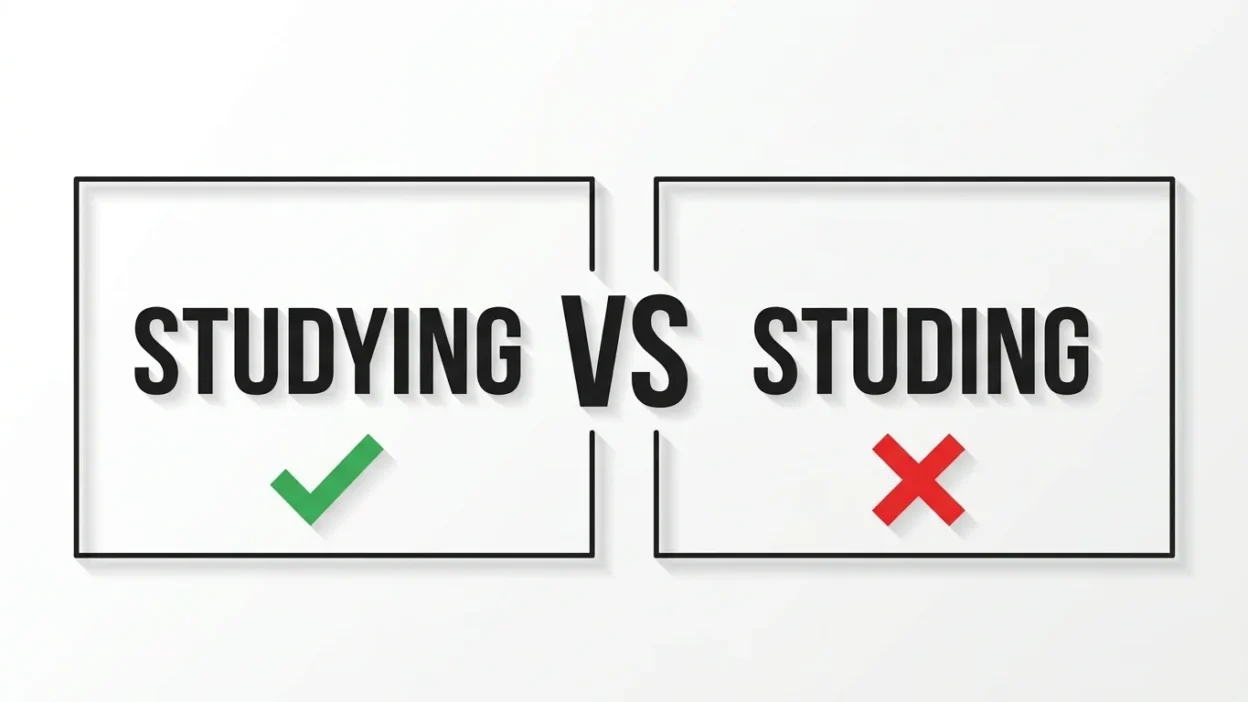
✅ Studying is the correct spelling.
❌ Studing is incorrect and is not recognized as a standard English word.
The verb study changes to studying when adding the -ing ending because the letter y remains after a consonant and simply takes -ing.
Correct: I am studying for my exam.
Incorrect: I am studing for my exam.
What Does “Studying” Mean?
Studying is the present participle and gerund form of the verb study.
The word study means:
- To learn about a subject
- To examine something carefully
- To prepare for an exam or test
- To gain knowledge through reading, observation, or practice
Examples of Studying
- She is studying mathematics at university.
- We are studying English grammar today.
- They spent the evening studying for the final exam.
- He enjoys studying history in his free time.
- I am studying the instructions carefully.
In all these examples, studying is the correct spelling.
Is “Studing” a Real Word?
No. Studing is not a correct English spelling.
The mistake usually happens when writers forget that the base word ends with y. Instead of removing the y, English spelling rules require it to stay when adding -ing.
Incorrect Examples
- I am studing for tomorrow’s test.
- She is studing biology.
- They were studing all night.
Each sentence should use studying instead.
Correct Versions
- I am studying for tomorrow’s test.
- She is studying biology.
- They were studying all night.
Studying vs Studing: Side-by-Side Comparison
| Feature | Studying | Studing |
|---|---|---|
| Correct English spelling | ✅ Yes | ❌ No |
| Dictionary word | ✅ Yes | ❌ No |
| Present participle of study | ✅ Yes | ❌ No |
| Accepted in academic writing | ✅ Yes | ❌ No |
| Accepted in professional writing | ✅ Yes | ❌ No |
The comparison clearly shows that studying is the only correct form.
Why Is “Studying” Correct?
To understand the spelling, look at the base verb:
Study
When adding -ing, the y stays:
Study + ing = Studying
This follows a common English spelling rule.
Rule for Verbs Ending in Y
When a verb ends in a consonant followed by y, keep the y and add -ing.
Examples:
| Base Verb | -ing Form |
|---|---|
| Study | Studying |
| Carry | Carrying |
| Cry | Crying |
| Try | Trying |
| Reply | Replying |
Notice that the y remains in every example.
Common Mistakes People Make
Many learners mistakenly think the y should be removed before adding -ing.
Mistake 1: Dropping the Y
❌ Studing
✅ Studying
Mistake 2: Mixing Up Grammar Rules
Some people confuse the rule for adding -ed with the rule for adding -ing.
For example:
- Study → Studied (correct)
- Study → Studying (correct)
Notice that the spelling changes differently depending on the ending.
Mistake 3: Fast Typing Errors
When typing quickly, writers often skip the y accidentally.
Always proofread academic assignments, emails, and reports to catch these errors.
Examples of Studying in Sentences
Here are practical examples showing how studying is used naturally.
Education
- She is studying engineering at college.
- We are studying chemistry this semester.
- The students are studying for their final exams.
Research
- Scientists are studying climate patterns.
- Researchers are studying human behavior.
Careful Observation
- He is studying the map before the trip.
- The detective was studying the evidence.
Personal Development
- I am studying Spanish online.
- They are studying new business strategies.
Memory Trick to Remember the Correct Spelling
A simple trick is to remember the original word:
Study
If you can still see the word study, then adding -ing becomes easy:
Study → Studying
Think:
“Keep the Y and add ING.”
This quick reminder prevents the common mistake of writing studing.
American vs British English
One helpful fact is that there is no difference between American and British English in this case.
| Version | Correct Spelling |
|---|---|
| American English | Studying |
| British English | Studying |
| Australian English | Studying |
| Canadian English | Studying |
English-speaking countries all use studying.
Similar Words That Follow the Same Rule
Learning related examples helps reinforce the pattern.
Carry → Carrying
- She is carrying a heavy bag.
Cry → Crying
- The baby is crying loudly.
Try → Trying
- I am trying my best.
Reply → Replying
- He is replying to emails.
Apply → Applying
- She is applying for a job.
Just like studying, all these words keep the y.
When Should You Use “Studying”?
Use studying whenever you need:
- A present participle
- A continuous verb tense
- A gerund acting as a noun
Present Continuous
- I am studying right now.
Past Continuous
- They were studying all evening.
Future Continuous
- She will be studying tomorrow.
Gerund Form
- Studying improves knowledge.
In every situation, studying remains the correct spelling.
Why Correct Spelling Matters
Correct spelling improves:
- Academic performance
- Professional communication
- Reader confidence
- Writing quality
- Search visibility
Using incorrect spellings such as studing can make essays, emails, and online content appear less polished.
Whether you’re writing a school assignment, blog post, or business document, choosing studying demonstrates strong language skills.
Frequently Asked Questions (FAQs)
1. Is studying or studing correct?
Studying is correct. Studing is incorrect.
2. Why does studying keep the letter y?
Because verbs ending in a consonant plus y keep the y when adding -ing.
3. Is studing accepted in any dictionary?
No. Standard English dictionaries do not recognize studing as a correct spelling.
4. How do you spell studying in British English?
It is spelled studying, exactly the same as in American English.
5. Is studying a verb or a noun?
It can function as both. It is a verb form in continuous tenses and a noun when used as a gerund.
6. What is the past tense of study?
The past tense is studied.
Example:
- I studied English yesterday.
7. How can I avoid spelling studying incorrectly?
Remember the rule:
Keep the Y + add ING = Studying
8. Are there other words like studying?
Yes. Examples include:
- Carrying
- Trying
- Crying
- Replying
- Applying
Summary
The debate over studying vs studing has a straightforward answer: studying is the only correct spelling. The word comes from the verb study, and when adding -ing, the letter y remains. As a result, studying follows standard English spelling rules, while studing is simply a common mistake.
Whether you are writing academic papers, preparing professional documents, or improving your English skills, using the correct form helps your writing appear polished and credible. Understanding this rule will also help you spell similar words correctly in the future.
Actionable Takeaway
Whenever you add -ing to study, remember this simple formula:
Study + ing = Studying
If you ever see studing, treat it as a spelling error and replace it with studying. Keeping the y is the key to getting it right every time.

Joy Root is a content writer at Whygenix.com, creating clear, engaging articles that explain complex ideas simply, helping readers understand why topics matter in everyday life and personal growth.