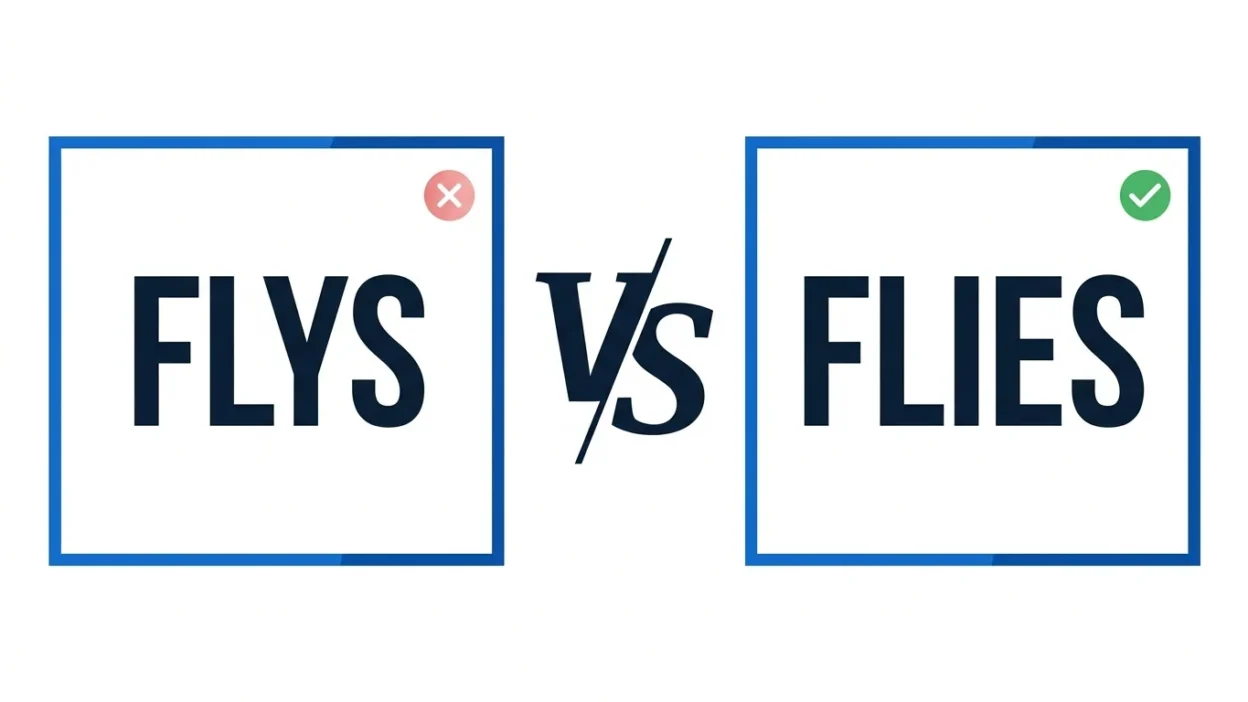
Have you ever paused while writing and wondered whether flys or flies is the correct spelling? You’re not alone. This pair of words causes confusion because both forms exist in English, but they are used in different situations. As a result, many writers accidentally choose the wrong one.
Understanding the difference between flys vs flies can improve your grammar, spelling, and overall writing quality. Whether you’re talking about insects, air travel, fishing equipment, or someone flying through the air, knowing which word to use will help you communicate clearly and confidently.
Quick Answer
In most situations, flies is the correct word.
✅ Flies = plural of fly (the insect) or the third-person singular form of the verb fly.
⚠️ Flys is much less common and is primarily used as a noun in specialized contexts, such as parts of tents or certain fishing terms.
Examples
- The bird flies across the lake. ✅
- Several flies landed on the fruit. ✅
- The tent has removable flys. ⚠️ (specialized usage)
For everyday writing, you’ll almost always use flies.
Flys vs Flies: Comparison Table
| Feature | Flys | Flies |
|---|---|---|
| Common English Usage | Rare | Very Common |
| Plural of Fly (Insect) | ❌ No | ✅ Yes |
| Verb Form of Fly | ❌ No | ✅ Yes |
| Specialized Noun Usage | ✅ Sometimes | ❌ Usually No |
| Recommended for Most Writing | ❌ No | ✅ Yes |
What Does Flies Mean?
Flies has two primary meanings in English.
1. Plural of Fly (The Insect)
When referring to more than one fly, the correct plural form is flies.
Examples:
- The kitchen was full of flies.
- Several flies gathered around the fruit bowl.
- Farmers often struggle with flies during summer.
2. Third-Person Singular Form of Fly
When someone or something performs the action of flying, we use flies.
Examples:
- The airplane flies to London every day.
- She flies frequently for work.
- The eagle flies high above the mountains.
This is the most common usage of flies in everyday English.
What Does Flys Mean?
Flys is a much rarer word.
In specialized contexts, flys can refer to:
- Tent fly coverings
- Parts of tents
- Certain fishing-related items
- Specific technical or industry terminology
Examples:
- The camping store sells waterproof tent flys.
- The damaged flys needed replacement.
Outside these niche uses, flys is generally not the word you want.
Why Is the Plural Fly → Flies?
Many people wonder why we don’t simply add -s to make flys.
The answer lies in an important English spelling rule.
When a noun ends in:
- Consonant + y
The y changes to i, and -es is added.
Examples
| Singular | Plural |
|---|---|
| Fly | Flies |
| Baby | Babies |
| City | Cities |
| Lady | Ladies |
| Story | Stories |
Because fly ends with a consonant (l) followed by y, the correct plural becomes:
Fly → Flies
Not:
Fly → Flys
Why Do People Confuse Flys and Flies?
There are several reasons.
1. Simple Plural Assumptions
Many English learners assume every noun forms its plural by adding -s.
Examples:
- Book → Books
- Car → Cars
- Dog → Dogs
They then incorrectly apply the same pattern:
- Fly → Flys ❌
2. Similar Pronunciation
In conversation, the difference isn’t always obvious, especially for non-native speakers.
3. Rare Specialized Usage
Because flys occasionally appears in camping or fishing contexts, some writers assume it’s interchangeable with flies.
However, in most situations, it is not.
Common Uses of Flies
Talking About Insects
Examples:
- Flies can spread germs.
- Houseflies are common during warm weather.
- The flies disappeared after the kitchen was cleaned.
Talking About Air Travel
Examples:
- He flies to New York every month.
- The airline flies internationally.
- She flies business class whenever possible.
Talking About Birds and Animals
Examples:
- The eagle flies gracefully.
- A bat flies at night.
- The butterfly flies from flower to flower.
Figurative Expressions
Examples:
- Time flies when you’re having fun.
- The weeks fly by quickly.
- Opportunities can fly away if ignored.
Example Sentences Side by Side
| Flys | Flies |
|---|---|
| The tent flys were replaced. | The airplane flies daily. |
| Waterproof flys protect campers. | Several flies landed on the table. |
| Specialized camping flys are available. | Time flies during vacations. |
Notice how flies dominates normal English usage.
Common Mistakes to Avoid
Mistake #1: Using Flys as the Plural of Fly
❌ There were many flys in the room.
✅ There were many flies in the room.
Mistake #2: Using Flys as a Verb
❌ The bird flys south every winter.
✅ The bird flies south every winter.
Mistake #3: Assuming Flys Is Always Wrong
While uncommon, flys can be correct in specialized contexts involving tent coverings and related equipment.
Mistake #4: Forgetting the Y-to-IES Rule
Remember:
- Fly → Flies
- Baby → Babies
- City → Cities
This rule helps prevent many spelling errors.
Memory Trick to Remember the Difference
A simple trick is:
Flies = Flying or Multiple Flies
Think:
“Y changes to IES when there are many.”
Examples:
- One fly
- Two flies
Or:
- He flies
- She flies
Flys = Rare Specialized Word
If you’re not discussing tents or technical equipment, you probably need flies.
Synonyms and Related Words
Depending on context, words related to flies include:
For Insects
- Houseflies
- Insects
- Bugs
- Gnats
- Pests
For Flying
- Soars
- Glides
- Travels
- Airborne movement
- Takes flight
These related terms can improve writing variety and SEO relevance.
American vs British English
There is no major difference between American and British English regarding flys and flies.
Both varieties use:
✅ Flies for:
- The plural of fly
- The verb form of fly
Both recognize flys only in limited specialized contexts.
Therefore, regardless of your audience, flies is usually the correct choice.
FAQs About Flys vs Flies
Is flies the correct plural of fly?
Yes. The plural of the insect fly is flies.
Is flys a real word?
Yes, but it is rare and mostly used in specialized contexts such as camping and fishing.
Which is more common, flys or flies?
Flies is dramatically more common in everyday English.
Why does fly become flies?
Because nouns ending in a consonant plus y typically change y to ies in the plural form.
Is it “the bird flies” or “the bird flys”?
The correct phrase is “the bird flies.”
Is flys ever correct in everyday writing?
Usually not. Most writers will almost always need flies.
Do Americans and British people use different spellings?
No. Both American and British English follow the same rules.
What is the easiest way to remember the difference?
Remember that flies is used for insects and flying actions, while flys appears only in rare specialized situations.
Final Summary
The difference between flys vs flies is straightforward once you understand the grammar rules. Flies is the standard spelling used as the plural form of fly and as the third-person singular form of the verb fly. It is the version you’ll encounter in everyday conversation, writing, literature, business communication, and education.
While flys is technically a real word in certain niche contexts, it is uncommon and rarely needed by most writers. If you’re talking about insects, birds, airplanes, or the action of flying, flies is almost certainly the correct choice.
Actionable Takeaway
Before using either word, ask yourself:
Am I talking about insects or something that flies?
If the answer is yes, use flies.
Only use flys when referring to specialized items such as tent fly coverings or other technical meanings. Following this simple rule will help you avoid one of the most common spelling mistakes involving the word fly.

Bret Lee writes educational and research-based content for Whygenix.com, focused on clarity, accuracy, and explaining why concepts matter through simple, engaging, reader-friendly writing.