Have you ever typed “gummie” and wondered whether it should actually be “gummy”? You’re not alone. Many English learners, writers, and even native speakers get confused by these similar-looking words.
The good news is that the answer is straightforward. While both forms may appear online, only one is recognized as the standard spelling in modern English. Understanding the difference can help you write more accurately and avoid common spelling mistakes.
Quick Answer
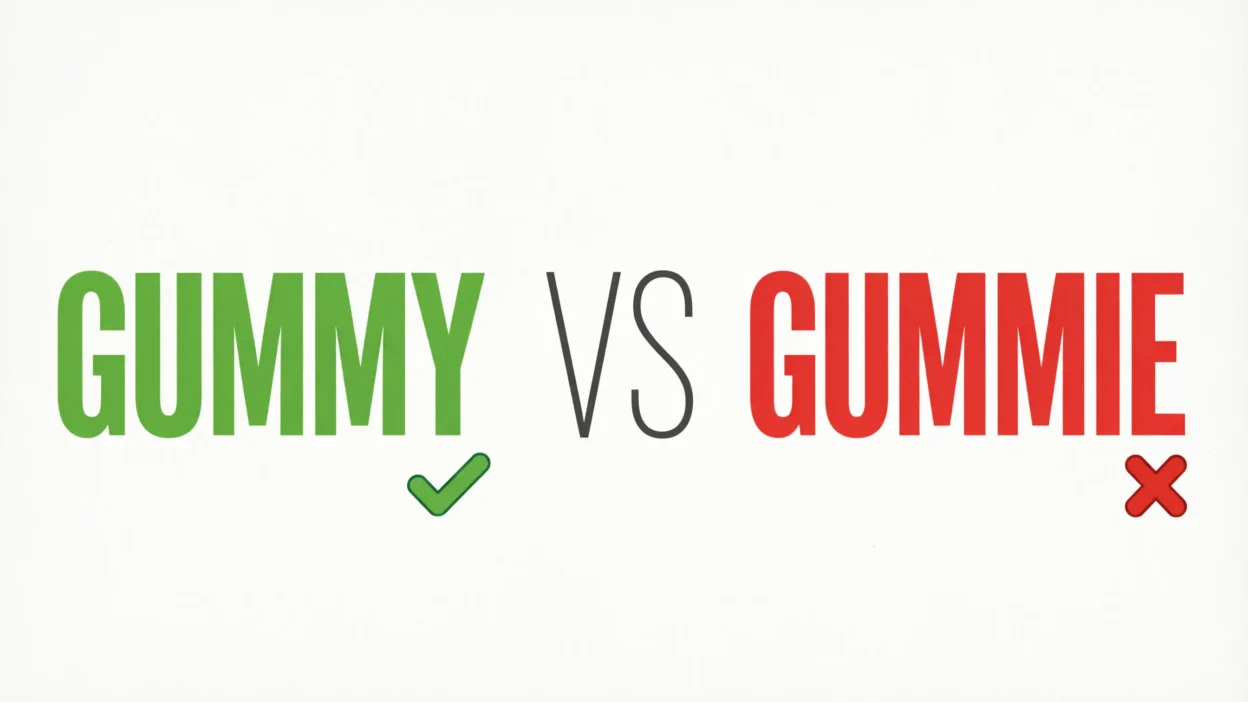
Gummy is the correct and standard spelling in English.
Gummie is generally considered a misspelling of gummy and is rarely accepted in formal writing.
✅ Correct: These gummy candies are delicious.
❌ Incorrect: These gummie candies are delicious.
What Does “Gummy” Mean?
The word gummy is an adjective used to describe something that has a sticky, soft, or rubbery texture. It is commonly associated with candy, vitamins, and substances that resemble gum.
Definition of Gummy
Gummy (adjective):
- Sticky or covered with a gum-like substance
- Soft and chewy in texture
- Similar to rubber or gelatin
Examples
- I bought a pack of gummy bears for the trip.
- The glue became gummy after drying.
- My child prefers gummy vitamins instead of tablets.
- The candy had a sweet and gummy texture.
What Does “Gummie” Mean?
In most situations, gummie is simply an incorrect spelling of gummy.
Some people mistakenly add “-ie” because many English words use that ending, such as:
- cookie
give me in chat
Gummy vs Gummie: Which Spelling Is Correct and When Should You Use It?
Have you ever seen the words gummy and gummie and wondered which one is correct? Since both spellings look similar, it’s easy to assume they are interchangeable. However, only one is considered the standard spelling in modern English.
Whether you’re writing about gummy bears, gummy vitamins, or describing a sticky texture, using the correct spelling is important for clear communication. This guide explains the difference between gummy vs gummie, provides examples, highlights common mistakes, and helps you remember the correct form every time.
Quick Answer
Gummy is the correct spelling and the standard form used in English.
Gummie is generally considered a misspelling and should be avoided in formal, academic, professional, and everyday writing.
✅ Correct: I bought some gummy bears from the store.
❌ Incorrect: I bought some gummie bears from the store.
What Does “Gummy” Mean?
The word gummy is an adjective that describes something sticky, chewy, soft, or gum-like in texture. It is commonly used for candies, vitamins, and substances that resemble gum.
Definition of Gummy
Gummy (adjective):
- Sticky or covered with a gum-like substance
- Soft and chewy in texture
- Resembling gelatin or rubber
- Difficult to chew because of stickiness
Examples of Gummy in Sentences
- My favorite snack is gummy bears.
- These gummy vitamins taste better than pills.
- The adhesive became gummy after exposure to heat.
- The candy had a sweet and gummy texture.
- The child’s hands felt gummy after eating sweets.
What Does “Gummie” Mean?
In standard English dictionaries, gummie is not recognized as the preferred spelling of the word.
Most of the time, gummie appears because of a spelling error or misunderstanding of English spelling patterns. While you may occasionally see it online, it is not considered correct in formal writing.
Why Do People Write “Gummie”?
Many English words form informal or plural-like variations ending in -ie, such as:
- cookie
- brownie
- sweetie
- veggie
Because of these patterns, some writers mistakenly assume that gummie is acceptable. However, standard English uses gummy.
Gummy vs Gummie: Side-by-Side Comparison
| Feature | Gummy | Gummie |
|---|---|---|
| Correct English spelling | ✅ Yes | ❌ No |
| Found in dictionaries | ✅ Yes | ❌ Rarely |
| Suitable for formal writing | ✅ Yes | ❌ No |
| Commonly used in marketing | ✅ Yes | ❌ No |
| Accepted in academic writing | ✅ Yes | ❌ No |
| Recommended spelling | ✅ Yes | ❌ No |
Why Is “Gummy” the Correct Spelling?
The adjective gummy comes from the noun gum.
When English forms adjectives from certain nouns ending in a consonant, the final consonant is often doubled before adding -y.
Similar Examples
| Base Word | Adjective |
|---|---|
| fog | foggy |
| mud | muddy |
| fun | funny |
| gum | gummy |
Because of this common spelling rule, gummy follows standard English conventions.
Common Uses of the Word “Gummy”
The word appears in many everyday contexts.
1. Gummy Candy
The most common usage.
Examples:
- gummy bears
- gummy worms
- gummy rings
- fruit gummies
2. Gummy Vitamins
Chewable supplements designed for easier consumption.
Examples:
- children’s gummy vitamins
- gummy multivitamins
- gummy probiotics
3. Gummy Texture
Used to describe something sticky or chewy.
Examples:
- gummy rice
- gummy dough
- gummy residue
4. Gummy Materials
Describing substances that become sticky.
Examples:
- gummy glue
- gummy adhesive
- gummy resin
Common Mistakes People Make
Mistake #1: Using Gummie in Professional Writing
❌ The company launched new gummie supplements.
✅ The company launched new gummy supplements.
Mistake #2: Assuming Both Spellings Are Correct
Many people believe both versions are acceptable because they look similar.
However, dictionaries and style guides consistently favor gummy.
Mistake #3: Copying Incorrect Online Spellings
The internet contains many spelling mistakes. Just because you see gummie online doesn’t mean it is correct.
Always verify spellings using reliable sources.
Easy Trick to Remember the Correct Spelling
Think about these familiar words:
- funny
- muddy
- foggy
- gummy
Notice how they all end in -y rather than -ie.
If funny is correct instead of funnie, then gummy is correct instead of gummie.
Is There a Difference Between American and British English?
No.
Both American English and British English use gummy as the standard spelling.
American English
- gummy bears
- gummy vitamins
- gummy candy
British English
- gummy sweets
- gummy texture
- gummy residue
The spelling remains exactly the same in both varieties of English.
Synonyms and Related Words
Depending on context, these words may be similar to gummy:
- Sticky
- Chewy
- Gelatinous
- Soft
- Rubbery
- Elastic
- Gooey
- Viscous
- Tacky
- Gum-like
These related terms can improve vocabulary variety in your writing.
Examples of Correct Usage
Here are more sentence examples using gummy correctly:
- She packed several bags of gummy bears for the road trip.
- The vitamins come in a tasty gummy form.
- The mixture became gummy after cooling.
- Children often prefer gummy supplements over tablets.
- The candy remained soft and gummy even after several days.
- The adhesive left a gummy residue on the surface.
- I enjoy gummy fruit snacks as an afternoon treat.
- The dough became too gummy because of excess moisture.
When Should You Use “Gummy”?
Use gummy whenever you are referring to:
- Gummy bears
- Gummy worms
- Gummy candy
- Gummy vitamins
- Sticky textures
- Gum-like substances
- Chewy foods
In virtually every modern English writing situation, gummy is the correct choice.
Frequently Asked Questions (FAQs)
1. Is gummy or gummie correct?
Gummy is the correct and standard English spelling. Gummie is generally considered a misspelling.
2. Is gummie a real word?
It occasionally appears online, but it is not recognized as the preferred standard spelling in English.
3. Why is gummy spelled with a “y”?
The spelling follows a common English pattern seen in words like foggy, muddy, and funny.
4. Are gummy bears spelled with “y” or “ie”?
They are always spelled gummy bears.
5. Do dictionaries include gummie?
Most major dictionaries recognize gummy as the standard form and do not recommend gummie.
6. Is gummy used in both American and British English?
Yes. Both American and British English use the spelling gummy.
7. Can I use gummie in formal writing?
No. Formal writing should use gummy.
8. How can I remember the correct spelling?
Think of similar words like funny, muddy, and foggy. They all end in -y, just like gummy.
Summary
When comparing gummy vs gummie, the correct choice is simple: gummy is the accepted spelling in modern English. It is used in dictionaries, professional writing, product packaging, educational materials, and everyday communication. The spelling gummie is generally regarded as a mistake and should be avoided.
If you want your writing to look polished and professional, always choose gummy. Whether you’re talking about gummy bears, gummy vitamins, gummy candy, or a sticky texture, the standard spelling remains the same. Remember the pattern used in words like funny and muddy, and you’ll never have trouble choosing the correct form again.
Actionable Takeaway
Whenever you write about chewy candies, supplements, or sticky textures, use gummy with a “y.” Before publishing content, quickly check for accidental uses of gummie and replace them with the correct spelling to maintain accuracy and professionalism.

Bret Lee writes educational and research-based content for Whygenix.com, focused on clarity, accuracy, and explaining why concepts matter through simple, engaging, reader-friendly writing.