Have you ever typed “posses” when you meant “possess” and wondered if it was correct? You’re not alone. These two words look very similar, but they have completely different meanings and uses in English. Because of their similar spelling, many writers, students, and even native speakers occasionally confuse them.
Understanding the difference between possess vs posses can help you avoid spelling mistakes and communicate more clearly. In this guide, you’ll learn the correct meaning of each word, see examples, discover common errors, and find easy tips to remember the right spelling every time.
Quick Answer
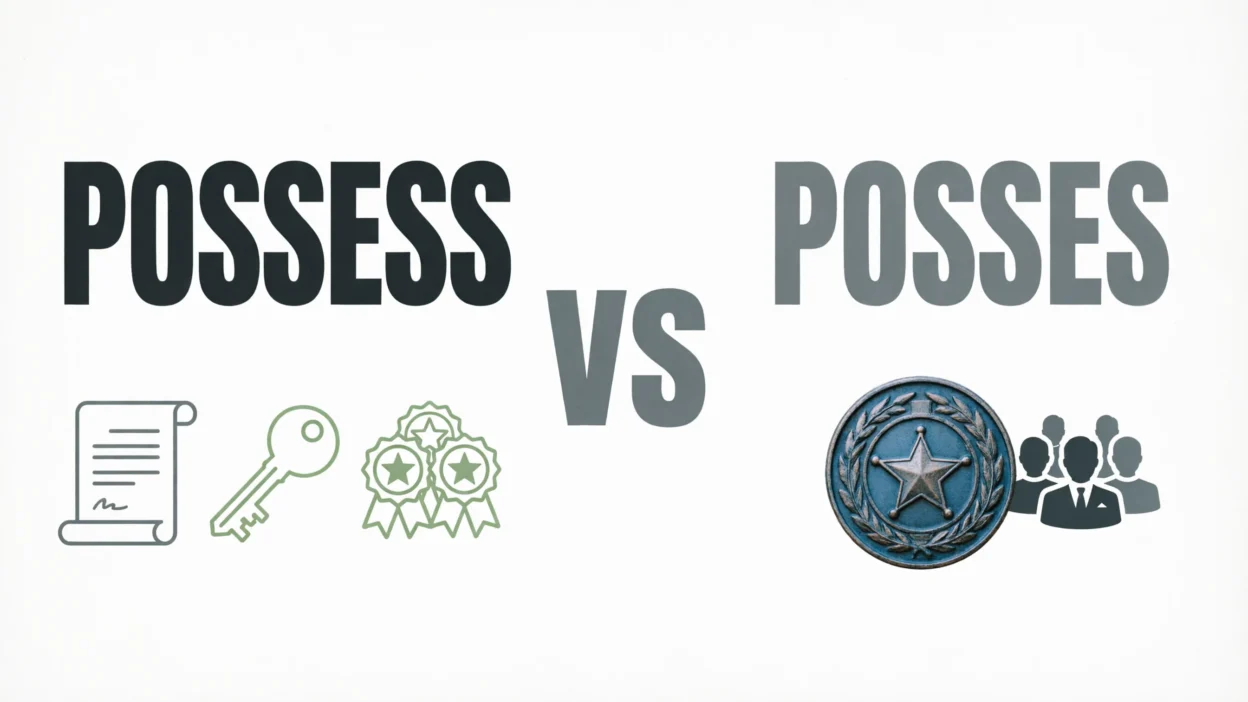
Possess is a verb that means to own, have, control, or contain something.
Posses is a plural noun referring to groups of people formed to help law enforcement or pursue someone.
✅ Correct: I possess strong communication skills.
✅ Correct: The sheriff organized several posses to search the area.
❌ Incorrect: I posses a new laptop.
In most everyday writing, possess is the word you need.
What Does “Possess” Mean?
The word possess is a verb. It means to own, hold, have, control, or be characterized by something.
Examples of Possess
- She possesses excellent leadership qualities.
- They possess extensive knowledge of history.
- I possess a valid driver’s license.
- The company possesses valuable intellectual property.
- He possesses remarkable patience.
The word can refer to physical ownership or non-physical qualities.
Physical Ownership
- She possesses three houses.
- The museum possesses rare artifacts.
Personal Qualities
- He possesses great courage.
- They possess exceptional talent.
What Does “Posses” Mean?
Posses is the plural form of posse.
A posse is a group of people, traditionally organized by a sheriff or authority figure, to help catch criminals or maintain order.
Examples of Posses
- Several posses searched the mountains.
- The sheriff formed multiple posses during the investigation.
- Historical records mention posses used in the Old West.
This word is much less common in everyday English than possess.
Possess vs Posses: Side-by-Side Comparison
| Feature | Possess | Posses |
|---|---|---|
| Part of Speech | Verb | Plural Noun |
| Meaning | To own, have, or control | Multiple groups called posses |
| Common Usage | Very common | Relatively uncommon |
| Example | I possess the required skills. | Several posses joined the search. |
| Correct in Everyday Writing? | Usually yes | Only in specific contexts |
Why Do People Confuse Possess and Posses?
The confusion mainly comes from spelling.
The word possess contains a double s at the end, while posses looks similar but has a completely different meaning.
Many writers accidentally drop the final s when typing quickly.
Common Misspellings
- Poses ❌
- Posses (when meaning own) ❌
- Possesss ❌
- Possess ✅
Incorrect vs Correct Examples
| Incorrect | Correct |
|---|---|
| I posses a car. | I possess a car. |
| She posses great talent. | She possesses great talent. |
| They posses the necessary experience. | They possess the necessary experience. |
Easy Trick to Remember the Difference
A simple memory trick can help.
Possess = Own
Notice that possess ends with “ss”, and it is the word associated with ownership.
Think:
“To own something, you need the extra S.”
If you’re talking about having, owning, controlling, or containing something, choose possess.
If you’re discussing groups organized to pursue someone, use posses.
How “Possess” Is Used in Different Contexts
In Business Writing
- The company possesses significant market influence.
- Candidates who possess leadership skills are preferred.
In Academic Writing
- Researchers possess valuable data.
- Students possess different learning styles.
In Personal Communication
- I possess the documents you requested.
- She possesses a positive attitude.
In Legal Writing
- The suspect did not possess illegal materials.
- Individuals who possess permits may enter.
Common Phrases Using “Possess”
The word possess appears in many common expressions.
Possess Knowledge
- Experts possess specialized knowledge.
Possess Skills
- Employees possess technical expertise.
Possess Power
- Leaders possess decision-making authority.
Possess Qualities
- She possesses remarkable determination.
Possess Property
- They possess land in several regions.
Common Mistakes Writers Make
Mistake 1: Using Posses Instead of Possess
❌ I posses excellent communication skills.
✅ I possess excellent communication skills.
Mistake 2: Assuming Both Spellings Mean the Same Thing
They do not.
- Possess = own or have
- Posses = groups of people
Mistake 3: Forgetting the Double S
❌ I posess a degree.
✅ I possess a degree.
Mistake 4: Misusing Posses in Formal Writing
Unless you are discussing law enforcement groups or historical events, posses is probably not the word you want.
American vs British English
There is no significant difference between American and British English regarding these words.
Both varieties use:
- Possess as the verb meaning own or have.
- Posses as the plural of posse.
Examples are spelled the same in both regions.
| American English | British English |
|---|---|
| possess | possess |
| posses | posses |
So regardless of whether you’re writing for a U.S. or U.K. audience, the rules remain identical.
Synonyms of Possess
Depending on context, you can replace possess with:
- Own
- Have
- Hold
- Control
- Retain
- Maintain
- Command
- Carry
- Contain
- Feature
Example
Original:
- She possesses strong leadership skills.
Alternative:
- She has strong leadership skills.
Examples in Everyday Sentences
Here are more examples to reinforce the difference.
Using Possess
- Do you possess a valid passport?
- She possesses excellent organizational skills.
- The library possesses thousands of rare books.
- They possess enough resources to finish the project.
- He possesses natural athletic ability.
Using Posses
- Historical posses often rode on horseback.
- Several posses participated in the search effort.
- The county organized posses during emergencies.
When Should You Use Possess?
Use possess whenever you’re talking about:
- Ownership
- Characteristics
- Skills
- Talents
- Resources
- Qualities
- Control
Examples:
- Possess confidence
- Possess knowledge
- Possess authority
- Possess property
- Possess experience
These are far more common than situations requiring posses.
Frequently Asked Questions
Is possess or posses correct?
If you mean to own, have, or hold something, possess is correct.
What does posses mean?
Posses is the plural form of posse, meaning multiple groups of people organized for a specific purpose, often law enforcement.
Why is possess spelled with two S letters at the end?
The standard English spelling of the verb is possess, with a double s ending.
Can I use posses as a verb?
No. Posses is not the standard verb form meaning “to own.” Use possess instead.
Is posses a real word?
Yes. It is the plural form of posse, though it is much less common than possess.
Do American and British English spell possess differently?
No. Both American and British English use the same spelling: possess.
How can I remember the correct spelling?
Remember that ownership requires an extra s. Therefore, possess is the word used when you mean “to own” or “to have.”
Final Summary
The difference between possess vs posses is straightforward once you understand their meanings. Possess is a verb that means to own, have, control, or contain something. It is the correct word in most everyday, academic, professional, and business writing. Posses, on the other hand, is simply the plural form of posse, referring to multiple organized groups of people, often associated with law enforcement or historical contexts.
When in doubt, ask yourself whether you’re talking about ownership, skills, qualities, or resources. If the answer is yes, choose possess. Since this is the word used far more frequently, it will be the correct choice in the vast majority of situations. Keeping the extra s at the end is an easy way to avoid one of the most common spelling mistakes involving these words.
Actionable Takeaway
Before submitting any piece of writing, quickly check whether you used possess when referring to ownership, abilities, qualities, or control. If you see posses in those situations, it’s almost certainly a spelling mistake that should be corrected.

Joy Root is a content writer at Whygenix.com, creating clear, engaging articles that explain complex ideas simply, helping readers understand why topics matter in everyday life and personal growth.