Have you ever typed “insue” and wondered whether it was a real English word? You’re not alone. Many writers, students, and professionals confuse insue vs ensue because the words look and sound somewhat similar. However, only one of them is considered correct in modern English.
Understanding the difference is important if you want your writing to appear polished, professional, and grammatically accurate. In this guide, you’ll learn the meaning of ensue, why insue is usually considered a spelling mistake, common examples, mistakes to avoid, and tips for remembering the correct form.
Quick Answer
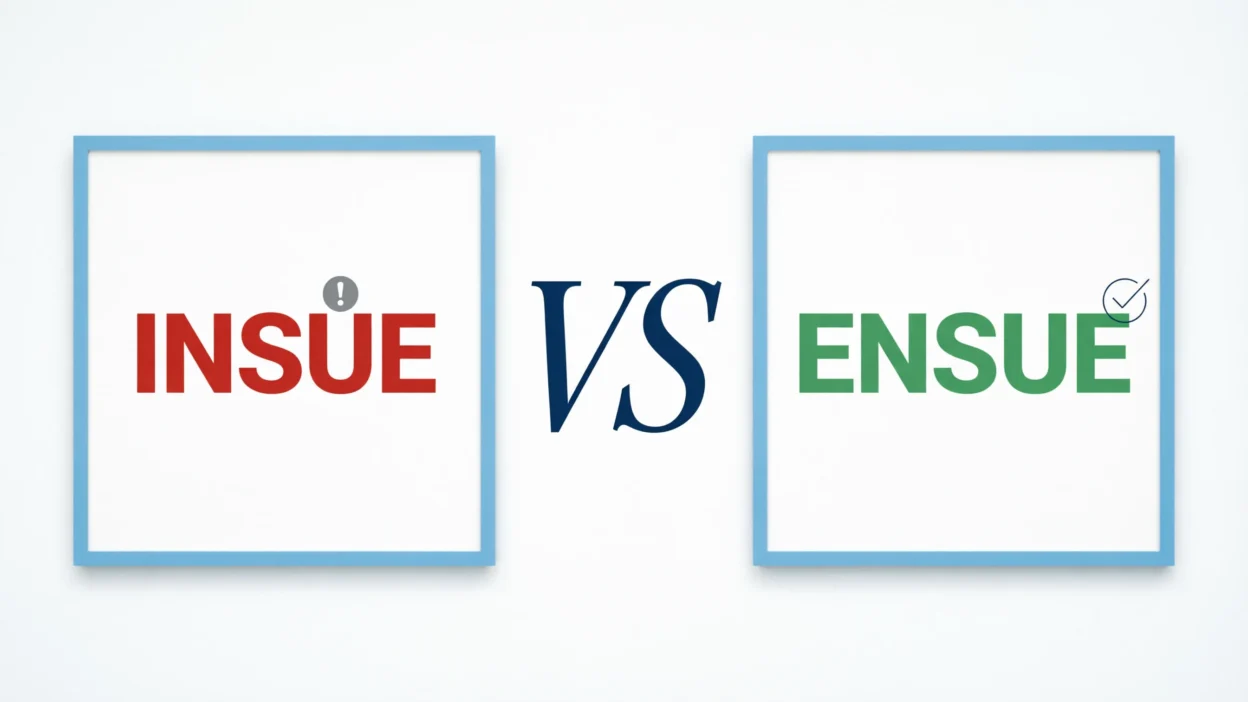
Ensue is the correct English word. It means to happen afterward as a result of something else.
Insue is generally considered a misspelling of ensue and is not recognized as a standard English word.
✅ Correct: A heated debate ensued after the announcement.
❌ Incorrect: A heated debate insued after the announcement.
What Does “Ensue” Mean?
The verb ensue means:
- To happen afterward
- To follow as a consequence
- To occur as a result of a previous event
In simple terms, when one event causes another event to happen, the second event can be described as something that ensues.
Definition
Ensue (verb):
To occur or follow as a consequence of an earlier action or event.
Examples
- Chaos ensued after the power outage.
- Laughter ensued when the comedian told a joke.
- A lengthy discussion ensued following the meeting.
- Several legal issues ensued from the dispute.
- Celebration ensued after the team won the championship.
In each example, something happens first, and another event follows because of it.
What Does “Insue” Mean?
In modern English, insue is generally not accepted as a standard word.
Most people who write insue actually mean ensue. The spelling confusion often occurs because English contains many words beginning with “in-,” causing writers to mistakenly assume the word follows the same pattern.
Why Do People Write “Insue”?
Common reasons include:
- Typographical errors
- Mishearing the pronunciation
- Confusion with words beginning with “in”
- Lack of familiarity with the word “ensue”
If you’re writing for academic, professional, or business purposes, always use ensue instead of insue.
Insue vs Ensue: Side-by-Side Comparison
| Feature | Insue | Ensue |
|---|---|---|
| Correct English Word | ❌ No | ✅ Yes |
| Part of Speech | Not standard | Verb |
| Dictionary Recognition | Generally no | Yes |
| Meaning | None in modern English | To happen afterward |
| Formal Writing | Incorrect | Correct |
| Academic Usage | Avoid | Recommended |
| Professional Communication | Avoid | Appropriate |
How to Use “Ensue” Correctly
The word ensue often appears in formal, academic, journalistic, and professional writing.
Pattern
Event A happens → Event B ensues
Examples:
- The alarm sounded, and panic ensued.
- The negotiations failed, and legal action ensued.
- Heavy rain fell throughout the night, and flooding ensued.
- The company released a new policy, and confusion ensued among employees.
- The referee made a controversial call, and arguments ensued.
Common Contexts Where “Ensue” Is Used
1. News Reports
Journalists frequently use ensue when describing consequences.
Examples:
- Violence ensued after the protest.
- Debate ensued following the announcement.
2. Legal Writing
Lawyers and legal professionals often use the word.
Examples:
- Litigation ensued after the contract dispute.
- Several lawsuits ensued from the incident.
3. Business Communication
Examples:
- A discussion ensued regarding the proposed changes.
- Delays ensued due to supply chain disruptions.
4. Academic Writing
Examples:
- Further research ensued after the initial findings.
- A theoretical debate ensued among scholars.
Common Mistakes With Ensue
Mistake #1: Writing “Insue”
❌ The meeting ended and confusion insued.
✅ The meeting ended and confusion ensued.
Mistake #2: Using Ensue Without a Prior Event
Because ensue means “follow as a consequence,” there should usually be something that happens first.
Less clear:
❌ Confusion ensued.
Better:
✅ After the policy change, confusion ensued.
Mistake #3: Confusing Ensue With Result
Although similar, they are used differently.
Incorrect:
❌ The project ensued success.
Correct:
✅ The project resulted in success.
Correct:
✅ Success ensued after months of effort.
Easy Trick to Remember the Correct Spelling
Think of the phrase:
“Events ENSUE.”
The word ensue starts with EN-, and it often describes what happens after an event.
Memory tip:
- Event → Ensue
- Consequence → Ensue
- Result → Ensue
If you’re tempted to write insue, remember that dictionaries recognize ensue, not insue.
Example Sentences: Ensue in Everyday Writing
Here are additional examples to help you master the word.
Workplace Examples
- A productive conversation ensued after the presentation.
- Several questions ensued during the meeting.
- Confusion ensued because the instructions were unclear.
School Examples
- A class discussion ensued after the teacher introduced the topic.
- Excitement ensued when exam results were announced.
Personal Life Examples
- A friendly argument ensued over which movie to watch.
- Laughter ensued when the dog stole a sandwich.
- Celebration ensued after the family received good news.
News and Media Examples
- Public criticism ensued following the decision.
- International discussions ensued after the summit.
- Political controversy ensued after the statement.
Synonyms of Ensue
Using related words can improve your vocabulary and make your writing more engaging.
Common synonyms include:
- Follow
- Result
- Occur
- Develop
- Arise
- Happen
- Come afterward
- Emerge
- Proceed
- Materialize
Examples
Instead of:
Confusion ensued.
You could write:
- Confusion followed.
- Confusion arose.
- Confusion developed.
- Confusion occurred afterward.
However, ensue often sounds more formal and concise.
Is There Any Difference Between American and British English?
No significant difference exists between American English and British English regarding this word.
Both varieties use:
✅ Ensue
Both varieties consider:
❌ Insue incorrect
Whether you’re writing for readers in the United States, the United Kingdom, Canada, Australia, or elsewhere, ensue remains the standard spelling.
Why “Ensue” Is Often Misspelled
English spelling can be challenging because pronunciation doesn’t always reveal the correct spelling.
The word ensue is commonly misspelled because:
- It is not used daily by many speakers.
- The pronunciation can be misleading.
- Writers may assume it starts with “in.”
- Spell-check may not catch every context-related error.
Fortunately, once you learn the correct spelling, it becomes much easier to remember.
When Should You Use Ensue?
Use ensue whenever you want to describe:
- A consequence
- A reaction
- A result
- Something that follows another event
Examples:
- Negotiations failed, and conflict ensued.
- The announcement was made, and applause ensued.
- The storm intensified, and flooding ensued.
If you’re describing an outcome that follows a previous action, ensue is often an excellent choice.
Frequently Asked Questions (FAQs)
Is insue a real word?
No. In modern standard English, insue is generally considered a misspelling of ensue.
What does ensue mean?
Ensue means to happen afterward or occur as a consequence of something else.
How do you use ensue in a sentence?
Example: The announcement shocked the audience, and silence ensued.
Is ensue formal or informal?
Ensue is generally considered a formal or neutral word and is commonly used in professional, academic, and journalistic writing.
Can I use insue in academic writing?
No. Academic writing should use ensue, not insue.
Is ensue used in American English?
Yes. Ensue is widely used in American English.
Is ensue used in British English?
Yes. British English also uses ensue as the standard spelling.
What is a synonym for ensue?
Common synonyms include follow, result, occur, arise, and develop.
Summary
When comparing insue vs ensue, the answer is straightforward: ensue is the correct word, while insue is generally a misspelling. The word ensue means to happen afterward as a consequence of an earlier event, making it useful when describing results, reactions, and outcomes.
Whether you’re writing an essay, business report, email, article, or social media post, choosing ensue will make your writing clearer and more professional. Remember that both American and British English recognize ensue as the correct spelling, while insue should be avoided.
Actionable Takeaway
Before submitting any piece of writing, quickly search for “insue” and replace it with “ensue” if necessary. A simple proofreading check can eliminate this common spelling error and improve the credibility of your writing instantly.