If you’ve ever typed “cancell” and wondered whether it is correct, you’re not alone. Many English learners and native speakers alike get confused between cancell vs cancel, especially because English spelling rules can be inconsistent.
The good news is that the answer is straightforward. Understanding the difference can help you avoid spelling mistakes in emails, academic writing, business communication, and everyday conversations. This guide explains the correct spelling, provides examples, highlights common errors, and discusses American and British English variations.
Quick Answer
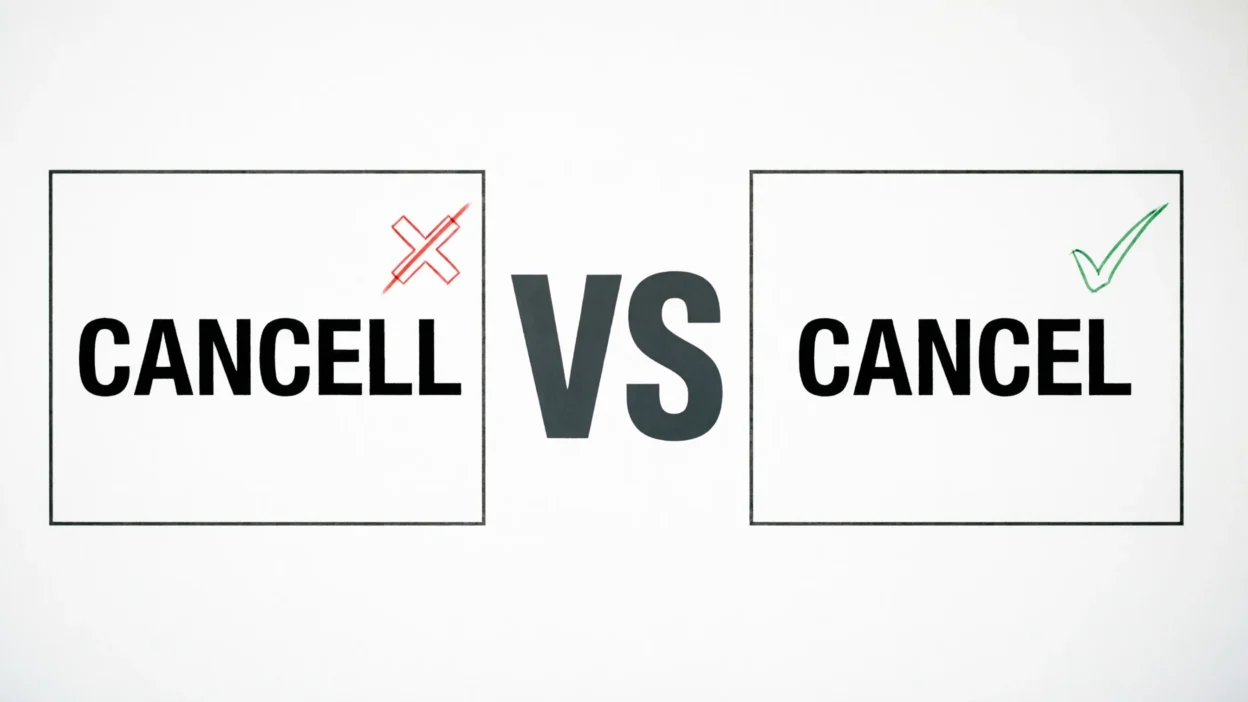
“Cancel” is the correct spelling.
“Cancell” is generally considered a misspelling in modern English.
✅ Correct: I need to cancel my appointment.
❌ Incorrect: I need to cancell my appointment.
While some related forms such as cancelled and cancelling use a double “l” in British English, the base verb remains cancel, not cancell.
What Does “Cancel” Mean?
The word cancel is a verb that means:
- To decide that something planned will not happen
- To stop or end an agreement
- To invalidate something
- To eliminate or offset an effect
Examples of Cancel
- We had to cancel the meeting because of bad weather.
- She decided to cancel her subscription.
- The airline may cancel flights during storms.
- Please cancel my order immediately.
The word is widely used in business, travel, education, entertainment, and daily communication.
Is “Cancell” a Real Word?
In standard English dictionaries, cancell is not recognized as a correct standalone word.
Most of the time, people write cancell because they are confusing it with:
- Cancelled
- Cancelling
- Cancellation
Since these related forms often contain double “l” in some versions of English, writers mistakenly assume the root word should also be spelled with two “l”s.
However, the root verb remains:
✅ Cancel
❌ Cancell
Cancell vs Cancel: Side-by-Side Comparison
| Feature | Cancel | Cancell |
|---|---|---|
| Correct English spelling | Yes | No |
| Found in modern dictionaries | Yes | No |
| Used in formal writing | Yes | No |
| Accepted in American English | Yes | No |
| Accepted in British English | Yes | No |
| Recommended for professional use | Yes | No |
The table clearly shows that cancel is the only accepted spelling.
Why Do People Write “Cancell”?
There are several reasons why this mistake occurs.
1. Confusion With “Cancelled”
Many people see:
- Cancelled
- Cancelling
and assume the base word must be cancell.
In reality:
- Base form: Cancel
- Past tense: Cancelled (British)
- Present participle: Cancelling (British)
2. Typing Errors
When typing quickly, it is easy to accidentally add an extra “l.”
3. English Spelling Patterns
English contains words that double consonants before adding suffixes. This sometimes causes writers to overapply the rule.
For example:
- Travel → Travelled
- Signal → Signalled
This pattern leads some people to write cancell, even though it is incorrect.
American vs British English Differences
This is where much of the confusion originates.
American English
American English usually prefers a single “l” in derived forms.
Examples:
- Canceled
- Canceling
Examples in sentences:
- The concert was canceled yesterday.
- They are canceling the event.
British English
British English commonly uses a double “l” in derived forms.
Examples:
- Cancelled
- Cancelling
Examples in sentences:
- The concert was cancelled yesterday.
- They are cancelling the event.
Important Note
Regardless of the variety of English:
✅ Cancel
❌ Cancell
The base word never changes.
Examples of Correct Usage
Here are examples showing how cancel should be used.
In Business Writing
- We may need to cancel the contract.
- The company decided to cancel the project.
In Travel
- The airline might cancel the flight.
- Severe weather forced officials to cancel departures.
In School
- The principal chose to cancel classes.
- Teachers agreed not to cancel the field trip.
In Everyday Life
- I want to cancel my gym membership.
- She forgot to cancel her reservation.
Examples of Incorrect Usage
These examples contain spelling mistakes.
❌ I need to cancell my appointment.
❌ They will cancell the meeting tomorrow.
❌ Please cancell my subscription.
Correct versions:
✅ I need to cancel my appointment.
✅ They will cancel the meeting tomorrow.
✅ Please cancel my subscription.
Related Words You Should Know
Understanding related forms can help prevent spelling confusion.
| Word | Meaning |
|---|---|
| Cancel | To stop or call off |
| Canceled | American English past tense |
| Cancelled | British English past tense |
| Canceling | American English present participle |
| Cancelling | British English present participle |
| Cancellation | The act of canceling something |
| Cancelable | Capable of being canceled |
Notice that cancell does not appear among the correct forms.
Common Mistakes to Avoid
Mistake #1: Adding an Extra L to the Base Word
❌ Cancell
✅ Cancel
Mistake #2: Mixing American and British Spellings
American:
- Canceled
- Canceling
British:
- Cancelled
- Cancelling
Try to remain consistent throughout your writing.
Mistake #3: Assuming Double-L Forms Affect the Root Word
Many writers think:
Cancelled → Cancell
This assumption is incorrect.
The root word remains:
✅ Cancel
Memory Trick to Remember the Correct Spelling
A simple way to remember it is:
“The action starts with one L.”
- Cancel → one L
- Cancelled → may have two Ls depending on English style
Think of the root word as the foundation. The extra “l” only appears in certain derived forms, not in the original verb.
When Should You Use “Cancel”?
Use cancel whenever you are writing the basic verb form.
Examples:
- Cancel the order.
- Cancel the reservation.
- Cancel the meeting.
- Cancel the membership.
- Cancel the subscription.
- Cancel the appointment.
If you’re unsure, remember that every major English dictionary lists cancel, not cancell.
SEO-Related Search Terms
People searching for cancell vs cancel often look for:
- correct spelling of cancel
- is cancell a word
- cancel meaning
- canceled vs cancelled
- cancelling vs canceling
- common English spelling mistakes
- American vs British spelling
- grammar and spelling guide
- English writing tips
- correct word usage
Understanding these related terms can help improve your overall English writing accuracy.
Frequently Asked Questions (FAQs)
Is cancell a correct English word?
No. Cancell is generally considered a spelling mistake. The correct word is cancel.
Which spelling should I use: cancell or cancel?
Always use cancel.
Why do I sometimes see two Ls in related words?
British English often uses double-L forms such as cancelled and cancelling, but the root word remains cancel.
Is cancel correct in both American and British English?
Yes. Both American and British English use cancel as the base verb.
Is canceled or cancelled correct?
Both are correct.
- Canceled = American English
- Cancelled = British English
Is canceling or cancelling correct?
Both are accepted depending on regional spelling preferences.
- Canceling = American English
- Cancelling = British English
Why do spell-checkers mark “cancell” as wrong?
Because it is not recognized as a standard English word.
What is the noun form of cancel?
The most common noun form is cancellation.
Summary
When comparing cancell vs cancel, the correct choice is always cancel. It is the standard spelling recognized in both American and British English and is used in formal, academic, professional, and everyday writing. The spelling cancell is considered a mistake and should be avoided.
The confusion usually comes from related forms such as cancelled, cancelling, canceled, and canceling. While these variations differ between American and British English, the root verb never changes. Whenever you need the basic form of the word, choose cancel with a single “l.”
Actionable Takeaway
Before submitting an email, report, article, or social media post, quickly check whether you’ve written cancel or cancell. If you see cancell, replace it with cancel. Remember: one “l” for the base word, and regional spelling rules only affect some derived forms.

Sara Taylor is a content writer at Whygenix.com, creating clear, engaging articles that simplify complex ideas, helping readers understand the why behind topics in education, lifestyle, and personal development.