Have you ever typed “stold” and wondered whether it was a real word? You’re not alone. Many English learners and native speakers occasionally confuse stole vs stold, especially because English verbs often follow patterns that seem inconsistent.
The good news is that the answer is simple. One of these words is correct in standard English, while the other is considered a mistake. In this guide, you’ll learn the difference between stole and stold, see practical examples, avoid common errors, and gain confidence using the correct form in everyday writing and conversation.
Quick Answer
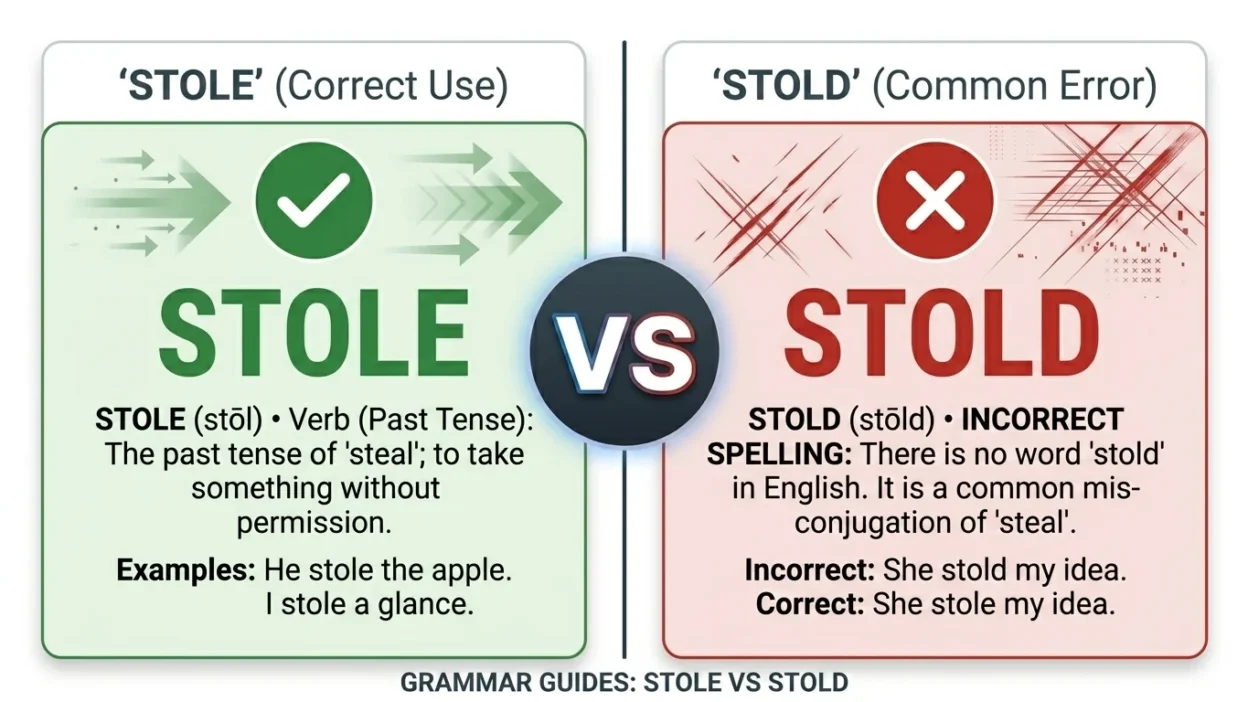
Stole is the correct past tense of the verb steal.
❌ Stold is not a standard English word and should not be used.
Correct: She stole my pen yesterday.
Incorrect: She stold my pen yesterday.
If you’re choosing between stole vs stold, always use stole.
What Does “Stole” Mean?
The word stole is the simple past tense of the verb steal.
Steal means to take something that belongs to someone else without permission and with the intention of keeping it.
Verb Forms of Steal
| Verb Form | Word |
|---|---|
| Base Form | Steal |
| Past Tense | Stole |
| Past Participle | Stolen |
| Present Participle | Stealing |
Examples
- Someone stole my bicycle last night.
- He stole the answer from his friend’s paper.
- The thief stole several valuable paintings.
- She stole a glance at the clock during the meeting.
In all these examples, stole refers to an action that happened in the past.
Is “Stold” a Real Word?
No. Stold is not recognized as a standard English word.
People sometimes create stold by applying regular verb patterns. Since many verbs form the past tense by adding -ed, learners may mistakenly think that an irregular verb like steal should follow a similar pattern.
However, English contains many irregular verbs, and steal is one of them.
Incorrect Examples
❌ He stold my wallet.
❌ They stold the car yesterday.
❌ Someone stold my phone.
Correct Versions
✅ He stole my wallet.
✅ They stole the car yesterday.
✅ Someone stole my phone.
Whenever you’re tempted to write stold, replace it with stole.
Stole vs Stold: Side-by-Side Comparison
| Feature | Stole | Stold |
|---|---|---|
| Is it a real English word? | Yes | No |
| Past tense of steal? | Yes | No |
| Accepted in formal writing? | Yes | No |
| Found in dictionaries? | Yes | No |
| Common learner mistake? | No | Yes |
The comparison clearly shows that stole is the only correct choice.
Why Do People Say “Stold”?
Language learners often look for patterns. Since English has many verbs ending in -ed in the past tense, people sometimes assume that every verb should follow a similar rule.
For example:
- Walk → Walked
- Jump → Jumped
- Clean → Cleaned
However, irregular verbs do not follow this pattern:
- Go → Went
- See → Saw
- Steal → Stole
Because of these irregular forms, some speakers accidentally create nonstandard words such as stold.
Examples of “Stole” in Everyday Sentences
Here are some examples showing the correct usage of stole.
In Daily Conversation
- Someone stole my package from the porch.
- My brother stole the last cookie.
- The dog stole food from the table.
In News Reports
- The suspects stole several vehicles.
- Criminals stole sensitive information from the company.
In Literature and Storytelling
- The pirate stole a treasure map.
- The magician stole the audience’s attention.
Notice how natural and correct stole sounds in every sentence.
Understanding “Stolen” vs “Stole”
Another common source of confusion is the difference between stole and stolen.
Stole = Past Tense
Use stole when describing an action that happened in the past.
Examples:
- He stole my notebook.
- They stole the money.
Stolen = Past Participle
Use stolen with helping verbs such as has, have, had, was, or were.
Examples:
- Someone has stolen my wallet.
- The jewelry was stolen last week.
- They had stolen the documents before leaving.
Quick Comparison
| Correct Usage | Example |
|---|---|
| Stole | He stole my bike. |
| Stolen | My bike was stolen. |
Common Mistakes Related to Stole vs Stold
Mistake 1: Using “Stold” as Past Tense
❌ She stold my phone.
✅ She stole my phone.
Mistake 2: Using “Stolen” Without a Helping Verb
❌ He stolen my laptop.
✅ He stole my laptop.
or
✅ He has stolen my laptop.
Mistake 3: Mixing Verb Forms
❌ They have stole the money.
✅ They have stolen the money.
Learning the three forms—steal, stole, stolen—helps eliminate these mistakes.
Memory Trick to Remember the Correct Word
A simple way to remember the correct form is:
Steal → Stole → Stolen
Think of other irregular verbs:
- Speak → Spoke → Spoken
- Break → Broke → Broken
- Wake → Woke → Woken
Notice the similar pattern.
Since speak becomes spoke, it becomes easier to remember that steal becomes stole, not stold.
American vs British English
When comparing stole vs stold, there is no difference between American and British English.
Both varieties of English use:
✅ Stole
❌ Stold
Whether you’re writing in the United States, the United Kingdom, Canada, Australia, or elsewhere, stole is the accepted past tense form.
Related Words and Synonyms
Depending on context, words related to stole include:
- Took
- Robbed
- Swiped
- Snatched
- Shoplifted
- Misappropriated
- Pilfered
- Looted
Examples
- The thief stole a watch.
- The thief snatched a watch.
- The thief swiped a watch.
Although these words have slightly different meanings, they are often used in similar contexts.
When Can “Stole” Be Used Figuratively?
Interestingly, stole doesn’t always refer to theft.
Examples
- She stole the show with her performance.
- The baby stole everyone’s heart.
- His speech stole the spotlight.
In these expressions, stole means attracting attention or admiration rather than taking something illegally.
FAQs About Stole vs Stold
1. Is stold a word in English?
No. Stold is not a standard English word and should not be used in formal or informal writing.
2. What is the past tense of steal?
The correct past tense of steal is stole.
3. Why do people say stold?
People often create stold by mistake because they try to apply regular verb patterns to an irregular verb.
4. Is stole correct in American English?
Yes. Stole is correct in American English and British English.
5. What is the past participle of steal?
The past participle is stolen.
6. Which sentence is correct?
✅ Someone stole my wallet.
❌ Someone stold my wallet.
7. Can I use stold in informal writing?
No. Even in casual writing, stold is considered incorrect.
8. How do I remember the correct form?
Memorize the verb sequence:
Steal → Stole → Stolen
This helps you avoid confusing the forms.
Summary
The debate over stole vs stold has a straightforward answer: stole is the correct past tense of steal, while stold is not a recognized English word. Whether you’re writing an email, a school assignment, a blog post, or a social media update, using stole ensures your grammar is accurate and professional.
Remember the full verb pattern: steal, stole, stolen. Once you learn these three forms, you’ll avoid one of the most common English grammar mistakes. Whenever you see or hear stold, treat it as an error and replace it with stole.
Actionable Takeaway
Before submitting any piece of writing, quickly check whether you’ve used steal, stole, or stolen correctly. If you’re referring to a completed action in the past, choose stole. If you’re using a helping verb such as has, have, or had, choose stolen. Never use stold in standard English.
Featured Image Prompt:
Create a clean, professional educational typography-style featured image. Split the image into two distinct rectangular frames. In the left frame, display the word “STOLE” in large bold English typography with a green checkmark. In the right frame, display the word “STOLD” in large bold English typography with a red X mark. Place a large “VS” between the two frames. Use a modern white background, high contrast, grammar-learning theme, SEO blog header style, clear readable English text, and polished academic design.

Joy Root is a content writer at Whygenix.com, creating clear, engaging articles that explain complex ideas simply, helping readers understand why topics matter in everyday life and personal growth.