If you’ve ever paused while writing and wondered whether drily or dryly is the correct spelling, you’re not alone. These two words look different, sound the same, and often appear in similar contexts. That can make even experienced writers question which version belongs in their sentence.
The good news is that both drily and dryly are correct spellings of the same adverb. However, one is more common in modern usage, while the other is often preferred in specific dictionaries and style guides. Understanding the difference can help you write with greater confidence and clarity.
Quick Answer
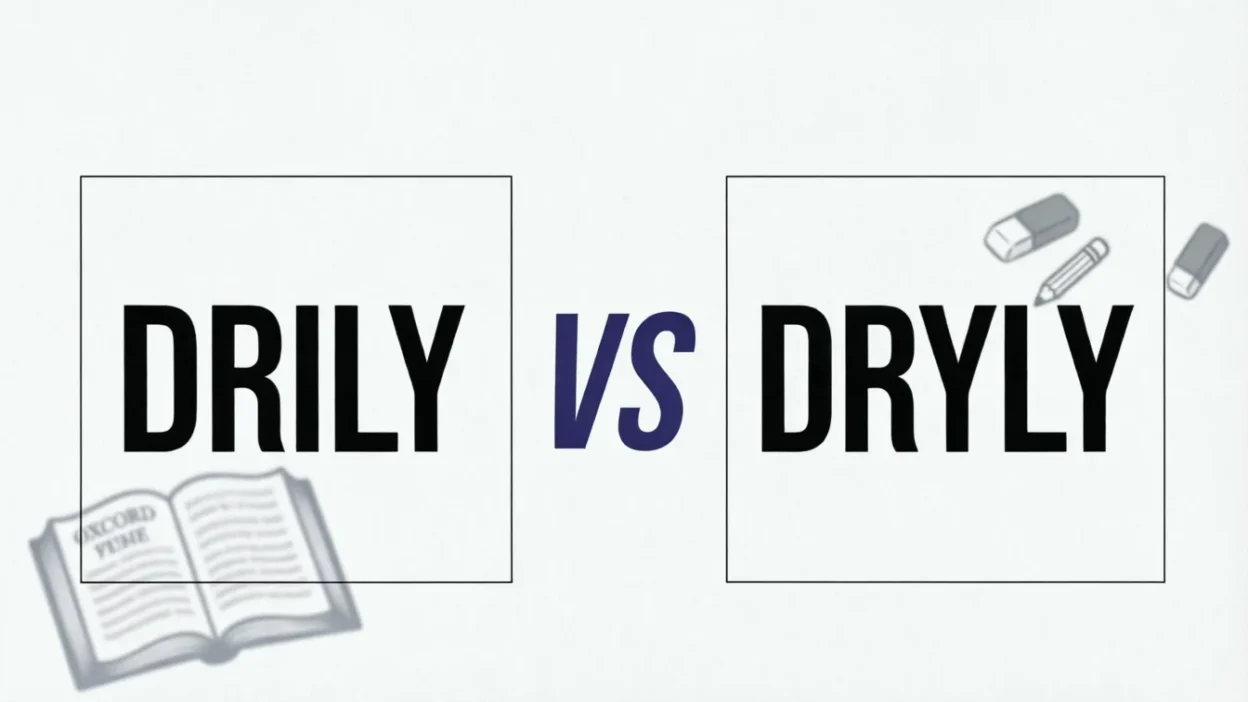
Both “drily” and “dryly” are correct spellings. They mean the same thing: in a dry manner, especially when speaking with little emotion, humor, or enthusiasm.
- Dryly is the more common spelling in modern English.
- Drily is an accepted alternative spelling.
- The choice usually depends on personal preference, regional usage, or style guide recommendations.
What Do Drily and Dryly Mean?
The words drily and dryly are adverbs derived from the adjective dry.
They can describe:
- Something done without moisture.
- Speech or humor that is subtle, sarcastic, or unemotional.
Examples
- She dryly noted that the project had failed.
- He drily remarked that arriving three hours late was not exactly punctual.
- The towel was hanging dryly in the sunlight.
- The professor drily explained the obvious mistake.
In all these examples, replacing one spelling with the other would not change the meaning.
Drily vs Dryly: Comparison Table
| Feature | Drily | Dryly |
|---|---|---|
| Correct spelling | Yes | Yes |
| Meaning | Same as dryly | Same as drily |
| Pronunciation | Identical | Identical |
| Modern popularity | Less common | More common |
| Dictionary acceptance | Accepted | Accepted |
| Preferred by many writers | Sometimes | Often |
| Use in formal writing | Acceptable | Acceptable |
Why Are There Two Spellings?
English spelling often creates alternate forms when adding suffixes to words ending in y.
Normally, when a word ends in a consonant plus y, the y changes to i before adding a suffix.
For example:
- Happy → Happily
- Easy → Easily
- Angry → Angrily
Following this pattern, some people naturally form:
- Dry → Drily
However, English also allows:
- Dry → Dryly
Because the base word is short and commonly used, both spellings became accepted over time.
Which Spelling Is More Common?
In modern writing, dryly tends to appear more frequently than drily.
Writers often prefer dryly because:
- It keeps the original spelling of the word “dry.”
- Readers recognize it more easily.
- It looks more natural to many English speakers.
Examples
✅ Common modern usage:
- She smiled dryly.
- The journalist dryly commented on the situation.
- He dryly observed that nothing had changed.
✅ Less common but correct:
- She smiled drily.
- The journalist drily commented on the situation.
- He drily observed that nothing had changed.
American vs British English
One interesting aspect of the drily vs dryly debate is that it is not strongly divided between American and British English.
Both spellings are accepted in:
- American English
- British English
- Canadian English
- Australian English
However:
- Dryly is generally more common in everyday modern writing.
- Drily may appear more often in some dictionaries and traditional editorial styles.
Because both are considered standard, neither will usually be marked as incorrect by editors.
Understanding the Meaning Through Examples
Dryly Meaning “Without Emotion”
When someone speaks in a calm, detached, or sarcastic way:
- “That’s certainly one way to solve the problem,” she said dryly.
- “Excellent timing,” he remarked drily after they missed the train.
Dryly Meaning “With Subtle Humor”
A dry sense of humor is understated and often sarcastic.
Examples:
- The comedian dryly joked about everyday life.
- The author drily described the absurd situation.
Dryly Meaning “Without Moisture”
Although less common:
- The clothes dried dryly in the desert air.
- The paint cured drily under the warm conditions.
Common Mistakes Writers Make
Mistake 1: Thinking One Is Incorrect
Many people assume one spelling must be wrong.
❌ Incorrect belief:
- Drily is wrong.
✅ Reality:
- Both drily and dryly are correct.
Mistake 2: Switching Spellings in the Same Document
Consistency matters.
Example:
- Chapter 1: She replied dryly.
- Chapter 2: She replied drily.
While not technically wrong, inconsistent spelling can look unprofessional.
Mistake 3: Confusing Meaning
Some writers believe:
- Dryly = sarcastically
- Drily = without moisture
This is incorrect.
Both words share exactly the same meanings.
Examples in Sentences
Using Dryly
- The manager dryly thanked everyone for arriving late.
- She dryly pointed out the obvious flaw.
- He dryly remarked that the weather forecast had been wrong again.
- The actor dryly delivered the line for comic effect.
- My friend dryly observed that nothing ever goes according to plan.
Using Drily
- The professor drily noted the inconsistency.
- She drily commented on the report.
- He drily suggested reading the instructions first.
- The editor drily mentioned the missing citations.
- The speaker drily acknowledged the mistake.
Synonyms for Drily and Dryly
Depending on context, you can use:
For Sarcastic Speech
- Ironically
- Wryly
- Sardonically
- Mockingly
- Cynically
- Casually
- Deadpan
For Emotionless Speech
- Calmly
- Flatly
- Coolly
- Matter-of-factly
- Impassively
- Neutrally
Example
Instead of:
- She said dryly.
You could write:
- She said wryly.
- She said matter-of-factly.
- She said deadpan.
When Should You Choose Dryly?
Choose dryly if:
- You want the most familiar modern spelling.
- You’re writing for a broad audience.
- You prefer visual consistency with the word “dry.”
Examples:
- News articles
- Blog posts
- Marketing content
- Academic writing
- Business communication
Many readers instantly recognize dryly, making it a practical choice.
When Should You Choose Drily?
Choose drily if:
- You prefer the traditional spelling pattern.
- Your style guide recommends it.
- You want consistency with words like “happily” and “easily.”
Examples:
- Literary writing
- Traditional publishing
- Personal stylistic preference
Remember that readers will still understand the word perfectly.
Memory Trick
A simple way to remember the difference:
- Dryly keeps the original word dry intact.
- Drily follows the common English rule of changing y to i before adding a suffix.
Since both methods are accepted, either spelling is correct.
Frequently Asked Questions
Is dryly the correct spelling?
Yes. Dryly is completely correct and is the more commonly used spelling today.
Is drily a real word?
Yes. Drily is a legitimate dictionary-recognized spelling of the same word.
Do drily and dryly mean different things?
No. They have identical meanings and can be used interchangeably.
Which spelling is more common?
Dryly is generally more common in modern English writing.
Is drily old-fashioned?
Not exactly. It is less common today but remains a standard and accepted spelling.
Should I use dryly in professional writing?
Yes. Dryly is widely accepted in professional, academic, and business writing.
Do dictionaries recognize both spellings?
Yes. Major dictionaries typically list both drily and dryly as correct variants.
Will grammar checkers flag drily?
Some grammar tools may suggest dryly because it is more common, but drily is still correct.
Summary
The debate over drily vs dryly is simpler than many people expect. Both spellings are correct, both have the same pronunciation, and both carry the same meaning. Whether you’re describing a sarcastic remark, a deadpan joke, or something done without moisture, either form works perfectly well.
That said, dryly is generally the preferred choice in modern writing because it is more familiar to readers and appears more frequently in contemporary publications. Drily remains a valid alternative, especially for writers who prefer traditional spelling conventions. The most important rule is consistency—choose one spelling and use it throughout your document.
Actionable Takeaway
For most writers, editors, bloggers, and students, dryly is the safest and most recognizable option. If you choose drily, you’re still using a correct English word. Pick the version that matches your style guide and stay consistent across your writing.

Sara Taylor is a content writer at Whygenix.com, creating clear, engaging articles that simplify complex ideas, helping readers understand the why behind topics in education, lifestyle, and personal development.