Have you ever typed “foward” and wondered whether it was correct? You’re not alone. This is one of the most common spelling mistakes in English because the words look so similar at first glance.
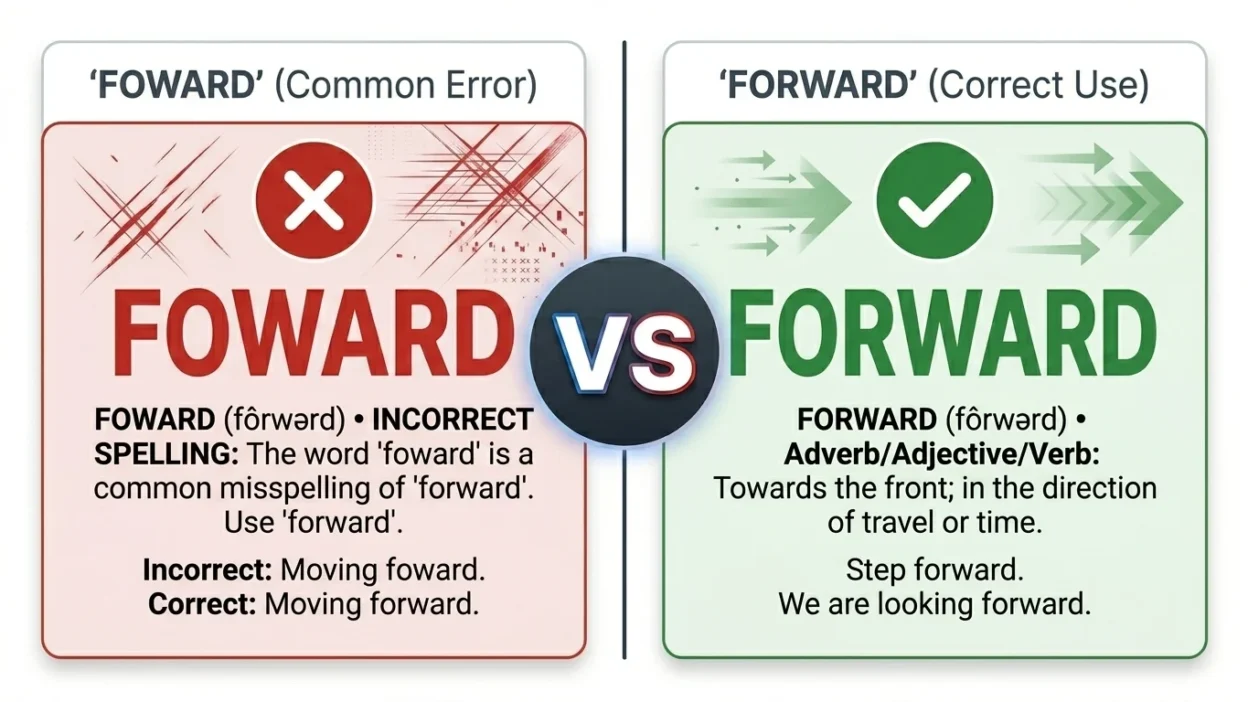
If you’re searching for the difference between foward vs forward, the answer is actually quite simple: forward is the correct spelling, while foward is generally considered a misspelling. Understanding this distinction can help you write more professionally and avoid common grammar errors.
Quick Answer
✅ Forward = Correct spelling
❌ Foward = Incorrect spelling (misspelling of forward)
Use forward whenever you want to describe movement ahead, progress, advancement, or sending something to another person.
Example:
- Correct: Please move forward.
- Correct: I will forward the email to you.
- Incorrect: Please move foward.
What Does “Forward” Mean?
The word forward is a versatile term in English. It can function as an adjective, adverb, verb, or noun depending on the context.
As an Adjective
Meaning: Positioned toward the front.
Examples:
- She sat in the forward section of the plane.
- The ship’s forward cabin was spacious.
As an Adverb
Meaning: Toward the front or ahead.
Examples:
- Take one step forward.
- The crowd moved forward slowly.
As a Verb
Meaning: To send something onward.
Examples:
- Please forward the document.
- Can you forward this message to the manager?
As a Noun
Meaning: A player in certain sports who focuses on offense.
Examples:
- He plays as a forward in soccer.
- The team’s star forward scored twice.
What Does “Foward” Mean?
In standard English, foward has no accepted meaning.
It is simply a spelling error that occurs when people accidentally omit the letter r after fo.
Because the pronunciation of forward can sometimes sound rushed in conversation, writers occasionally type foward without realizing the mistake.
Examples of Incorrect Usage:
- ❌ Move foward.
- ❌ Please foward the email.
- ❌ Looking foward to hearing from you.
Foward vs Forward: Side-by-Side Comparison
| Feature | Foward | Forward |
|---|---|---|
| Correct English spelling | ❌ No | ✅ Yes |
| Found in dictionaries | ❌ No | ✅ Yes |
| Accepted in formal writing | ❌ No | ✅ Yes |
| Used in business communication | ❌ No | ✅ Yes |
| Meaning | None | Ahead, onward, send |
| Recommended usage | Never | Always |
Why Do People Write “Foward” Instead of “Forward”?
Several factors contribute to this common spelling mistake.
1. Typing Too Quickly
Fast typing often causes letters to be omitted.
For example:
- forward → foward
2. Pronunciation Influence
In casual speech, some speakers pronounce the word quickly, making the r less noticeable.
3. Autocorrect Dependence
Many people rely on spell-check tools and may not notice the mistake when typing manually.
4. Habitual Misspelling
Once a spelling mistake becomes a habit, it can repeatedly appear in emails, texts, and documents.
Common Phrases Using “Forward”
Learning common expressions helps reinforce the correct spelling.
Looking Forward To
This is one of the most frequently used phrases in English.
Examples:
- I am looking forward to meeting you.
- We are looking forward to the event.
Incorrect:
- ❌ Looking foward to meeting you.
Move Forward
Meaning: Continue progressing.
Examples:
- It’s time to move forward.
- The company is ready to move forward with the project.
Push Forward
Meaning: Continue despite challenges.
Examples:
- The team decided to push forward.
- We must push forward and finish the task.
Forward Thinking
Meaning: Innovative and future-focused.
Examples:
- She is a forward-thinking leader.
- The organization values forward-thinking ideas.
Examples of Correct Usage
Here are more examples showing how forward should be used.
In Everyday Conversation
- Please step forward.
- She leaned forward in her chair.
- We need to move forward together.
In Emails
- Could you forward the attachment?
- I will forward your request to the department.
- Please forward any updates.
In Business Writing
- The company is moving forward with expansion plans.
- We look forward to working with you.
- Management decided to forward the proposal.
In Academic Writing
- Researchers suggest moving forward with additional studies.
- The discussion forwards understanding of the topic.
Common Mistakes to Avoid
Many writers repeatedly make the same errors.
Mistake 1: Using “Foward” in Professional Emails
Incorrect:
- ❌ I will foward the report tomorrow.
Correct:
- ✅ I will forward the report tomorrow.
Mistake 2: Writing “Looking Foward To”
Incorrect:
- ❌ Looking foward to your response.
Correct:
- ✅ Looking forward to your response.
Mistake 3: Assuming Both Spellings Are Acceptable
Incorrect assumption:
- ❌ Both spellings are fine.
Reality:
- ✅ Only forward is correct in standard English.
Memory Trick to Remember the Correct Spelling
A simple trick is to remember:
FOR + WARD = FORWARD
Think of moving toward a ward or destination ahead.
Another helpful reminder:
The word forward contains two important parts:
- for
- ward
If you don’t see the r after fo, the spelling is likely wrong.
American vs British English
Unlike some English words that have different spellings in the United States and the United Kingdom, forward remains the same in both varieties.
| American English | British English |
|---|---|
| Forward | Forward |
Examples:
- American: We are moving forward.
- British: We are moving forward.
There is no accepted British spelling of foward.
Synonyms of Forward
Depending on the context, you can use these alternatives:
For Movement
- Ahead
- Onward
- Further
- Frontward
- Progressively
For Sending Information
- Send
- Dispatch
- Transmit
- Relay
- Pass along
For Progress
- Advance
- Proceed
- Continue
- Develop
- Progress
Using synonyms can improve writing variety while maintaining clarity.
Related LSI Keywords
To better understand the topic, you may encounter related terms such as:
- correct spelling of forward
- forward meaning
- common spelling mistakes
- English grammar tips
- forward definition
- looking forward meaning
- forward email meaning
- grammar mistakes in English
- spelling errors
- English writing tips
FAQs
Is “foward” ever correct?
No. In modern standard English, foward is considered a misspelling of forward.
Why do people write “foward”?
Usually because of typing errors, pronunciation habits, or simple spelling confusion.
Is “forward” a verb?
Yes. It can mean to send something onward, such as an email or message.
Example: Please forward the invoice.
Is “looking foward to” correct?
No.
The correct phrase is:
Looking forward to
Is “forward” used in both American and British English?
Yes. Both American and British English use the spelling forward.
Can spell-check detect “foward”?
Most modern spell-check tools identify foward as an error and suggest forward.
What is the easiest way to remember the spelling?
Remember the structure:
FOR + WARD = FORWARD
If the r is missing, the word is spelled incorrectly.
Summary
The debate over foward vs forward is actually straightforward because only one spelling is correct. Forward is the accepted English word used to describe movement ahead, progress, advancement, or sending information to someone else. On the other hand, foward is simply a common misspelling that should be avoided in both casual and professional writing.
Whether you’re writing emails, reports, academic papers, or social media posts, using the correct spelling improves clarity and credibility. The next time you type the phrase “looking forward to” or need to forward an email, double-check that the letter r is included after fo.
Actionable Takeaway
Before sending any document, email, or message, quickly search for “foward” and replace it with “forward.” Making this small correction will instantly improve the professionalism and accuracy of your writing.
Featured Image Prompt
Create a clean, modern typography-focused educational featured image for an English grammar article about “foward vs forward”. Split the image into two distinct rectangular frames. In the left frame, display the word “FOWARD” in bold red English typography with a subtle incorrect/error indicator. In the right frame, display the word “FORWARD” in bold green English typography with a correct/checkmark indicator. Place a large stylish “VS” between the two frames. Use a professional white background, high contrast, modern typography, grammar-learning theme, minimal design, SEO blog featured image style, crisp text, and clear readability.

Sara Taylor is a content writer at Whygenix.com, creating clear, engaging articles that simplify complex ideas, helping readers understand the why behind topics in education, lifestyle, and personal development.