Have you ever typed “whisp” and wondered whether it was a real word or simply a misspelling of “wisp”? You’re not alone. Many English learners and native speakers alike get confused because the words look and sound somewhat similar.
Understanding the difference between wisp vs whisp is important for clear and accurate writing. In most situations, only one of these spellings is considered correct in modern English. This guide explains the meanings, examples, common mistakes, and everything you need to know so you never confuse them again.
Quick Answer
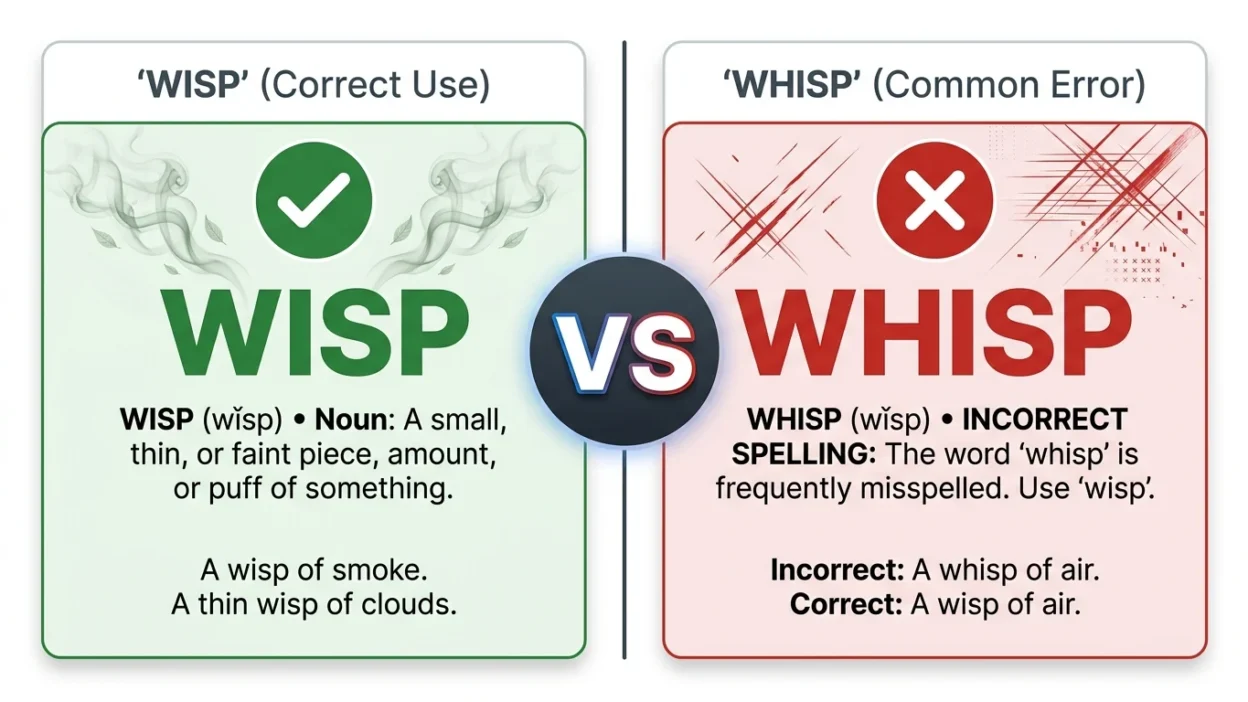
Wisp is the correct English word.
Whisp is generally considered a misspelling of wisp and is not recognized as a standard English word in modern dictionaries.
Correct: A wisp of smoke drifted through the air.
Incorrect: A whisp of smoke drifted through the air.
What Does “Wisp” Mean?
The word wisp is a noun that refers to a small, thin, delicate amount or piece of something.
It is commonly used when talking about:
- Smoke
- Hair
- Clouds
- Straw
- Mist
- Fabric
- Anything thin and light
Definition of Wisp
A wisp means:
A small, thin bunch, strand, or amount of something.
Examples of Wisp in Sentences
- A wisp of smoke rose from the chimney.
- She brushed a wisp of hair from her face.
- The mountain was covered by wisps of cloud.
- Only a wisp of fog remained in the valley.
- A wisp of cotton floated through the air.
In each example, the word describes something light, thin, and delicate.
What Does “Whisp” Mean?
In modern standard English, whisp is generally not considered a correct word.
Most instances of whisp occur because people:
- Accidentally add an “h” after “w.”
- Confuse it with words like whisper, whistle, or whisk.
- Make a spelling error while typing.
Is Whisp a Real Word?
No. Major dictionaries do not recognize whisp as a standard English word.
If you write whisp, spell-check software will usually suggest wisp instead.
Wisp vs Whisp: Side-by-Side Comparison
| Feature | Wisp | Whisp |
|---|---|---|
| Correct English spelling | Yes | No |
| Found in dictionaries | Yes | Generally no |
| Common usage | Very common | Usually a misspelling |
| Meaning | Small thin amount or strand | No standard meaning |
| Suitable for formal writing | Yes | No |
Why Do People Confuse Wisp and Whisp?
Several factors contribute to this common spelling mistake.
1. Similarity to “Whisper”
The word whisper begins with “wh,” causing some writers to assume that wisp follows the same pattern.
For example:
- whisper
- whistle
- while
Because many English words begin with “wh,” adding an “h” can feel natural even when it is incorrect.
2. Pronunciation Confusion
Some accents make it difficult to distinguish between words beginning with “w” and “wh.”
As a result, people may spell the word based on how they think it sounds.
3. Typing Errors
The letters are close together conceptually, making whisp a common typo in emails, social media posts, and online searches.
Examples of Correct Usage of Wisp
Here are more examples showing how wisp should be used.
Referring to Smoke
- A wisp of smoke curled into the sky.
- The campfire produced only a small wisp of smoke.
Referring to Hair
- A wisp of hair covered her eyes.
- He noticed a silver wisp of hair near his temple.
Referring to Clouds
- Wisps of cloud drifted across the blue sky.
- The airplane passed through a wisp of cloud.
Referring to Mist or Fog
- A thin wisp of mist hovered above the lake.
- Morning sunlight pierced the wisps of fog.
Common Phrases Using Wisp
The word appears in many descriptive English expressions.
A Wisp of Smoke
Used to describe a small amount of smoke.
Example:
- A wisp of smoke emerged from the engine.
A Wisp of Hair
Refers to a thin strand of hair.
Example:
- A wisp of hair fell across her forehead.
Wisps of Cloud
Describes thin, delicate clouds.
Example:
- Wisps of cloud decorated the horizon.
A Wisp of Fog
Means a thin patch of fog.
Example:
- A wisp of fog lingered over the field.
Common Mistakes to Avoid
Mistake #1: Writing “Whisp”
❌ The whisp of smoke disappeared.
✅ The wisp of smoke disappeared.
Mistake #2: Assuming Whisp Is an Alternative Spelling
Some people believe whisp is a British spelling while wisp is American.
This is incorrect.
Mistake #3: Mixing Up Wisp and Whisper
Although the words may seem related, they have different meanings.
- Wisp = a thin piece or amount of something.
- Whisper = to speak very quietly.
Example:
- She spoke in a whisper.
- A wisp of smoke floated upward.
American vs British English
One question many writers ask is whether whisp might be accepted in British English.
The answer is no.
American English
The correct spelling is:
Wisp
Example:
- A wisp of smoke rose from the fire.
British English
The correct spelling is also:
Wisp
Example:
- A wisp of cloud drifted across the countryside.
There is no standard distinction between American and British English regarding this word.
Memory Trick to Remember the Correct Spelling
A simple trick can help you avoid this mistake forever.
Think about the word:
Wisp = Wispy
Because wispy is the adjective form, both words begin with wis-.
Examples:
- wispy clouds
- wispy hair
- wisp of cloud
- wisp of hair
Since wispy does not contain an “h,” neither does wisp.
Related Words and Synonyms
If you’re looking for alternative words, here are some useful synonyms.
Synonyms for Wisp
- Strand
- Trace
- Thread
- Tendril
- Curl
- Hint
- Fragment
- Shred
- Bit
- Sliver
Examples
- A strand of hair
- A trace of smoke
- A thread of mist
- A sliver of cloud
These words often convey a similar idea of something thin or delicate.
When Should You Use Wisp?
Use wisp whenever you want to describe:
- A small amount of smoke
- A thin strand of hair
- A delicate cloud formation
- A light patch of fog or mist
- A narrow piece of fabric or straw
The word creates vivid imagery and is commonly used in both creative and everyday writing.
FAQs About Wisp vs Whisp
Is whisp a real word?
No. In standard modern English, whisp is generally considered a misspelling of wisp.
Which spelling is correct: wisp or whisp?
Wisp is the correct spelling.
What does wisp mean?
A wisp is a small, thin amount, strand, or piece of something.
Is whisp used in British English?
No. British English also uses the spelling wisp.
Can I use whisp in formal writing?
No. Formal writing should always use wisp.
What is a wisp of smoke?
It means a small, thin stream or amount of smoke.
What is the adjective form of wisp?
The adjective form is wispy.
Why do people spell wisp as whisp?
Most often because of confusion with words like whisper, whistle, and other words beginning with “wh.”
Summary
When comparing wisp vs whisp, the answer is straightforward: wisp is the correct spelling, while whisp is usually a spelling mistake. A wisp refers to a thin strand, trace, or small amount of something such as smoke, hair, cloud, fog, or straw. It is widely accepted in both American and British English and appears frequently in literature, journalism, and everyday conversation.
Remember that there is no standard English situation where whisp is preferred over wisp. Whenever you’re writing about a delicate strand, trace, or thin piece of something, choose wisp with confidence. Doing so will make your writing more accurate, professional, and easier for readers to understand.
Actionable Takeaway
Before publishing or sending any piece of writing, quickly check for “whisp.” If you find it, replace it with “wisp.” This simple proofreading habit will help you avoid one of the most common spelling mistakes related to this word and improve the overall quality of your writing.

Bret Lee writes educational and research-based content for Whygenix.com, focused on clarity, accuracy, and explaining why concepts matter through simple, engaging, reader-friendly writing.