Have you ever typed “villian” and wondered if it was actually correct? You’re not alone. This is one of the most common English spelling mistakes, especially because the incorrect version looks surprisingly believable at first glance.
If you’re searching for the difference between villain vs villian, the good news is that the answer is simple. Only one spelling is accepted in standard English, while the other is considered a misspelling. Understanding the difference can help improve your writing, avoid embarrassing mistakes, and boost confidence in both academic and professional communication.
Quick Answer
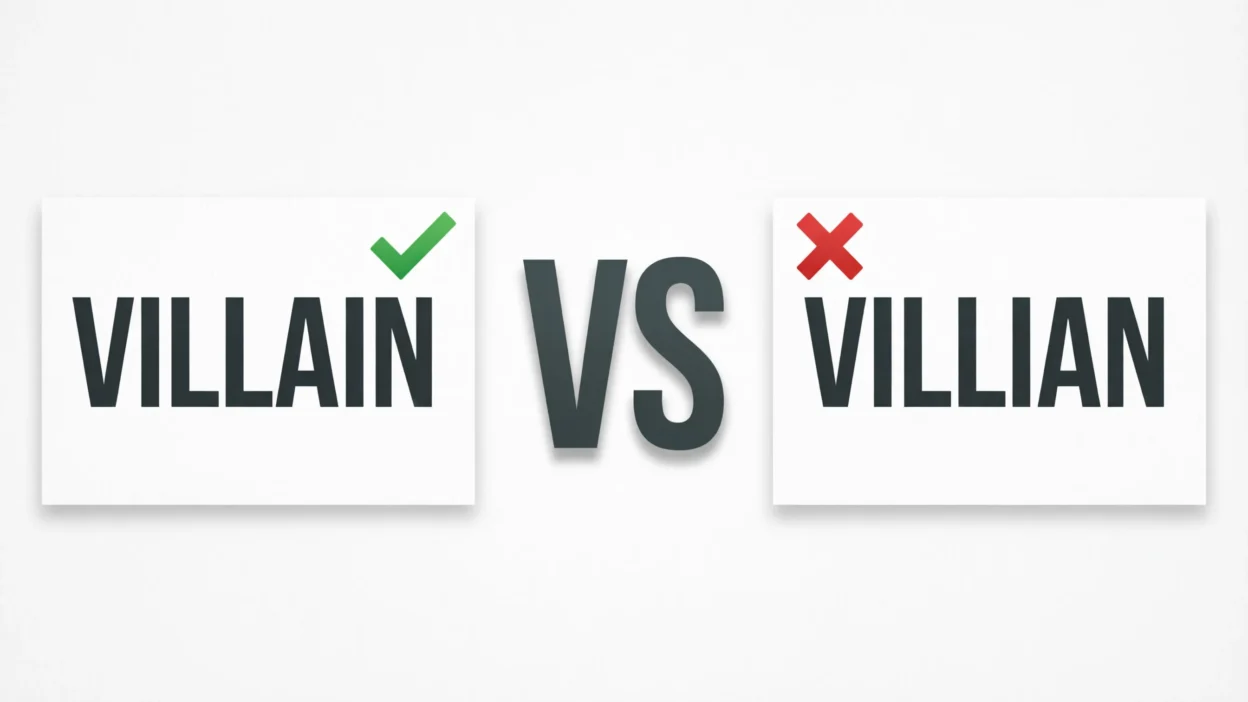
Villain is the correct spelling.
❌ Villian = Incorrect spelling (misspelling)
✅ Villain = Correct spelling, meaning a bad character, criminal, or antagonist
Example:
- ✅ The villain tried to take over the kingdom.
- ❌ The villian tried to take over the kingdom.
Villain vs Villian: The Main Difference
| Word | Correct? | Meaning |
|---|---|---|
| Villain | ✅ Yes | A bad person, antagonist, criminal, or evil character |
| Villian | ❌ No | Misspelling of “villain” |
The confusion usually happens because many English words contain the letter sequence “ian” at the end, such as:
- Musician
- Historian
- Librarian
- Technician
Because of these familiar patterns, writers sometimes accidentally type villian instead of villain.
However, the correct spelling has always been villain, with “ain” at the end.
What Does “Villain” Mean?
The word villain refers to a person who does bad things or opposes the hero in a story. It can also describe a dishonest, cruel, or immoral person in real life.
Definition
Villain (noun):
A wicked person, criminal, antagonist, or evil character who creates conflict or causes harm.
Examples
- The villain kidnapped the princess.
- Every superhero movie needs a memorable villain.
- The detective finally caught the villain.
- In the novel, the villain secretly controlled the city.
- The audience loved the hero but hated the villain.
What Does “Villian” Mean?
The word villian has no accepted meaning in modern English dictionaries.
It is simply a spelling mistake that occurs when people accidentally switch the positions of the letters a and i.
Examples of Incorrect Usage
- ❌ The villian escaped from prison.
- ❌ The movie’s villian was terrifying.
- ❌ Every hero needs a villian.
Correct Versions
- ✅ The villain escaped from prison.
- ✅ The movie’s villain was terrifying.
- ✅ Every hero needs a villain.
Why Do People Misspell Villain as Villian?
Several factors contribute to this common error.
1. Letter Reversal
Many people naturally reverse the letters a and i, creating:
- villain → villian
This type of spelling error is extremely common in English.
2. Similar Word Endings
English contains many words ending in -ian:
- Musician
- Physician
- Historian
- Politician
Writers may unconsciously assume villain follows the same pattern.
3. Fast Typing
When typing quickly, fingers often transpose letters, producing villian instead of villain.
4. Pronunciation Doesn’t Help
The pronunciation of villain does not strongly emphasize the spelling pattern, making it easier for people to rely on incorrect visual memory.
Origin of the Word “Villain”
Understanding the history can make the spelling easier to remember.
The word comes from the Old French word “vilain.”
Originally, it referred to a farm worker or peasant. Over time, the meaning shifted toward someone considered uncultured, dishonest, or wicked.
Eventually, English adopted the modern meaning:
A bad person or antagonist.
Notice that the historical spelling already contained “ain”, which explains why villain remains the correct form today.
Examples of Villain in Literature and Movies
The word appears frequently in books, television, comics, and films.
Fictional Examples
- The villain creates obstacles for the hero.
- A great villain often has a compelling backstory.
- The villain’s plan nearly succeeded.
- Readers often remember the villain as much as the protagonist.
Real-Life Usage
The word can also be used figuratively.
- The media portrayed him as the villain of the scandal.
- Pollution is often seen as the villain behind environmental problems.
- In the debate, each side tried to make the other look like the villain.
Common Mistakes Related to Villain
Here are several errors people frequently make.
Mistake #1: Writing Villian
❌ The villian escaped.
✅ The villain escaped.
Mistake #2: Assuming Spell Check Will Catch It
Some platforms may not immediately flag the error, especially in informal writing.
Always double-check important documents.
Mistake #3: Confusing Pronunciation With Spelling
Many English words have spellings that don’t perfectly match pronunciation.
Learning the correct written form is essential.
Easy Memory Trick
A simple way to remember the correct spelling is:
VillAIN contains “AIN.”
Think:
The villain causes PAIN.
Both words end in AIN.
- Villain → AIN
- Pain → AIN
Since villains often create pain and trouble, this memory trick helps many writers remember the correct spelling.
Villain in Different Contexts
In Literature
The villain opposes the protagonist and drives conflict within the story.
In Movies
Villains provide tension, drama, and excitement.
In Video Games
The final villain is often the most powerful enemy.
In Everyday Speech
People sometimes use villain metaphorically to describe someone blamed for a problem.
American vs British English
Unlike many spelling differences between American and British English, there is no variation here.
Both American English and British English use:
✅ Villain
Both reject:
❌ Villian
This means the correct spelling remains the same regardless of region.
Synonyms of Villain
Depending on context, you can use several alternatives.
General Synonyms
- Antagonist
- Criminal
- Wrongdoer
- Scoundrel
- Rogue
- Villainous character
- Evildoer
- Malefactor
- Lawbreaker
- Miscreant
Storytelling Synonyms
- Nemesis
- Arch-enemy
- Opponent
- Adversary
- Evil mastermind
Using synonyms can make writing more engaging and varied.
Villain vs Villian in SEO and Online Searches
Interestingly, thousands of users search for “villian” every month because it is such a common typo.
Search engines generally recognize the intent and often suggest:
Did you mean: villain?
However, using the correct spelling in articles, essays, business documents, and academic writing is important for professionalism and credibility.
Frequently Asked Questions
Is villian a real word?
No. Villian is not recognized as a standard English word. It is a misspelling of villain.
Which spelling is correct: villain or villian?
Villain is the only correct spelling.
Why do people write villian?
People often reverse the letters a and i, creating a common spelling error.
Is villian accepted in British English?
No. British English uses villain, just like American English.
What is the meaning of villain?
A villain is an evil person, criminal, antagonist, or character who opposes the hero.
How do you pronounce villain?
It is commonly pronounced as:
VIL-uhn
Can villain refer to a real person?
Yes. It can describe a person viewed as dishonest, cruel, or responsible for wrongdoing.
Is villain always used negatively?
Generally yes. The word usually carries a negative meaning, although it can sometimes be used humorously.
Conclusion
When comparing villain vs villian, the answer is straightforward: villain is the correct spelling, while villian is a common misspelling. The mistake usually happens because writers reverse the letters a and i or assume the word follows the pattern of words ending in -ian. Despite its frequent appearance online, villian is not accepted in standard English.
To avoid the error, remember the simple phrase: “A villain causes pain.” Both words share the ending AIN, making the correct spelling easier to recall. Whether you’re writing a school essay, a novel, a blog post, or a professional document, using villain correctly will make your writing clearer and more polished.
Actionable Takeaway
Before publishing or submitting any piece of writing, quickly check for the typo “villian.” Replace it with “villain” every time. Saving this simple rule can help you avoid one of the most common English spelling mistakes.

Sara Taylor is a content writer at Whygenix.com, creating clear, engaging articles that simplify complex ideas, helping readers understand the why behind topics in education, lifestyle, and personal development.