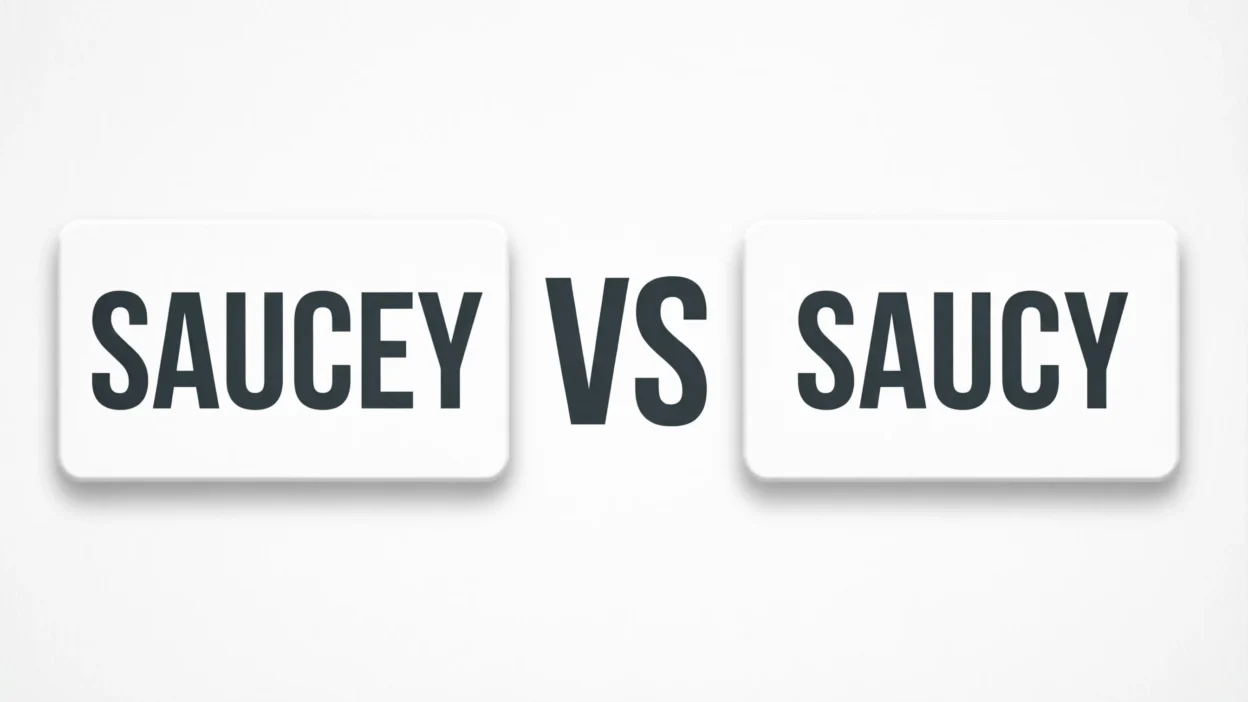
English is full of words that look similar but have different meanings, spellings, or usage contexts. One common confusion is saucey vs saucy. If you’ve seen both versions online, in social media posts, or in casual conversations, you might wonder whether they’re interchangeable or if one is actually incorrect.
The good news is that the difference is simple once you understand the context. While saucy is the standard dictionary spelling, saucey is often used as a modern slang variation. Knowing when to use each word can help you write more clearly and avoid common spelling mistakes.
Quick Answer
Saucy is the correct and standard English spelling recognized in dictionaries.
Saucey is an informal slang spelling often used on social media, in branding, or in casual online communication.
For formal writing, school assignments, business communication, and professional content, always use saucy.
Saucey vs Saucy: At a Glance
| Feature | Saucy | Saucey |
|---|---|---|
| Dictionary Word | Yes | No (generally considered slang) |
| Standard English | Yes | No |
| Formal Writing | Recommended | Not recommended |
| Casual Online Use | Sometimes | Common |
| Meaning | Bold, cheeky, spicy, stylish | Usually same as saucy |
| Accepted by Editors | Yes | Usually no |
What Does “Saucy” Mean?
The word saucy has been part of English for centuries. Traditionally, it means someone who is bold, cheeky, disrespectfully confident, or playful in a mischievous way.
It can also describe something exciting, spicy, flirtatious, or full of attitude.
Examples of Saucy
- The child gave a saucy reply to her teacher.
- He made a saucy comment during the meeting.
- She wore a saucy red dress to the party.
- The magazine published a saucy celebrity interview.
- The restaurant is famous for its saucy pasta dishes.
Depending on the context, saucy can describe behavior, fashion, humor, personality, or even food.
What Does “Saucey” Mean?
Saucey is an alternative spelling that became popular through internet culture, slang, music, and social media.
People often use saucey to mean:
- Stylish
- Confident
- Cool
- Attractive
- Full of personality
- Trendy
In many cases, “sauce” itself is slang for style, swagger, or confidence. Therefore, saucey evolved as a creative spelling connected to that meaning.
Examples of Saucey
- That outfit looks saucey.
- His new car is pretty saucey.
- The basketball player made a saucey move.
- She’s always posting saucey fashion photos.
Although common online, many dictionaries still consider saucey a nonstandard spelling.
Why Do People Confuse Saucey and Saucy?
The confusion happens because both words are pronounced similarly.
Pronunciation
Both are generally pronounced as:
SAW-see
Since English spelling isn’t always predictable, many people assume that adding an “e” after “sauce” makes more sense.
However, standard English follows the traditional spelling:
✅ Saucy
❌ Saucey (in formal writing)
The Origins of Saucy
The word saucy comes from the noun sauce, which historically referred not only to food but also to sharp or impertinent behavior.
Over time, English speakers began using saucy to describe someone who was:
- Bold
- Smart-mouthed
- Playfully disrespectful
- Confident
Today, the word carries a lighter and often more playful meaning.
When to Use Saucy
Use saucy when writing:
- Blog posts
- Academic papers
- Business emails
- News articles
- Professional websites
- Books
- Formal social media captions
Correct Examples
- The comedian delivered several saucy jokes.
- Her saucy personality made her popular with audiences.
- The article contained a few saucy remarks.
- The chef prepared a delicious saucy chicken recipe.
When to Use Saucey
Use saucey only when:
- Writing slang
- Creating social media content
- Mimicking casual speech
- Referring to a brand or username
- Using modern internet language
Correct Informal Examples
- That sneaker collection is saucey.
- Your Instagram aesthetic is saucey.
- He posted a saucey highlight reel.
Remember that many editors and grammar checkers will still flag saucey as a spelling error.
Common Mistakes People Make
Mistake #1: Using Saucey in Professional Writing
❌ The report contained several saucey observations.
✅ The report contained several saucy observations.
Mistake #2: Assuming Saucey Is the Official Spelling
Many people learn the word through social media first and mistakenly believe saucey is standard English.
Mistake #3: Mixing Both Spellings
Choose the version that fits your audience:
- Formal audience → Saucy
- Casual audience → Saucey may be acceptable
Saucy Meaning in Different Contexts
1. Personality
A person who is playful, bold, or cheeky.
Example:
She has a saucy sense of humor.
2. Fashion
Someone who dresses confidently or stylishly.
Example:
That jacket gives a saucy look.
3. Food
Containing plenty of sauce.
Example:
I love saucy barbecue ribs.
4. Flirtation
Playfully romantic or slightly provocative.
Example:
He sent a saucy text message.
Saucey in Modern Pop Culture
The rise of social media platforms has expanded the use of saucey as a slang term.
Influencers, gamers, athletes, and musicians frequently use words like:
- Sauce
- Saucey
- Drip
- Swagger
- Stylish
- Fresh
- Trendy
In this context, saucey often means someone has confidence, style, and personality.
American vs British English
Interestingly, there is no major difference between American and British English regarding this word.
| English Variant | Preferred Spelling |
|---|---|
| American English | Saucy |
| British English | Saucy |
| Australian English | Saucy |
| Canadian English | Saucy |
Across major English-speaking countries, saucy remains the standard spelling.
Synonyms for Saucy
Depending on the context, alternatives include:
For Cheeky Behavior
- Impudent
- Bold
- Insolent
- Sassy
- Impertinent
For Stylish Appearance
- Trendy
- Fashionable
- Chic
- Confident
- Stylish
For Flirtatious Meaning
- Playful
- Suggestive
- Teasing
- Flirtatious
Using these related words can improve writing variety and SEO relevance.
How to Remember the Difference
A simple trick:
Saucy = Standard spelling
The letter “C” in saucy can remind you of “Correct.”
So think:
Saucy = Correct dictionary spelling
Saucey = Casual slang spelling
FAQs About Saucey vs Saucy
Is saucey a real word?
It is used widely in slang and online communication, but it is generally not considered the standard dictionary spelling.
Which spelling is correct: saucey or saucy?
Saucy is the correct standard English spelling.
Can I use saucey in professional writing?
It is better to avoid it. Use saucy in formal and professional contexts.
Why do people spell it saucey?
Many people connect it directly to the word “sauce” and create a modern slang variation.
Are saucey and saucy pronounced differently?
No. They are usually pronounced the same way.
Is saucey acceptable on social media?
Yes. Many users intentionally choose it as a trendy or stylistic spelling.
Does British English use saucey?
No. British English generally uses the standard spelling saucy.
What does saucey mean in slang?
It often means stylish, confident, cool, fashionable, or full of swagger.
Summary
When comparing saucey vs saucy, the key difference is that saucy is the traditional and officially recognized English spelling, while saucey is a modern slang variation commonly found on social media and in casual conversations. Both may carry similar meanings related to confidence, style, boldness, or playful attitude, but only saucy is appropriate for formal writing.
If you’re writing for school, work, professional websites, blogs, or published content, choose saucy every time. Reserve saucey for informal situations where slang and internet culture are expected. Understanding this distinction will help your writing appear polished, accurate, and credible.
Actionable Takeaway
Before using either spelling, think about your audience. If the content is formal or professional, use saucy. If you’re posting casually on social media or using modern slang, saucey may fit the tone. When in doubt, choose saucy—it’s the safest and most widely accepted option.

Bret Lee writes educational and research-based content for Whygenix.com, focused on clarity, accuracy, and explaining why concepts matter through simple, engaging, reader-friendly writing.