Have you ever typed “simular” when you actually meant “similar”? If so, you’re not alone. This is one of the most common spelling mistakes in English because the two words look and sound somewhat alike.
Understanding the difference between simular vs similar can help you write more accurately and confidently. In this guide, you’ll learn which word is correct, what each term means, common mistakes to avoid, and practical examples that make the distinction easy to remember.
Quick Answer
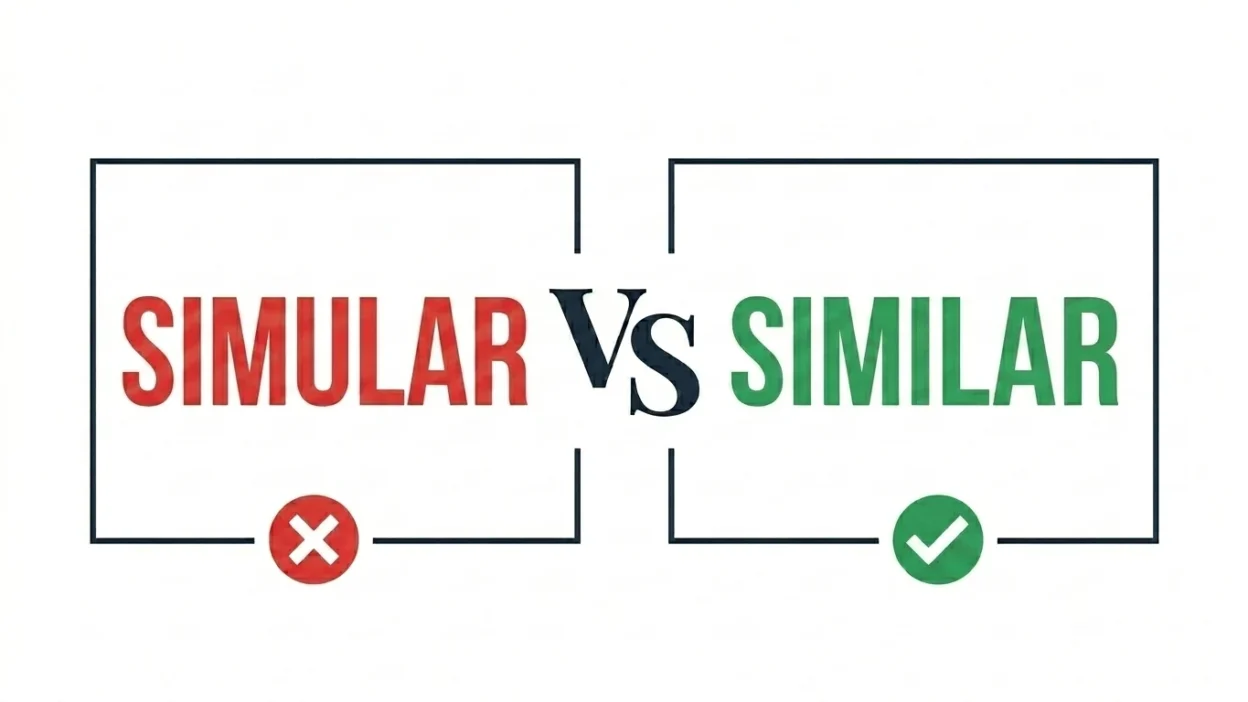
Similar is the correct English word and means having a resemblance or being alike in some way.
Simular is generally considered a misspelling of similar in English. In most writing situations, you should use similar and avoid simular.
Correct: The two houses look similar.
Incorrect: The two houses look simular.
What Does Similar Mean?
The word similar is an adjective used to describe people, things, ideas, or situations that share characteristics or qualities.
Definition
Similar = alike, comparable, resembling each other, having common features.
Examples
- The twins have similar personalities.
- Our new software has features similar to the previous version.
- These colors are very similar, making them difficult to distinguish.
- The two recipes are similar, but one contains more spices.
Synonyms of Similar
- Alike
- Comparable
- Resembling
- Related
- Equivalent
- Matching
- Parallel
- Kindred
Using these related terms can make your writing more varied and natural.
What Does Simular Mean?
In standard English dictionaries, simular is not recognized as the correct spelling of similar.
Most of the time, when people write simular, they simply mean similar but accidentally misspell it.
Why Do People Write Simular?
Several factors contribute to this common spelling error:
- Typing too quickly
- Pronunciation confusion
- Autocorrect issues
- Lack of familiarity with the correct spelling
- Mixing up vowel sounds
Since English spelling can be unpredictable, it’s easy to replace the “i” in the second syllable with a “u.”
Simular vs Similar: Side-by-Side Comparison
| Feature | Simular | Similar |
|---|---|---|
| Correct English Word? | No | Yes |
| Part of Speech | Not standard English | Adjective |
| Dictionary Recognition | Generally no | Yes |
| Meaning | Usually a misspelling | Alike or comparable |
| Suitable for Formal Writing | No | Yes |
| Suitable for Academic Writing | No | Yes |
The comparison makes it clear that similar is the word you should use in virtually every English writing situation.
Examples of Similar in Everyday Sentences
Seeing words in context is one of the best ways to remember them.
School and Education
- The two essays have similar themes.
- Their answers were remarkably similar.
Business and Work
- We analyzed products from similar companies.
- The competitors offer similar services.
Technology
- This smartphone has features similar to premium models.
- Both applications perform similar functions.
Personal Conversations
- We have similar interests in music.
- Their life experiences are surprisingly similar.
Common Mistakes People Make
Many writers accidentally use simular because they assume it follows a different spelling pattern.
Mistake #1: Using Simular in Professional Writing
❌ The results were simular to last year’s report.
✅ The results were similar to last year’s report.
Mistake #2: Assuming Both Spellings Are Acceptable
❌ Simular and similar mean the same thing and are both correct.
✅ Similar is correct; simular is usually a misspelling.
Mistake #3: Ignoring Spell Check Warnings
Modern grammar tools often flag simular as an error. Pay attention to these suggestions when editing.
Easy Trick to Remember the Correct Spelling
A simple memory trick can help.
Think of the word:
Similar = Same + Like
Both concepts relate to resemblance.
Notice that similar contains “i-l-a-r” at the end.
When in doubt, remember this sentence:
“Things that are similar are alike.”
Repeated exposure to the correct spelling helps build long-term memory.
Is Simular Ever a Real Word?
In modern English, simular is generally treated as an incorrect spelling of similar.
However, you may occasionally encounter Simular as:
- A company name
- A product name
- A surname
- A proper noun in specialized contexts
In ordinary English grammar and vocabulary, though, similar remains the correct choice.
American vs British English
One useful fact about simular vs similar is that there is no difference between American and British English.
American English
✅ Similar
British English
✅ Similar
Unlike words such as color/colour or organize/organise, the spelling similar remains the same in both varieties of English.
Why Correct Spelling Matters
Correct spelling affects more than grammar.
Better Professional Image
Accurate spelling helps create a positive impression in:
- Emails
- Reports
- Resumes
- Academic papers
Improved Searchability
Using the correct word makes your content easier to find online.
Stronger Communication
Readers focus on your message instead of noticing spelling mistakes.
Even a small error like simular can distract readers and reduce credibility.
Similar in Academic and Professional Writing
The word similar frequently appears in formal writing.
Academic Example
“The findings were similar to those reported in previous studies.”
Business Example
“Our customers expressed similar concerns during the survey.”
Research Example
“The experiment produced similar outcomes across all test groups.”
Because the word is common in professional communication, learning its correct spelling is especially valuable.
Related Words and Phrases
To expand your vocabulary, here are some closely related expressions.
Similar To
- This design is similar to the original.
- Her writing style is similar to her mentor’s.
Very Similar
- The two cars are very similar in appearance.
Strikingly Similar
- Their stories were strikingly similar.
Nearly Similar
- The results were nearly similar across regions.
Using these phrases naturally can improve writing quality and readability.
Frequently Asked Questions (FAQs)
1. Is simular a real English word?
In standard English, simular is generally considered a misspelling of similar.
2. Which is correct: simular or similar?
Similar is the correct spelling.
3. Why do people write simular?
People often make the mistake because of pronunciation confusion or typing errors.
4. What does similar mean?
It means having characteristics in common, alike, or resembling something else.
5. Is simular accepted in American English?
No. American English uses similar.
6. Is simular accepted in British English?
No. British English also uses similar.
7. Can I use simular in academic writing?
No. Academic and professional writing should use similar.
8. How can I remember the correct spelling?
Associate similar with the idea of things being alike and practice using the correct spelling regularly.
Final Summary
When comparing simular vs similar, the answer is straightforward. Similar is the correct English word used to describe things that are alike, comparable, or share common characteristics.
It appears in everyday conversation, academic writing, business communication, and professional documents.
Simular, on the other hand, is usually just a spelling mistake. Whether you’re writing an email, report, essay, or blog post, choosing similar will ensure your writing remains accurate and professional. Whenever you find yourself typing simular, take a moment to double-check and replace it with similar.
Actionable Takeaway
Before publishing or sending any document, search for the word simular and replace it with similar. Building this simple proofreading habit will instantly improve your writing accuracy and credibility.

Bret Lee writes educational and research-based content for Whygenix.com, focused on clarity, accuracy, and explaining why concepts matter through simple, engaging, reader-friendly writing.